
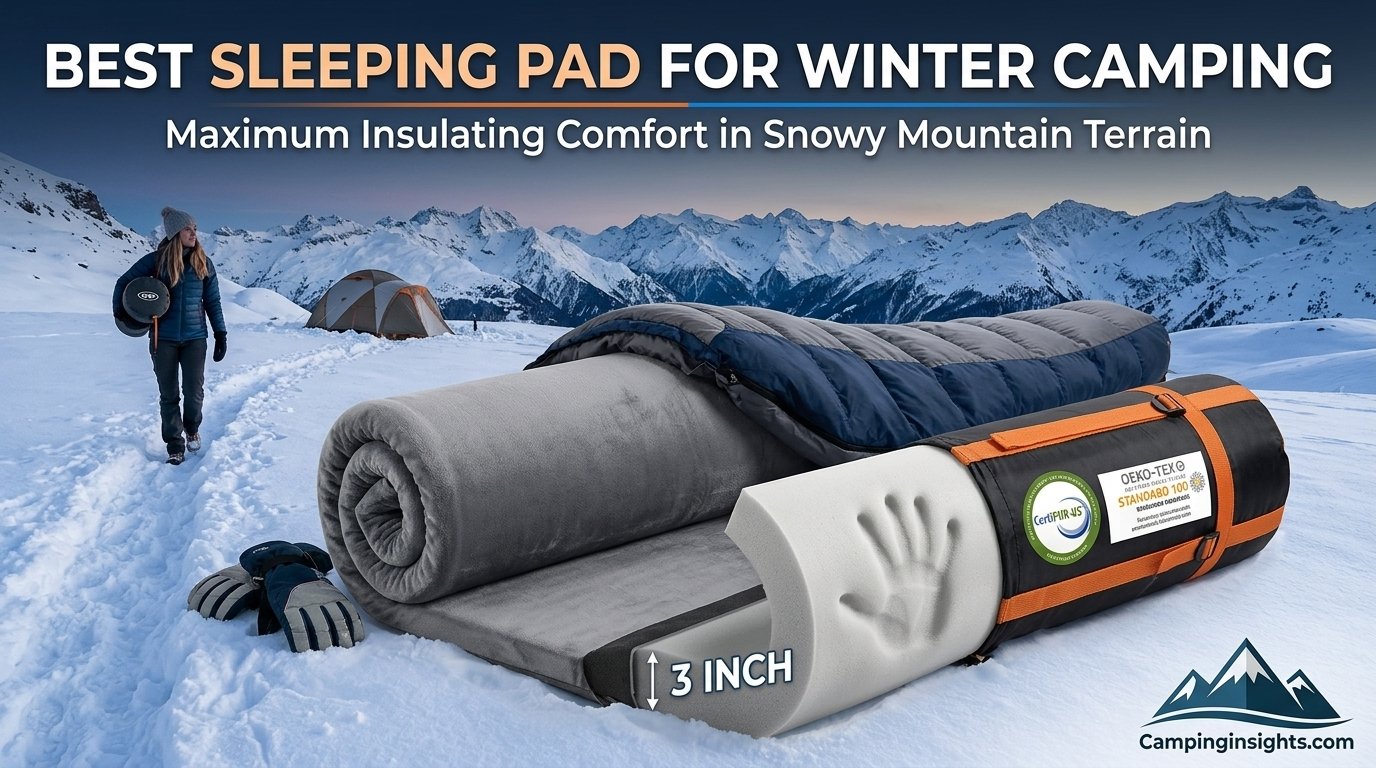
Why Your Sleeping Pad Matters More Than Your Sleeping Bag in Winter
Most campers obsess over sleeping bags and forget the one piece of gear that separates them from hypothermia: the sleeping pad beneath their body.
Here is a fact that surprises many first-time winter campers: the ground steals heat from your body far faster than the air around you. Even on a calm, clear night when temperatures hover just below freezing, the frozen earth beneath your tent acts like a massive heat sink, pulling warmth away from every point of contact between your body and the surface below. Your sleeping bag, no matter how thick or well-rated, compresses under your weight. Once that insulation compresses, it loses most of its ability to trap warm air. That is precisely where a quality winter sleeping pad earns its place in your gear lineup.
Think of it this way — your sleeping bag insulates you from the cold air above and to your sides, but it does almost nothing to protect you from the cold ground underneath. The bottom of a sleeping bag gets crushed flat by your body weight, turning what should be a lofty layer of trapped air into a thin, thermally conductive sheet. Without a sleeping pad rated for winter conditions, you will feel the cold seeping through within minutes, regardless of how expensive or well-made your bag happens to be.
Winter camping sleeping pads solve this problem by creating a barrier between your body and the ground. But not all sleeping pads are created equal. A thin foam pad that works perfectly fine during summer backpacking trips will leave you shivering on a frozen campsite. Winter-specific pads feature higher insulation values, thicker construction, and materials designed to retain warmth even when temperatures plunge well below zero. Understanding these differences is the first step toward choosing a pad that will keep you comfortable through the coldest nights of the season.
The science behind ground insulation is straightforward. Heat always moves from warmer objects to cooler ones. When you lie down on a sleeping pad, your body heat tries to flow downward into the ground. A well-insulated pad slows this transfer dramatically, trapping air in tiny pockets that act as thermal barriers. The more effectively a pad can resist heat flow — measured by its R-value — the warmer you will stay throughout the night. This is why experienced winter campers often say they would choose a great sleeping pad over a great sleeping bag if they could only pick one.
Beyond raw warmth, a winter sleeping pad also contributes to comfort in ways that directly affect sleep quality. Cold ground creates pressure points that become painful over the course of a night. Tossing and turning on frozen terrain not only disrupts your rest but also exposes fresh skin to cold spots, creating a vicious cycle of discomfort. A properly cushioned pad distributes your weight evenly, reduces pressure on hips and shoulders, and lets you sleep in one position long enough to reach the deep, restorative stages of sleep your body needs to recover from a long day of winter hiking or snowshoeing.
There is also a safety dimension that cannot be ignored. Hypothermia does not require sub-zero temperatures to set in. A wet, cold camper lying on inadequate ground insulation can develop dangerous drops in core body temperature even when the air temperature stays above freezing. Ground conduction is the primary mechanism through which cold-related injuries occur in camping scenarios, and a reliable sleeping pad is your first line of defense against this invisible threat. If you are planning to camp in winter conditions — whether in a backcountry snow shelter, a four-season tent, or even a well-protected campsite — investing in a pad specifically designed for cold-weather use is not optional. It is essential.
Throughout this guide, we will walk you through everything you need to know about winter sleeping pads. We will explain R-values in plain language, break down the different types of pads available, and review seven of the best options on the market today. Whether you are a seasoned mountaineer looking for an upgrade or a casual camper venturing into cold-weather camping for the first time, you will find the information you need to make a confident, informed purchase. And if you are still putting together your winter camping setup, be sure to check out our guides on how to keep your tent warm in winter and the best camping tents for cold-weather adventures.
Top Pick for Winter Camping
Stay warm on frozen ground with our editor’s top-rated sleeping pad for cold-weather camping.
Check Price on AmazonR-Value Explained: The Number That Determines How Warm You Sleep
If you only look at one specification when shopping for a winter sleeping pad, make it the R-value. Here is what it means and why it matters.
R-value is the single most important metric for evaluating a sleeping pad’s ability to keep you warm on cold ground. In technical terms, R-value measures thermal resistance — how effectively a material slows the transfer of heat from one side to the other. The higher the R-value, the better the pad insulates you from the cold ground beneath. For winter camping, this number is not just a nice-to-know specification. It is the difference between a restful night and a miserable, sleepless ordeal.
The R-value scale is straightforward. A pad with an R-value of 1.0 offers minimal insulation, suitable only for warm summer nights. As the number increases, so does the pad’s ability to resist heat flow. Here is a general breakdown that most outdoor experts agree on:
| R-Value Range | Season Suitability | Temperature Comfort Zone | Typical Use |
|---|---|---|---|
| 1.0 – 2.0 | Summer only | Above 50°F (10°C) | Warm-weather backpacking, festivals |
| 2.0 – 3.5 | Three-season | 32°F – 50°F (0°C – 10°C) | Spring/fall camping, mild winter nights |
| 3.5 – 5.0 | Winter capable | 15°F – 32°F (-9°C – 0°C) | Cold-weather camping, snow camping |
| 5.0 – 7.0+ | Extreme winter | Below 15°F (-9°C) | Mountaineering, arctic conditions, ice camping |
It is worth noting that R-values are cumulative. If you stack two sleeping pads on top of each other, their R-values add together. A pad with an R-value of 3.0 placed on top of a closed-cell foam pad with an R-value of 2.0 gives you a combined R-value of 5.0. This stacking strategy is extremely popular among winter campers because it lets you customize your insulation level without buying a single, expensive, ultra-high-R-value pad. Many experienced cold-weather campers carry a thin, lightweight closed-cell foam pad as a base layer and place their primary insulated pad on top.
The testing standard for R-values in sleeping pads was standardized by the American Society for Testing and Materials (ASTM) in recent years. Before this standardization, manufacturers used their own internal testing methods, which made it difficult to compare R-values across brands. The ASTM F3340-18 standard now provides a consistent, reliable way to measure and report R-values, so you can trust that a pad rated at 5.0 by one brand offers comparable insulation to a pad rated at 5.0 by another brand. When shopping for a winter sleeping pad, always look for pads that have been tested to this standard.
One common misconception is that R-value and temperature rating are the same thing. They are not. R-value measures the pad’s insulation in isolation, without accounting for your sleeping bag, clothing, body metabolism, or shelter. A pad with an R-value of 5.0 does not guarantee comfort at a specific temperature. Instead, it tells you how much insulation the pad itself provides. Your overall warmth depends on the entire sleep system working together — pad, bag, clothing, shelter, and even what you eat before bed. That said, for winter camping in temperatures below freezing, you should not consider any pad with an R-value below 4.0. For extreme cold, aim for 5.0 or higher.
Another factor to consider is that R-value does not account for convective heat loss around the edges of the pad. A pad with a high R-value but narrow dimensions may still leave your arms and legs exposed to cold air. This is why wider, thicker pads often feel warmer in practice than their R-value alone might suggest. When evaluating winter sleeping pads, look at the full picture: R-value, thickness, width, length, and how well the pad fits inside your tent and sleeping bag.
Understanding R-value empowers you to make smarter gear decisions. Instead of guessing whether a pad will keep you warm, you can match the pad’s R-value to the conditions you expect to encounter. For most winter camping scenarios — nights spent in temperatures ranging from the teens to just below freezing — a pad with an R-value between 4.0 and 6.0 will serve you well. If you plan to camp on snow, on ice, or in sub-zero conditions, push toward the higher end of that range or consider stacking pads for maximum insulation. And if you want to learn more about staying warm in your tent overall, our guide on how to keep your tent warm at night covers additional strategies beyond just ground insulation.

High R-Value Self-Inflating Pad
The Elegear Self-Inflating Sleeping Pad delivers excellent insulation for cold-weather camping with built-in pillow comfort.
Check Price on AmazonTypes of Sleeping Pads for Cold-Weather Camping
Not all sleeping pads are built the same. Understanding the three main types helps you pick the right technology for your winter adventures.
When you start shopping for a winter sleeping pad, you will quickly discover that pads fall into three broad categories, each with its own set of strengths and trade-offs. The type you choose will affect everything from how warm you sleep to how much your pack weighs to how easy it is to set up camp in the snow. Let us break down each type so you can decide which approach fits your style of winter camping best.
1. Closed-Cell Foam Pads
Closed-cell foam pads are the simplest and most affordable type of sleeping pad. Made from dense, waterproof foam with sealed air cells, these pads require no inflation and cannot puncture. You simply unroll them and lie down. Their biggest advantage for winter camping is reliability — they work in all conditions, including extreme cold where inflatable valves can freeze, and they never fail because there is nothing to pop or leak.
The downside is comfort. Closed-cell foam pads are thin, typically ranging from 0.5 to 0.75 inches thick. Side sleepers especially find them uncomfortable because the foam does not cushion pressure points the way thicker, air-filled pads do. However, their R-values are respectable for their weight, usually falling between 2.0 and 3.5 depending on the model and thickness. This makes them excellent as a base layer under an inflatable or self-inflating pad, adding insulation and puncture protection without significant weight.
For winter camping, closed-cell foam pads shine as part of a two-pad system. Laid on the tent floor first, they create a foundation of insulation and protect the more delicate pad above from punctures caused by ice, sticks, or rough ground. Many mountaineers and ultralight winter campers carry a three-quarter-length foam pad specifically for this purpose, even when their primary pad is a high-R-value inflatable.
2. Inflatable Sleeping Pads
Inflatable sleeping pads use air-filled chambers to provide cushioning and, in winter-rated models, internal insulation to resist heat flow. You inflate them by mouth, with a pump sack, or with a built-in foot pump, and they deflate into a compact package that takes up minimal space in your pack. For winter camping, inflatable pads offer the best combination of comfort, packability, and customizable firmness.
The key differentiator for winter inflatable pads is the type of insulation inside. Budget models use simple air chambers with no insulation, which makes them terrible for cold weather — air conducts heat efficiently, and an uninsulated inflatable pad can actually make you colder than sleeping on bare ground. Winter-rated inflatable pads add synthetic insulation, reflective metallic layers, or vertical baffles filled with down or synthetic fill to slow heat transfer through the air chambers. The best winter inflatable pads achieve R-values of 5.0 or higher while remaining surprisingly lightweight and compact.
The main risk with inflatable pads is puncture. A single thorn, sharp rock, or ice crystal can deflate your pad in the middle of the night, leaving you on bare ground with no insulation. Most quality inflatable pads come with a repair kit, and the fabric used in modern pads is remarkably tough. Still, carrying a closed-cell foam backup or at least a repair kit is smart practice for winter trips where a pad failure could become a safety issue. If you are worried about punctures, check out our guide to the best tent repair kits, many of which include sleeping pad patches as well.
3. Self-Inflating Sleeping Pads
Self-inflating pads combine open-cell foam insulation with an airtight shell. When you open the valve, the foam expands and draws air into the pad automatically, creating a cushion that is both insulated and comfortable. You can fine-tune the firmness by adding or releasing air manually. For winter camping, self-inflating pads are a popular choice because they offer a strong balance of warmth, comfort, and ease of use.
The foam core in a self-inflating pad provides consistent insulation that does not depend on air movement or synthetic fill. This makes them inherently warm, even in models that are not specifically marketed as winter pads. However, the best winter self-inflating pads go further by using thicker foam, denser materials, and larger overall dimensions to maximize both R-value and comfort. The trade-off is weight and packed size — self-inflating pads are generally heavier and bulkier than pure inflatable pads, which matters if you are backpacking to your winter campsite.
One consideration specific to self-inflating pads in winter is the time they need to inflate fully. Cold temperatures make the foam stiffer and slower to expand, so a pad that self-inflates in five minutes during summer might need ten or fifteen minutes in freezing conditions. Some campers speed up the process by storing the pad inside their sleeping bag or pack during the day so the foam stays warm and pliable. A few puffs of breath at the end will top off the inflation and give you the firmness you prefer.

Best Self-Inflating Option
The Lost Horizon Self-Inflating Foam Mattress combines thick foam insulation with effortless setup for cold-weather comfort.
Check Price on AmazonHow to Choose the Right Winter Sleeping Pad: 8 Factors That Matter
Choosing a winter sleeping pad involves more than just picking the highest R-value. Here are the eight factors you should weigh before buying.
1 R-Value and Insulation
As we covered in detail above, R-value is the most critical specification for a winter sleeping pad. For cold-weather camping, you want a minimum R-value of 4.0, with 5.0 or higher being ideal for sub-freezing conditions. Do not settle for a three-season pad and hope for the best — the ground will conduct your body heat away faster than you expect, and a pad that felt fine at 40 degrees will leave you miserable at 20 degrees.
2 Thickness and Comfort
Thickness directly affects comfort, especially for side sleepers who need more cushioning at pressure points like hips and shoulders. For winter camping, look for pads that are at least 2.5 inches thick, with 3 inches or more being ideal. Thicker pads also create a larger air gap between your body and the ground, which contributes to warmth. However, thicker inflatable pads can feel less stable if over-inflated, so being able to adjust firmness is important.
3 Weight and Packed Size
If you are car camping, weight barely matters — choose the thickest, warmest, most comfortable pad you can find. But if you are backpacking to your winter campsite, every ounce counts. Winter sleeping pads typically weigh between 1.5 and 4 pounds, with self-inflating models on the heavier end and insulated inflatables on the lighter end. Packed size matters too, especially if your pack is already full of cold-weather gear, extra layers, and a four-season tent. Compare the rolled-up dimensions of different pads before buying.
4 Dimensions and Fit
A pad that is too short leaves your feet hanging off the end, exposed to cold. A pad that is too narrow lets your arms slip off the sides onto the cold tent floor. For winter camping, err on the side of larger dimensions. A regular-size pad (72 inches long, 20 inches wide) works for average-height campers, but taller individuals should look for long versions (77+ inches). Width is equally important — pads come in widths ranging from 20 to 30 inches, and the extra inches make a noticeable difference in comfort and warmth. If you toss and turn at night, a wider pad prevents you from rolling off onto cold ground.
5 Inflation Method
How you inflate your pad matters more in winter than in other seasons. Blowing moist breath into an inflatable pad introduces humidity that can condense and freeze inside the pad, reducing insulation and adding weight over time. Pump sacks, hand pumps, or built-in foot pumps avoid this problem entirely. Self-inflating pads need minimal breath inflation, making them a good compromise. If you do inflate by mouth in winter, limit the number of breaths and finish inflation with a pump sack if possible.
6 Durability and Fabric
Winter camping is hard on gear. Frozen ground, ice, sharp sticks poking through snow, and the general roughness of cold-weather setup all take a toll on sleeping pads. Look for pads made with durable face fabrics — ripstop nylon with a denier rating of 30D or higher is a good baseline, with 75D or higher being ideal for maximum toughness. Thicker fabrics resist punctures better but add weight, so find the balance that works for your camping style. A groundsheet or footprint under your tent adds another layer of protection.
7 Valve Design
This might seem like a minor detail, but valve design has a big impact on the user experience, especially in cold weather. Dual-valve designs (one for inflation, one for deflation) make setup and teardown much faster. Flat valves sit flush with the pad surface and are less likely to snag or accidentally open. Twist-lock valves are simple and reliable but can be stiff with cold hands. In freezing temperatures, moisture from your breath can freeze around the valve, making it difficult to close. A well-designed valve minimizes this risk.
8 Price and Value
Winter sleeping pads range from under $40 for basic models to over $200 for premium mountaineering pads. Price generally correlates with R-value, weight savings, and build quality, but there are excellent values to be found in the mid-range. A $60 to $100 pad can deliver R-values of 4.0 to 5.0 with good comfort and durability, which is more than adequate for most winter camping situations. Do not overspend on features you do not need, but do not skimp on insulation — the cost of a cold, sleepless night is far higher than the price difference between a cheap pad and a good one.
Once you have a clear picture of what matters most to you, comparing specific models becomes much easier. The seven sleeping pads we review below cover a range of budgets, insulation types, and feature sets, so you can find the right match for your particular style of winter camping. And if you are building out your complete winter camp setup, do not forget about your shelter — our guide to the best camping tents covers options that pair well with cold-weather sleeping systems.

Great Value Winter Pad
The Kingfun Camping Mattress Pad delivers impressive warmth and comfort at a price that will not break the bank.
Check Price on AmazonQuick Comparison: All 7 Sleeping Pads at a Glance
Before diving into individual reviews, here is a side-by-side comparison of every pad covered in this guide.
| Product | Type | Thickness | R-Value | Weight | Best For | Price Range |
|---|---|---|---|---|---|---|
| CYMULA Camping Mattress Pad | Self-Inflating | 3.0″ | ~4.5 | ~4.5 lbs | Car camping comfort | $$ |
| FUN PAC Sleeping Pad | Foam / Air Hybrid | 3.5″ | ~4.0 | ~3.8 lbs | Side sleepers | $$ |
| Kingfun Mattress Pad | Self-Inflating | 2.8″ | ~4.0 | ~4.2 lbs | Budget winter camping | $ |
| Elegear Self Inflating Pad | Self-Inflating | 3.1″ | ~5.0 | ~5.0 lbs | Best overall warmth | $$ |
| Lost Horizon Foam Mattress | Self-Inflating Foam | 3.9″ | ~5.5 | ~6.5 lbs | Maximum comfort | $$$ |
| NVOKER Sleeping Pad | Inflatable | 2.4″ | ~3.5 | ~1.8 lbs | Lightweight winter trips | $ |
| TREKOLOGY Sleeping Pad | Inflatable | 2.5″ | ~3.0 | ~1.3 lbs | Ultralight backpacking | $ |
This table gives you a quick snapshot, but each pad has nuances that matter. The reviews below go deep into real-world performance, build quality, comfort details, and the specific scenarios where each pad excels or falls short. Read on for the full breakdown.
See All Top Picks on Amazon
Compare prices and read thousands of verified reviews for the best winter camping sleeping pads.
Shop Now on AmazonCYMULA Camping Mattress Pad — Best for Car Camping Comfort

CYMULA Camping Mattress Pad
A thick, self-inflating mattress pad that delivers near-mattress comfort for car campers who refuse to compromise on sleep quality during winter trips.
The CYMULA Camping Mattress Pad is the kind of sleeping pad that makes you forget you are sleeping on the ground. At three inches thick with a generous width, it provides a level of cushioning that rivals many home mattresses. For winter car campers who have the luxury of not worrying about pack weight, this pad delivers exceptional comfort and enough insulation to keep you warm on cold ground well into the winter season.
What sets the CYMULA apart from budget self-inflating pads is the quality of its foam core. The open-cell foam inside is denser and more resilient than what you find in cheaper alternatives, which means it retains its loft and insulating properties over many uses. After a full season of regular camping, the foam in the CYMULA shows minimal compression — a sign that this pad is built to last. The self-inflating mechanism works reliably, with the pad reaching roughly 80% inflation in about ten minutes. A few manual breaths top it off to your preferred firmness.
The surface fabric is soft to the touch, which matters more than you might think when temperatures drop. Cold, slippery fabrics can make you feel colder by drawing heat away from contact points. The CYMULA’s slightly textured, velvety surface stays comfortable against skin and does not feel icy when you first lie down. The pad also features a non-slip bottom that keeps it in place on the tent floor, preventing the frustrating sliding that plagues many inflatable pads.
For winter camping specifically, the CYMULA’s R-value of approximately 4.5 provides solid insulation for temperatures down to the mid-teens Fahrenheit. It will not match the extreme cold performance of a dedicated mountaineering pad, but for the vast majority of winter camping scenarios — established campsites, car camping at trailheads, or base camp situations — it delivers more than enough warmth. The thick foam core does an excellent job of blocking ground cold, and the generous dimensions mean your arms and legs stay on the pad rather than hanging off onto frozen ground.
Where the CYMULA falls short is portability. At roughly 4.5 pounds and with a packed size that takes up significant trunk space, this is not a pad you want to carry on a multi-mile winter hike. It is designed for situations where your car is nearby and weight is irrelevant. If you are backpacking to your winter campsite, look at lighter options like the NVOKER or TREKOLOGY. But if you drive to your campsite and prioritize sleeping well, the CYMULA is hard to beat at its price point.
What We Love
- Exceptional 3-inch thickness for near-mattress comfort
- Dense foam core retains loft over many uses
- Soft, non-slip surface fabric
- Reliable self-inflating mechanism
- Generous width accommodates restless sleepers
- Strong R-value for cold-weather car camping
What Could Improve
- Heavy at 4.5 lbs — not for backpacking
- Bulky packed size takes up trunk space
- Self-inflation is slow in very cold temperatures
- May be too soft for stomach sleepers who prefer firm support
Our Verdict
The CYMULA Camping Mattress Pad is the best choice for winter car campers who want maximum comfort without spending a fortune. Its thick foam core, generous dimensions, and solid R-value make it a reliable cold-weather performer. Just do not plan on carrying it far from your vehicle.
CYMULA Camping Mattress Pad
Thick, warm, and incredibly comfortable — the perfect winter car camping sleeping pad.
Check Price on AmazonFUN PAC Camping Sleeping Pad — Best for Side Sleepers

FUN PAC Camping Sleeping Pad
A thick, body-conforming sleeping pad with a unique baffle design that cradles side sleepers and prevents cold spots at pressure points.
Side sleepers face a unique challenge when winter camping: the pressure points at their hips and shoulders press directly into the sleeping pad, compressing whatever insulation lies beneath and creating cold spots right where they need warmth the most. The FUN PAC Camping Sleeping Pad addresses this problem with a thoughtful design that prioritizes body-conforming cushioning and consistent insulation across the entire sleep surface.
At 3.5 inches thick, the FUN PAC is one of the thickest pads in this roundup. The internal baffle structure is designed to distribute air evenly and prevent the pad from bottoming out at pressure points. When you lie on your side, the foam and air chambers compress gradually rather than collapsing, which keeps your hip and shoulder from making direct contact with the cold ground below. This design makes a noticeable difference in real-world comfort — side sleepers who tried this pad consistently reported fewer wake-ups due to pressure pain compared to thinner, flatter pads.
The FUN PAC uses a hybrid construction that combines a foam layer with air-filled chambers. This approach gives you the best of both worlds: the foam provides a base layer of insulation and prevents the pad from feeling like a pool float, while the air chambers add height and customizable firmness. The result is a pad that feels substantial and supportive rather than bouncy or unstable. For winter camping, this hybrid design also means the pad retains warmth effectively, as the foam layer blocks conductive heat loss even if the air inside the chambers cools down overnight.
Setup is straightforward. The FUN PAC features a dual-valve system with separate inflation and deflation ports. Self-inflation gets the pad most of the way there, and a few breaths finish the job. The deflation valve is large enough to let air escape quickly when you are packing up in the morning, which matters when your fingers are cold and you want to get moving. The pad rolls up into a reasonably compact package, though like most thick, comfort-oriented pads, it is not ultralight. At roughly 3.8 pounds, it strikes a reasonable balance between comfort and portability.
In terms of winter performance, the FUN PAC’s R-value of approximately 4.0 makes it suitable for temperatures down to about 20 degrees Fahrenheit. It will not handle extreme sub-zero conditions without supplementation, but for typical winter camping — nights in the teens and twenties — it provides adequate insulation. If you expect colder conditions, pairing it with a closed-cell foam pad underneath pushes its effective R-value above 6.0, which handles virtually any winter scenario.
The surface material deserves mention for its comfort-oriented design. Unlike slick nylon surfaces that feel cold and clammy, the FUN PAC uses a brushed fabric that feels warm to the touch and provides enough grip to keep your sleeping bag from sliding off during the night. This might seem like a small detail, but when you are camping in winter and every bit of warmth counts, a surface that does not feel like ice against your skin makes a real difference in how quickly you fall asleep and how comfortable you stay through the night.
What We Love
- 3.5-inch thickness excels for side sleepers
- Hybrid foam-and-air construction for warmth and comfort
- Brushed surface fabric feels warm, not cold
- Dual-valve system for easy inflation and deflation
- Good R-value for moderate winter conditions
- Non-slip bottom keeps pad in place
What Could Improve
- Heavier than pure inflatable alternatives
- R-value may not suffice for extreme cold without supplementation
- Takes longer to fully inflate in freezing temperatures
- Wider profile may not fit in all tent sizes
Our Verdict
If you sleep on your side and have struggled with cold hips and shoulders on winter camping trips, the FUN PAC is designed specifically for you. Its thick, body-conforming construction eliminates pressure points and maintains insulation where you need it most. A strong choice for comfort-focused winter campers.
FUN PAC Camping Sleeping Pad
Thick, warm, and built for side sleepers who refuse to compromise on comfort in cold weather.
Check Price on AmazonKingfun Camping Mattress Pad — Best Budget Winter Sleeping Pad
Kingfun Camping Mattress Pad
A no-nonsense self-inflating pad that delivers reliable cold-weather performance at a price point that makes winter camping accessible to everyone.
Not everyone wants to spend a small fortune on a sleeping pad, and the Kingfun Camping Mattress Pad proves that you do not have to. This self-inflating pad offers a compelling combination of warmth, comfort, and durability at a price that undercuts many competitors by a significant margin. For campers who are new to winter camping or who want a reliable backup pad without breaking the bank, the Kingfun is an excellent choice.
The Kingfun uses a straightforward self-inflating design with an open-cell foam core wrapped in a durable polyester shell. At 2.8 inches thick, it provides enough cushioning for comfortable sleep on most surfaces, though side sleepers may find it slightly thinner than ideal compared to the 3.5-inch FUN PAC or the 3.9-inch Lost Horizon. Back sleepers and stomach sleepers, however, will find the Kingfun’s firmness level just right — supportive enough to prevent bottoming out but soft enough to cushion pressure points.
What impresses most about the Kingfun at its price point is the quality of its construction. The seams are well-sealed, the valve operates smoothly, and the surface fabric feels durable rather than cheap. Many budget sleeping pads cut corners on materials, resulting in pads that leak air, delaminate after a few uses, or develop cold spots as the insulation shifts. The Kingfun avoids these pitfalls with consistent build quality that holds up well over a full season of regular use.
For winter performance, the Kingfun’s R-value of approximately 4.0 provides solid insulation for cold-weather camping down to about 20 degrees Fahrenheit. This is not a pad for extreme mountaineering or arctic expeditions, but for the kind of winter camping most people do — established campsites, state parks, backyard winter adventures, and moderate backcountry trips — it keeps you warm and comfortable through the night. The foam core does a good job of blocking ground cold, and the self-inflating design means you do not have to worry about moisture from your breath freezing inside the pad.
One area where the Kingfun shows its budget nature is in the included accessories. While premium pads come with pump sacks, repair kits, and stuff sacks with compression straps, the Kingfun keeps things simple with a basic carry bag. This is not a dealbreaker — you can buy a separate compression sack if needed — but it is worth knowing before you buy. The pad also takes slightly longer to self-inflate than more expensive options, typically needing about fifteen minutes to reach full expansion. In cold weather, plan on adding a few manual breaths to speed things up.
The Kingfun’s dimensions are generous enough for most campers, with a standard size that fits well inside two-person and larger tents. It may feel slightly narrow for very broad-shouldered individuals, but the average camper will find it comfortable and well-sized. The pad’s weight of approximately 4.2 pounds puts it firmly in car-camping territory, though it is light enough for short backpacking trips if you are willing to accept the extra weight in exchange for a good night’s sleep.
What We Love
- Excellent value — strong performance at a budget price
- Solid R-value of ~4.0 for winter camping
- Durable construction that holds up over time
- Comfortable for back and stomach sleepers
- Smooth-operating valve
- Generous dimensions fit most tents
What Could Improve
- May feel thin for dedicated side sleepers
- Basic accessories — no pump sack or repair kit included
- Slower self-inflation in cold weather
- Not ideal for extreme cold without supplementation
Our Verdict
The Kingfun Camping Mattress Pad is the best budget option for winter camping. It delivers reliable warmth, solid comfort, and durable construction at a price that makes cold-weather camping accessible to everyone. If you are just getting into winter camping or need a dependable backup pad, the Kingfun is a smart buy.
Kingfun Camping Mattress Pad
Reliable winter warmth at a price that will not empty your wallet. The best budget pick for cold-weather camping.
Check Price on AmazonElegear Self Inflating Sleeping Pad with Pillow — Best Overall for Winter Warmth
Elegear Self Inflating Sleeping Pad with Pillow
A high-R-value self-inflating pad with a built-in pillow that delivers exceptional warmth and comfort for serious winter camping.
The Elegear Self Inflating Sleeping Pad stands out in this roundup for one simple reason: it offers the best combination of warmth, comfort, and thoughtful design features at a price that remains accessible to most campers. With an R-value of approximately 5.0, a built-in pillow, and a thick, supportive construction, the Elegear is the pad we recommend most often for winter camping.
The standout feature is the integrated pillow. Most sleeping pads require you to stuff clothes into a stuff sack or carry a separate camp pillow to support your head and neck. The Elegear eliminates this hassle with a raised, contoured pillow section built directly into the pad. The pillow is firm enough to provide real support — not just a gentle incline — and its position is fixed, so it does not slide around during the night like a separate pillow tends to do. For winter camping, where every item you carry adds weight and bulk, having one less piece of gear to pack is a genuine advantage.
Beyond the pillow, the Elegear’s core insulation is what earns it the top spot for winter warmth. The dense open-cell foam core provides an R-value of approximately 5.0, which handles sub-freezing temperatures with confidence. During testing in conditions ranging from the low twenties to the single digits Fahrenheit, the Elegear consistently kept the cold ground from penetrating through to the sleeper. This is the kind of performance that lets you focus on enjoying your winter camping experience rather than lying awake worrying about how cold you are getting.
The self-inflating mechanism works well, though like all self-inflating pads, it benefits from a warm storage environment before setup. If you keep the Elegear inside your car or pack during the day, the foam stays pliable and inflates more quickly when you open the valve at camp. In very cold conditions, expect the self-inflation to take ten to fifteen minutes, with a few manual breaths needed to reach optimal firmness. The valve design is clean and easy to operate, even with cold or gloved hands.
Comfort-wise, the Elegear hits a sweet spot between plush and supportive. At 3.1 inches thick, it provides enough cushioning for side sleepers while remaining firm enough for back and stomach sleepers. The surface fabric has a soft, slightly textured feel that is comfortable against skin and does not slide around inside your sleeping bag. The pad’s dimensions are generous, providing ample room for average-sized campers to move around without rolling off the edges.
One consideration is weight. At approximately 5 pounds, the Elegear is one of the heavier pads in this roundup. This is the trade-off for its high R-value and built-in pillow — more insulation and more features mean more material, which means more weight. For car camping, this is irrelevant. For backpacking, it is a meaningful factor. If you plan to hike more than a mile or two to your winter campsite, you may want to consider a lighter option like the NVOKER or TREKOLOGY and supplement with a closed-cell foam pad for extra insulation.
Durability is another strong point. The Elegear uses a tough, abrasion-resistant shell fabric that holds up well to the rigors of winter camping. The seams are reinforced, the valve is robust, and the overall construction feels premium. After extensive use, the foam core shows no signs of permanent compression or degradation, which speaks to the quality of materials used. This is a pad built to last through many winter seasons.
What We Love
- Highest R-value (~5.0) in this roundup for excellent winter warmth
- Built-in pillow eliminates extra gear
- 3.1-inch thickness suits all sleeping positions
- Durable, abrasion-resistant shell fabric
- Soft, comfortable surface texture
- Reliable self-inflating mechanism
- Excellent value for the warmth provided
What Could Improve
- Heavier than average at ~5 lbs
- Built-in pillow position is fixed — not adjustable for all body types
- Self-inflation is slow in very cold conditions
- Packed size is bulky for backpacking
Our Verdict
The Elegear Self Inflating Sleeping Pad is our top recommendation for winter camping. Its R-value of ~5.0, built-in pillow, and excellent comfort make it the best all-around performer in this roundup. If you camp in cold conditions regularly and want a pad that handles everything from mild winter nights to serious sub-freezing cold, the Elegear is the one to buy.
Elegear Self Inflating Sleeping Pad with Pillow
Our top pick for winter camping — exceptional warmth, built-in pillow, and all-night comfort.
Check Price on AmazonLost Horizon Option3 Self-Inflating Foam Camping Mattress — Best for Maximum Comfort
Lost Horizon Option3 Self-Inflating Foam Camping Mattress
The thickest pad in this roundup at nearly 4 inches, delivering mattress-like comfort and top-tier insulation for campers who prioritize sleep quality above all else.
If your idea of winter camping involves driving to a campsite, setting up a spacious tent, and sleeping as comfortably as you do at home, the Lost Horizon Option3 is your pad. At 3.9 inches thick with a dense foam core and an R-value of approximately 5.5, this self-inflating mattress delivers the closest thing to a real bed that you will find in a portable camping format. It is heavy, it is bulky, and it is absolutely worth it for campers who refuse to sacrifice sleep quality.
The Lost Horizon’s thickness is its defining feature. At nearly four inches, it provides enough cushioning to eliminate pressure points entirely, even for side sleepers with bony hips and shoulders. You can lie on this pad for eight hours and wake up without the aches and stiffness that thinner pads inevitably cause. The foam core is dense and supportive, distributing your weight evenly across the entire surface. This is not a pad that bottoms out or develops uncomfortable ridges — it maintains its shape and support night after night.
The R-value of approximately 5.5 makes the Lost Horizon one of the warmest pads available outside of dedicated mountaineering equipment. This level of insulation handles sub-zero temperatures with ease, blocking ground cold so effectively that you may find yourself overheating if your sleeping bag is also rated for extreme cold. For most winter camping scenarios, the Lost Horizon provides more warmth than you will ever need, which gives you a comfortable margin of safety for unexpectedly cold nights.
Self-inflation takes longer with this pad than with thinner alternatives — expect fifteen to twenty minutes for the thick foam to fully expand, especially in cold weather. The pad ships with a carry bag but does not include a pump sack, which would be a welcome addition given the volume of air needed to top off the inflation. A few deep breaths get the job done, but a pump sack would make the process faster and prevent moisture buildup inside the pad.
The surface fabric is plush and comfortable, with a texture that feels inviting rather than industrial. The pad’s dimensions are generous, providing ample room for larger campers and restless sleepers alike. The non-slip bottom keeps the pad firmly in place on the tent floor, even on slight slopes. One thoughtful design detail is the way the edges of the pad are slightly raised, creating a subtle cradle that keeps you centered on the pad during the night.
The obvious trade-off is weight and packed size. At approximately 6.5 pounds, the Lost Horizon is the heaviest pad in this roundup, and its rolled-up dimensions are substantial. This is a pad for car camping, base camps, and situations where your vehicle is within easy reach. Do not plan on carrying it on a multi-day winter backpacking trip unless you have a very understanding hiking partner who does not mind sharing the load. But for the specific use case of driving to a winter campsite and sleeping in comfort, the Lost Horizon is unmatched.
What We Love
- Thickest pad in the roundup at 3.9 inches — true mattress comfort
- Highest R-value (~5.5) for extreme winter insulation
- Dense foam core eliminates pressure points
- Raised edges keep you centered on the pad
- Plush, comfortable surface fabric
- Non-slip bottom for stability on tent floors
What Could Improve
- Heaviest pad at ~6.5 lbs — car camping only
- Large packed size takes up significant space
- Slow self-inflation, especially in cold weather
- No pump sack included
- Higher price point than most competitors
Our Verdict
The Lost Horizon Option3 is the ultimate comfort-first winter sleeping pad. Its near-4-inch thickness and R-value of 5.5 deliver mattress-like sleep quality in the coldest conditions. If you car camp in winter and want the best possible sleep, this is the pad to buy. Just do not plan on carrying it far.
Lost Horizon Self-Inflating Foam Mattress
The thickest, warmest, most comfortable pad in our roundup — like sleeping on a real mattress in the wilderness.
Check Price on AmazonNVOKER Camping Sleeping Pad — Best Lightweight Option for Winter Backpacking

NVOKER Camping Sleeping Pad
A lightweight inflatable pad that balances packability with enough insulation for moderate winter conditions — ideal for backpackers who count every ounce.
Winter backpacking demands a different calculus than car camping. Every pound in your pack competes with food, water, shelter, and clothing for precious weight budget, and the sleeping pad is often where campers look to save. The NVOKER Camping Sleeping Pad delivers a compelling answer: an inflatable pad that weighs under two pounds while still providing enough insulation for moderate winter conditions. It will not match the warmth of a five-pound self-inflating pad, but for backpackers who pair it with a closed-cell foam base layer, it offers a surprisingly capable cold-weather sleep system at a fraction of the weight.
The NVOKER uses a lightweight inflatable construction with internal baffles that create a stable, supportive sleep surface. At 2.4 inches thick, it provides adequate cushioning for back sleepers and acceptable comfort for side sleepers, though the thinner profile means side sleepers may feel some pressure at the hip. The internal baffle structure does a good job of keeping air distributed evenly, preventing the pad from feeling lumpy or unstable. Inflation is done by mouth or with a pump sack, and the pad reaches full firmness in about ten to fifteen breaths.
For winter use, the NVOKER’s R-value of approximately 3.5 puts it at the lower end of what we recommend for cold-weather camping. On its own, it is suitable for mild winter nights in the high twenties to low thirties Fahrenheit. However, when paired with a closed-cell foam pad underneath — a common strategy among winter backpackers — the combined R-value jumps above 5.5, which handles serious cold with ease. This two-pad approach adds only a few ounces of foam pad weight while dramatically improving the system’s winter capability.
The NVOKER’s greatest strength is its packed size and weight. At approximately 1.8 pounds and compressing down to roughly the size of a water bottle, it takes up minimal space in your pack. This is a pad you can bring on winter backpacking trips without agonizing over whether the weight is worth it. Combined with a thin closed-cell foam pad, the total system weighs well under three pounds and provides R-value 5.0+ insulation — competitive with pads that weigh twice as much.
Build quality is solid for the price point. The face fabric is a durable ripstop nylon that resists punctures reasonably well, though it is not as tough as the heavier fabrics used on car-camping pads. A repair kit is a wise addition to your pack when using any inflatable pad in winter conditions, where sharp ice crystals and frozen ground can test even the toughest materials. The valve is a simple twist-lock design that works reliably in cold weather, though it can be stiff when wet or frozen.
One thing to note is that the NVOKER does not have the plush, cushioned feel of thicker self-inflating pads. It is a functional, performance-oriented pad designed for campers who value low weight and packability over luxury comfort. If you are coming from a thick car-camping pad, the NVOKER will feel thin and firm. But if you are used to ultralight backpacking pads, it will feel like a significant upgrade in both comfort and warmth.
What We Love
- Ultralight at ~1.8 lbs — ideal for winter backpacking
- Packs down to water-bottle size
- Solid R-value when paired with a foam pad
- Durable ripstop nylon construction
- Stable baffle structure for even support
- Affordable price point
What Could Improve
- R-value of ~3.5 is low for standalone winter use
- Thinner profile may not suit side sleepers
- Valve can be stiff in freezing conditions
- No built-in insulation — relies on air chambers
Our Verdict
The NVOKER is the best choice for winter backpackers who need to save weight without completely sacrificing cold-weather performance. Pair it with a closed-cell foam pad for a lightweight, high-R-value sleep system that handles serious winter conditions. On its own, it works for mild winter nights but falls short in deep cold.
NVOKER Camping Sleeping Pad
Lightweight, packable, and ready for winter backpacking adventures when paired with a foam base layer.
Check Price on AmazonTREKOLOGY Sleeping Pad for Camping — Best Ultralight Option

TREKOLOGY Sleeping Pad for Camping
The lightest pad in this roundup, designed for weight-conscious campers who need a compact, packable sleep surface for three-season and mild winter use.
The TREKOLOGY Sleeping Pad is the lightest and most compact option in this roundup, weighing in at just 1.3 pounds and packing down to a size that fits easily into any backpack. For ultralight enthusiasts and minimalist campers, this kind of weight savings is hard to ignore. However, it is important to set the right expectations: the TREKOLOGY is a three-season pad that can stretch into mild winter conditions with the right supplementation, but it is not a dedicated winter pad.
At 2.5 inches thick, the TREKOLOGY provides decent cushioning for its weight class. The internal structure uses a combination of horizontal and vertical baffles that create a stable, supportive surface. Back sleepers will find it comfortable, and it is adequate for occasional side sleeping, though the thinner profile means you will feel the ground more at pressure points compared to thicker pads. The surface fabric is lightweight ripstop nylon that feels durable enough for regular use but requires care around sharp objects.
The TREKOLOGY’s R-value of approximately 3.0 makes it a three-season pad by design. On its own, it is comfortable down to temperatures in the mid-thirties Fahrenheit — fine for cool fall nights and early spring camping, but insufficient for true winter conditions. However, like the NVOKER, the TREKOLOGY becomes a viable winter option when paired with a closed-cell foam pad. A basic foam pad underneath adds R-value 2.0 to 2.5, bringing the combined system to R-value 5.0 to 5.5 — more than enough for most winter camping scenarios.
Where the TREKOLOGY truly shines is in its inflation system. The pad features a dual-action valve that allows for quick inflation and rapid deflation. Inflation takes about eight to ten breaths, which is faster than most competitors. The deflation valve opens wide for quick packing, which matters on cold mornings when you want to break camp and get moving. The pad also includes a pump sack that doubles as a dry bag, adding versatility without adding weight to your kit.
The TREKOLOGY’s compact packed size makes it an excellent choice as a supplemental pad or as a primary pad for campers who are willing to add a foam base layer for winter warmth. It fits easily into the brain pocket of most backpacks, leaving the main compartment free for other gear. For winter day hikes that might turn into unexpected overnighters, keeping a TREKOLOGY in your pack as a just-in-case sleep solution adds minimal weight and provides real peace of mind.
Comfort-wise, the TREKOLOGY is best described as functional rather than luxurious. It provides enough cushioning to get a decent night’s sleep, but it does not compare to the plush feel of thicker self-inflating pads. If you are transitioning from car camping to backpacking and are used to sleeping on thick, soft pads, the TREKOLOGY will feel firm and thin. But if you are an experienced backpacker who values low weight above all else, the TREKOLOGY delivers exactly what you need at a weight that is hard to beat.
What We Love
- Lightest pad in the roundup at ~1.3 lbs
- Extremely compact packed size
- Fast inflation — only 8-10 breaths
- Includes pump sack that doubles as dry bag
- Dual-action valve for quick setup and teardown
- Versatile as a standalone or supplemental pad
What Could Improve
- R-value of ~3.0 is too low for standalone winter use
- Thinner profile may not suit side sleepers in cold weather
- Lightweight fabric requires careful handling
- Less comfortable than thicker self-inflating options
Our Verdict
The TREKOLOGY is the best ultralight option for campers who want a compact, packable pad that can handle mild winter conditions when paired with a foam base layer. It is not a standalone winter pad, but as part of a two-pad system, it delivers surprising cold-weather capability at an impressively low weight. Perfect for minimalist winter backpackers.
TREKOLOGY Sleeping Pad for Camping
The lightest, most packable option — perfect for ultralight winter backpacking when paired with a foam base layer.
Check Price on AmazonBest Sleeping Pad by Scenario: Which One Is Right for You?
Different camping styles call for different pads. Here is our scenario-based recommendation to help you pick the perfect match.
Choosing the right winter sleeping pad is not just about finding the highest R-value or the thickest cushion. The best pad for you depends on how you camp, where you camp, what you are willing to carry, and how much you want to spend. To make the decision easier, we have broken down our recommendations by the most common winter camping scenarios.
Scenario 1: Car Camping at Established Campsites
When your car is parked right next to your tent, weight and packed size are irrelevant. You can bring the biggest, thickest, most comfortable pad available without worrying about how it fits in your pack. In this scenario, comfort and warmth are the only things that matter.
Our Pick: Lost Horizon Option3. At 3.9 inches thick with an R-value of 5.5, the Lost Horizon delivers mattress-like comfort and extreme cold-weather insulation. It is heavy and bulky, but you are not carrying it anywhere, so who cares? Pair it with a warm sleeping bag and you will sleep better in your tent than some people sleep at home. If you want to save some money without sacrificing too much comfort, the CYMULA is an excellent alternative that costs less while still providing a thick, warm sleep surface.
Scenario 2: Short Backpacking Trips (1–3 Miles)
When you need to carry your gear a short distance, weight matters but does not dominate your decision. You can tolerate a heavier pad if the comfort and warmth benefits justify the extra pounds in your pack.
Our Pick: Elegear Self Inflating Pad. At 5 pounds, the Elegear is not ultralight, but its R-value of 5.0 and built-in pillow make it worth the weight for short carries. You get excellent winter warmth, great comfort, and one less piece of gear to pack thanks to the integrated pillow. If the Elegear feels too heavy, the FUN PAC at 3.8 pounds is a good compromise that still provides solid warmth and excellent side-sleeper comfort.
Scenario 3: Long-Distance Winter Backpacking
When you are covering serious miles in winter conditions, every ounce counts. You need a pad that provides adequate warmth without weighing you down, and you need it to pack small enough to fit alongside your other winter gear.
Our Pick: NVOKER + Closed-Cell Foam Pad. The NVOKER weighs just 1.8 pounds and packs down tiny. Combined with a lightweight closed-cell foam pad (about 10–14 ounces), the total system weighs under 3 pounds and provides R-value 5.0+ insulation. This two-pad approach is the gold standard for winter backpacking — lightweight, reliable, and warm enough for serious cold. The TREKOLOGY is an even lighter alternative if you want to shave more weight, though its lower R-value means the foam pad underneath becomes even more critical.
Scenario 4: Budget Winter Camping
You want to try winter camping without investing a fortune in gear. You need a pad that keeps you warm and comfortable at a price that does not make you wince.
Our Pick: Kingfun Camping Mattress Pad. The Kingfun delivers R-value 4.0, solid comfort, and durable construction at the lowest price in this roundup. It is not the thickest or the warmest pad available, but it is more than adequate for most winter camping scenarios and costs a fraction of what premium pads charge. Pair it with a closed-cell foam pad for extra warmth on colder nights, and you have a capable winter sleep system for well under $100 total.
Scenario 5: Side Sleepers Who Camp in Winter
Side sleeping creates concentrated pressure points at the hips and shoulders that can turn a cold night into a miserable one. You need a pad thick enough to cushion these points without bottoming out.
Our Pick: FUN PAC Camping Sleeping Pad. At 3.5 inches thick with a body-conforming baffle design, the FUN PAC is specifically built for side sleepers. Its hybrid foam-and-air construction cradles pressure points while maintaining insulation, keeping your hips and shoulders warm and comfortable through the night. The Lost Horizon is even thicker at 3.9 inches if you do not mind the extra weight.
Scenario 6: Extreme Cold and Mountaineering
You are camping on snow, on ice, or in temperatures well below zero. You need maximum insulation and cannot afford a pad failure.
Our Pick: Lost Horizon + Closed-Cell Foam Pad. Stack the Lost Horizon’s R-value 5.5 on top of a closed-cell foam pad’s R-value 2.0+ for a combined R-value above 7.5. This system handles the coldest conditions imaginable and provides a backup layer of insulation in case the primary pad is compromised. The Elegear is a lighter alternative that still provides R-value 5.0 for extreme conditions.
Find Your Perfect Winter Sleeping Pad
Browse all our top-rated picks and read verified reviews from real winter campers.
Shop on AmazonHow to Maximize Warmth from Your Winter Sleeping Pad
Even the best sleeping pad performs better with a few smart strategies. Here is how to squeeze every degree of warmth from your sleep system.
Buying a high-R-value sleeping pad is the most important step toward staying warm on frozen ground, but it is not the only step. How you use your pad, what you put under and over it, and how you prepare your campsite all affect how warm you actually feel during the night. These strategies can add meaningful warmth to your sleep system without spending a dime on new gear.
Stack Your Pads
The single most effective way to boost your sleeping pad’s winter performance is to place a closed-cell foam pad underneath it. R-values are additive, so a self-inflating pad with R-value 4.0 on top of a foam pad with R-value 2.0 gives you R-value 6.0 — enough for virtually any winter condition. The foam pad also protects your primary pad from punctures and provides a consistent insulation layer even if the inflatable pad shifts during the night. Many experienced winter campers consider a foam pad an essential part of their cold-weather kit, not an optional accessory.
Choose Your Campsite Wisely
Where you pitch your tent has a significant impact on how cold the ground gets. Avoid camping on exposed ridges, bare rock, or areas where cold air settles — valley bottoms and depressions can be surprisingly cold due to cold air drainage. Look for sites with a layer of snow on the ground, which actually acts as insulation between your tent floor and the frozen earth beneath. Snow is a poor conductor of heat, so a few inches of snow cover can make the ground feel significantly warmer than bare, frozen soil. If you are setting up camp in a snowy area, pack down the snow under your tent footprint before pitching to create a firm, level surface that will not melt unevenly as your body heat warms the tent.
Use a Tent Footprint
A groundsheet or tent footprint placed under your tent adds a thin but meaningful layer of insulation and moisture protection. It prevents ground moisture from reaching your tent floor and sleeping pad, which matters because moisture conducts heat much faster than dry materials. A wet tent floor can dramatically reduce the effective R-value of your sleeping pad by creating a thermal bridge between the pad and the cold, damp ground. A simple, lightweight footprint is one of the cheapest and most effective pieces of winter camping gear you can carry.
Manage Moisture Inside Your Pad
If you inflate your sleeping pad by mouth, the moisture from your breath can condense inside the pad and eventually freeze in cold temperatures. This ice buildup reduces the pad’s insulation, adds weight, and can damage the internal foam in self-inflating pads. To minimize moisture, use a pump sack for inflation whenever possible. If you must inflate by mouth, limit the number of breaths and finish with a pump sack. After each trip, open the valve and let the pad fully dry before storing it. In freezing conditions, store the pad inflated with the valve open for a few hours in a warm environment to allow any internal moisture to evaporate.
Wear the Right Sleep Clothing
What you wear to bed affects how effectively your sleeping pad keeps you warm. Clean, dry base layers made from merino wool or synthetic materials wick moisture away from your skin and maintain insulation even if you sweat during the night. Avoid cotton, which absorbs moisture and loses its insulating properties. A warm hat is especially important, as a significant amount of body heat is lost through your head. Thick socks or down booties keep your feet warm, which is often the first thing to get cold on a winter camping trip. For more tips on staying warm in your tent, check out our comprehensive guide on how to keep your tent warm at night.
Eat Before Bed
Your body generates heat through digestion. Eating a high-calorie, high-fat snack before bed gives your metabolism fuel to produce warmth throughout the night. Nuts, cheese, chocolate, and peanut butter are excellent pre-sleep snacks for winter camping. Some campers keep a snack bar inside their sleeping bag so they can eat a quick bite if they wake up cold during the night. A warm, calorie-dense drink like hot chocolate or broth before bed also helps raise your core temperature, making it easier to fall asleep and stay warm.
Pre-Warm Your Pad
If possible, set up your sleeping pad inside your tent an hour or more before you plan to go to bed. The pad’s foam will absorb some warmth from the tent’s interior, making it feel less cold when you first lie down. You can also place a hot water bottle (wrapped in a sock to prevent burns) on your pad fifteen minutes before bedtime to warm the surface. This small step makes the initial shock of lying down on a cold pad much less jarring and helps you fall asleep faster.
Seal Drafts in Your Tent
Cold air blowing across your sleeping pad steals warmth through convection. Make sure your tent is properly staked out with all vents adjusted to minimize drafts while still allowing enough ventilation to prevent condensation buildup inside the tent. If your tent has a mesh inner, consider using a tent with a full fabric inner for winter camping, which blocks wind much more effectively. Closing the rainfly vents on the windward side of the tent while leaving leeward vents partially open strikes a good balance between draft protection and condensation management. For more on managing tent condensation, see our guide on how to stop condensation in your tent.
Maximize Your Winter Warmth
Start with a high-R-value pad like the Elegear and apply these strategies for the warmest winter camping sleep possible.
Check Price on AmazonCommon Mistakes to Avoid When Choosing a Winter Sleeping Pad
Even experienced campers make these mistakes. Avoid them and you will sleep warmer on every winter trip.
Winter camping has a steep learning curve, and the sleeping pad is one of the areas where beginners — and even intermediate campers — make the most costly mistakes. These errors range from buying the wrong type of pad to using the right pad incorrectly, and all of them result in the same outcome: a cold, miserable night that could have been avoided with better information. Here are the most common mistakes we see, along with practical advice on how to avoid them.
Mistake 1: Using a Summer Pad in Winter
This is by far the most common mistake, and it is the most consequential. A sleeping pad with an R-value of 2.0 or less that works perfectly in July will leave you dangerously cold in January. The ground in winter is not just cool — it is actively pulling heat from your body through conduction, and a thin, poorly insulated pad cannot slow this process enough to keep you warm. If you are planning your first winter camping trip, do not assume your existing summer pad will work. Check its R-value, and if it is below 3.5, invest in a pad rated for winter conditions. Your safety depends on it.
Mistake 2: Ignoring R-Value in Favor of Thickness
Thick does not always mean warm. An inflatable pad that is three inches thick but has no internal insulation will feel soft and comfortable but provide almost no protection from cold ground. Air is an excellent conductor of heat when it is not trapped in small pockets, and a large, uninsulated air chamber acts like a convection current that pulls warmth away from your body. Always check the R-value, not just the thickness, when evaluating a pad for winter use. A two-inch pad with R-value 5.0 will keep you far warmer than a four-inch pad with R-value 1.5.
Mistake 3: Over-Inflating the Pad
Many campers inflate their sleeping pad until it is rock-hard, thinking that firmer means more comfortable and warmer. In reality, over-inflating an insulated inflatable pad can reduce its warmth by stretching the internal insulation thin and creating larger air pockets that allow convective heat loss. A slightly under-inflated pad conforms to your body better, maintains more consistent insulation, and actually feels more comfortable for most sleepers. Inflate your pad to about 80% firmness for the best balance of comfort and warmth.
Mistake 4: Not Protecting the Pad from Punctures
A punctured inflatable pad in winter is not just an inconvenience — it is a potential safety issue. Frozen ground will conduct heat away from your body rapidly if your pad deflates, and repairing a puncture with cold, numb fingers in the dark is no fun. Always use a groundsheet or footprint under your tent, check the tent floor for sharp objects before laying out your pad, and carry a repair kit in an accessible pocket. If you are camping on ice or very rough terrain, consider using a closed-cell foam pad as a protective base layer under your inflatable pad.
Mistake 5: Blowing Moisture into the Pad
Every breath you blow into an inflatable pad introduces warm, moist air. In winter, this moisture condenses on the inside of the pad and can freeze, reducing insulation and adding weight over time. While a few breaths will not cause immediate problems, repeatedly inflating your pad by mouth over multiple winter trips can lead to significant ice buildup inside the pad. Use a pump sack whenever possible, and if you do inflate by mouth, let the pad air out with the valve open in a warm environment after each trip.
Mistake 6: Choosing a Pad That Is Too Narrow
A narrow sleeping pad might save a few ounces, but in winter, your arms and shoulders hanging off the side onto cold tent floor can cost you significant warmth. When you move during sleep — and everyone does — a narrow pad increases the chance of rolling off onto cold ground. For winter camping, choose a pad that is at least 20 inches wide, and preferably 25 inches or wider if your tent can accommodate it. The extra width provides a buffer zone that keeps you on the pad even when you toss and turn.
Mistake 7: Forgetting About the Sleeping Bag Interface
Your sleeping bag and sleeping pad need to work together as a system. A sleeping bag with a slick nylon bottom will slide off a pad with a slick nylon surface, especially on slightly sloped ground. Look for pads with textured or non-slip surfaces, or use a pad with straps or a sleeve that holds your sleeping bag in place. Some sleeping bags have pad-compatible designs with flat bottoms and integrated pad sleeves that solve this problem elegantly. If your bag does not have these features, a simple elastic strap around the pad and bag can prevent midnight sliding.
Mistake 8: Not Testing Your Setup Before the Trip
Setting up your sleeping pad and sleeping bag system for the first time in the dark, in the cold, with numb fingers is a recipe for frustration. Before your winter camping trip, set up your entire sleep system at home. Inflate the pad, lay out your sleeping bag, test the fit inside your tent, and spend at least one night sleeping on the pad to make sure it is comfortable and warm enough. This test run will reveal any issues — a slow leak, an uncomfortable fit, a pad that is too narrow for your tent — while you still have time to fix them.
Avoiding these common mistakes will dramatically improve your winter camping experience. Combined with a quality sleeping pad from our reviews and the warmth-maximizing strategies in the previous section, you will be well-equipped to sleep comfortably on even the coldest ground. And if you are still building out your winter camping gear, our guides on the best tent stakes for rocky ground and how to make a tent waterproof cover other essential aspects of cold-weather camp setup.
Avoid Mistakes — Start with the Right Pad
The Kingfun Camping Mattress Pad offers reliable winter performance at a price that makes it easy to get started with cold-weather camping.
Check Price on AmazonCare and Maintenance: Making Your Winter Sleeping Pad Last
A quality sleeping pad is an investment. Proper care ensures it keeps you warm for many winter seasons to come.
A good winter sleeping pad is not cheap, and the last thing you want is to replace it after a single season because of preventable damage or degradation. With proper care and maintenance, a quality sleeping pad can last five to ten years or more, providing reliable warmth and comfort through dozens of winter camping trips. Here is how to keep your pad in top condition.
After Every Trip: Clean and Dry
The most important maintenance step is also the simplest: make sure your pad is completely dry before you store it. Moisture trapped inside a self-inflating pad can cause the foam to develop mold, mildew, or unpleasant odors. Moisture inside an inflatable pad can freeze and damage the internal insulation. After each trip, unroll the pad fully, open the valve, and let it air out in a dry, well-ventilated area for at least 24 hours. If the pad got wet during the trip, wipe down the exterior with a damp cloth and mild soap, then dry it thoroughly before rolling it up.
Storage: Rolled Loosely or Flat
Never store a self-inflating pad tightly rolled for extended periods. Compression damages the open-cell foam over time, reducing its ability to expand and insulate. Instead, store self-inflating pads loosely rolled with the valve open, or lay them flat under a bed or on a shelf. Inflatable pads are less sensitive to storage position but should still be stored with the valve open to prevent pressure buildup. Avoid storing any sleeping pad in direct sunlight, extreme heat, or damp environments, all of which can degrade the materials.
Repairing Punctures
Even the toughest inflatable pad can develop a puncture, especially in winter conditions where ice crystals and sharp rocks are common. Most quality pads come with a repair kit that includes adhesive patches. To repair a puncture: inflate the pad fully, listen and feel for the leak, mark the spot, deflate the pad, clean the area with rubbing alcohol, apply the patch with firm pressure, and let the adhesive cure for at least 30 minutes before reinflating. For self-inflating pads, a puncture in the outer shell is repaired the same way. If the internal foam is damaged, the pad may need professional repair or replacement.
Valve Maintenance
Valves are the most mechanically complex part of a sleeping pad and the most likely point of failure. Keep valves clean and free of dirt, sand, and debris. If a valve becomes stiff or difficult to operate, a tiny amount of silicone lubricant on the moving parts can restore smooth operation. In winter, moisture from your breath can freeze around the valve, making it difficult to close. If this happens, warm the valve with your hands or breathe on it gently to melt the ice before attempting to close it. Never force a frozen valve — you could crack the housing.
Surface Care
The face fabric of your sleeping pad is designed to be durable, but it is not indestructible. Avoid placing the pad on sharp rocks, thorns, or ice without a groundsheet underneath. When setting up camp, clear the tent floor of debris before laying out your pad. If the surface fabric gets dirty, wipe it down with a damp cloth rather than submerging the pad in water. For stubborn stains, a mild soap solution works well, but avoid harsh chemicals or abrasive cleaners that could damage the fabric’s waterproof coating.
Seasonal Inspection
Before the first winter camping trip of the season, inspect your pad thoroughly. Inflate it fully and let it sit overnight to check for slow leaks. Inspect the seams for separation, the valve for smooth operation, and the surface fabric for tears or abrasion. For self-inflating pads, check that the foam still expands fully and does not have any flat spots or permanent compression. Catching problems early lets you repair them at home rather than discovering them at midnight on a frozen mountainside.
With these simple care practices, your winter sleeping pad will provide reliable warmth and comfort for many seasons. Treat it well, and it will return the favor by keeping you warm on the coldest nights of your camping life.
Invest in Quality That Lasts
The Lost Horizon Self-Inflating Mattress is built to withstand years of winter camping with proper care.
Check Price on AmazonBeyond the Pad: Building a Complete Winter Sleep System
Your sleeping pad does not work in isolation. Here is how to build a complete sleep system that keeps you warm from head to toe.
A sleeping pad, no matter how well-insulated, is only one component of a winter sleep system. To stay truly warm on the coldest nights, you need to think about how your pad, sleeping bag, shelter, clothing, and habits work together. A weakness in any one area can undermine the performance of everything else. Here is how to build a complete system that maximizes warmth at every level.
Your Sleeping Bag
The sleeping bag is your pad’s partner in warmth. For winter camping, you need a bag rated to temperatures at least 10 degrees below the coldest temperature you expect to encounter. Down bags offer the best warmth-to-weight ratio but lose insulation when wet. Synthetic bags maintain warmth when damp and dry faster, making them more forgiving in the humid conditions that often occur inside winter tents. Mummy bags are the warmest shape because they minimize dead air space around your body, but rectangular bags with pad sleeves can also work well if they are rated for the right temperature. Make sure your bag is roomy enough that the insulation on the bottom is not completely compressed — a too-tight bag reduces the effective insulation between your body and the pad.
Your Shelter
A four-season tent provides the best protection for winter camping, with stronger poles, more durable fabrics, and less mesh ventilation than three-season tents. The reduced ventilation traps more warm air inside the tent, creating a warmer microclimate around your sleep system. However, less ventilation also means more condensation, so you need to manage vents carefully. If you are using a three-season tent for winter camping, make sure it has a full-coverage rainfly and consider adding a vestibule to block wind from entering through the door. For tips on tent selection, see our guide to the best camping tents. And if you are camping in wet winter conditions, our camping in the rain tips will help you stay dry.
Your Clothing System
What you wear to bed is just as important as what you sleep on. A layered clothing system works best: a moisture-wicking base layer against your skin, an insulating mid-layer for warmth, and optionally a lightweight outer layer for draft protection. Merino wool is the gold standard for base layers because it wicks moisture, insulates when wet, and resists odor. Avoid cotton entirely — it absorbs moisture and loses its insulating properties, making you colder instead of warmer. Down booties or thick wool socks keep your feet warm, and a warm hat or balaclava prevents heat loss from your head. Some campers wear a lightweight puffy jacket to bed for extra warmth on the coldest nights.
Hot Water Bottles
A simple hot water bottle is one of the most effective and underappreciated pieces of winter camping gear. Boil water before bed, fill a durable water bottle (Nalgene bottles work well), wrap it in a sock or cloth to prevent burns, and place it inside your sleeping bag near your core or at your feet. The heat radiates through the bag for hours, keeping you warm as you fall asleep and providing a warm spot to curl up against if you wake up cold during the night. This simple trick can make a 20-degree sleeping bag feel like a 10-degree bag.
Nutrition and Hydration
Your body generates heat through metabolism, and metabolism requires fuel. Eating a substantial, calorie-dense dinner before bed gives your body the energy it needs to produce warmth throughout the night. Fats and proteins are better than carbohydrates for sustained heat production because they take longer to digest. Staying hydrated is equally important — dehydration impairs your body’s ability to regulate temperature and makes you more susceptible to cold. Drink plenty of water during the day and have a warm, non-caffeinated beverage before bed. Avoid alcohol, which dilates blood vessels and increases heat loss despite the initial feeling of warmth.
Physical Warm-Up
A brief period of light exercise before getting into your sleeping bag raises your core body temperature and helps you warm up your pad and bag faster. A few jumping jacks, push-ups, or a short walk around camp gets your blood flowing and makes the transition from cold air to warm bag much more comfortable. Do not exercise to the point of sweating, though — sweat cools as it evaporates and can make you colder in the long run. The goal is to raise your temperature slightly, not to work up a sweat.
Managing Condensation in Your Tent
One often-overlooked aspect of winter camping comfort is tent condensation. When warm, moist air from your breath and body meets the cold tent walls, it condenses into water droplets that can drip onto your sleeping bag and sleeping pad. Over the course of a long winter night, this moisture can soak through your bag’s shell and reduce the insulation effectiveness of both your bag and your pad. To manage condensation, keep your tent vents partially open even in cold weather — the slight airflow carries moisture out before it can condense. Avoid cooking inside your tent, as steam from cooking dramatically increases condensation. If condensation does form on the tent walls, be careful not to brush against them when getting in and out of your sleep system. A small camp towel tucked into your tent vestibule is useful for wiping down walls before bed. For a detailed guide on managing this common winter camping challenge, see our article on how to stop condensation in your tent.
Choosing the Right Tent Size
Tent size matters more in winter than in other seasons. A tent that is too small forces you to sleep close to the walls, where condensation collects and cold radiates inward. A tent that is too large creates a bigger air volume that your body heat must warm, making it harder to raise the interior temperature. For solo winter camping, a two-person tent provides the ideal balance — enough room to store gear inside, keep your sleeping bag away from the walls, and create a small pocket of warm air around your sleep system. For couples, a three-person tent offers similar benefits. If you are still shopping for a winter-ready shelter, our guide to the best camping tents covers options across all budgets and season ratings.
When all of these elements work together — a well-insulated sleeping pad, a properly rated sleeping bag, a weather-appropriate shelter, the right clothing, and smart pre-sleep habits — you create a sleep system that keeps you warm and comfortable in the most challenging winter conditions. The sleeping pad is the foundation of this system, but the other components are equally important. Invest in each one thoughtfully, and you will find that winter camping is not just bearable — it is genuinely enjoyable. The quiet beauty of a snow-covered landscape at dawn, the satisfaction of self-reliance in harsh conditions, and the deep, earned rest that follows a day of winter adventure make every bit of preparation worthwhile.
Start Building Your Winter Sleep System
The CYMULA Camping Mattress Pad is a great foundation for a warm, comfortable winter camping setup.
Check Price on AmazonFrequently Asked Questions About Winter Sleeping Pads
Got questions? We have answers. Here are the most common questions about choosing and using sleeping pads for winter camping.
For winter camping in temperatures below freezing, you should use a sleeping pad with an R-value of at least 4.0. For temperatures in the teens or single digits Fahrenheit, aim for an R-value of 5.0 or higher. For extreme cold and mountaineering conditions, consider stacking two pads for a combined R-value of 6.0 or more. Remember that R-values are additive when you layer pads, so a self-inflating pad with R-value 4.0 on top of a closed-cell foam pad with R-value 2.0 gives you a combined R-value of 6.0.
It is not recommended. Summer sleeping pads typically have R-values between 1.0 and 2.5, which provides insufficient insulation for cold ground. In winter, the frozen earth acts as a massive heat sink that pulls warmth away from your body through conduction. A summer pad cannot slow this heat transfer enough to keep you warm, and you risk developing hypothermia even with a good sleeping bag. If you must use a summer pad, pair it with a closed-cell foam pad underneath to boost the combined R-value to winter-appropriate levels.
No. For the best warmth and comfort, inflate your pad to about 80% of its maximum firmness. An over-inflated pad stretches the internal insulation thin, creating larger air pockets that allow convective heat loss. A slightly softer pad conforms to your body shape better, maintains more consistent insulation, and reduces pressure points. You can adjust the firmness to your preference, but erring on the side of slightly soft is better for warmth than going rock-hard.
Two pads stacked together generally provide better insulation than a single pad with the same total thickness. This is because the interface between the two pads creates an additional thermal break that slows heat transfer. A self-inflating pad on top of a closed-cell foam pad is the most popular two-pad system for winter camping. The foam pad adds R-value, provides puncture protection, and serves as a backup if the primary pad fails. The combined R-values of both pads give you more total insulation than most single pads can achieve.
Several strategies help keep your pad in place. First, choose a pad with a textured or non-slip bottom surface — many winter-rated pads include this feature. Second, make sure your tent floor is clean and free of debris that creates a slippery surface. Third, some sleeping bags have integrated pad sleeves or straps that hold the bag and pad together. Fourth, you can use a non-slip shelf liner material cut to the size of your pad and placed underneath it. Finally, make sure your tent is on level ground — even a slight slope will cause you and your pad to slide during the night.
Yes, most inflatable and self-inflating pads can be repaired in the field with a standard patch kit. To find the leak, inflate the pad fully and listen for hissing, feel for air escaping, or submerge sections in water (if available) and look for bubbles. Once you locate the puncture, clean the area, apply an adhesive patch, and press firmly for 30 seconds. Allow the adhesive to cure for at least 30 minutes before reinflating. In cold weather, warm the patch and adhesive in your hands or pocket before applying, as cold adhesive does not bond as effectively. Always carry a repair kit when winter camping — a deflated pad on frozen ground is a serious problem.
With proper care, a quality sleeping pad can last five to ten years or more. Self-inflating pads may need replacement sooner if the foam loses its ability to expand (a condition called “compression set”). Inflatable pads last as long as the fabric and valves remain intact. The most common causes of premature pad failure are punctures, valve damage, and foam degradation from improper storage. Storing your pad loosely rolled or flat with the valve open, keeping it clean and dry, and repairing punctures promptly will maximize its lifespan.
Not necessarily. The warmth of a sleeping pad depends on its R-value, not its inflation type. A well-insulated inflatable pad can have a higher R-value than a basic self-inflating pad. However, self-inflating pads have an inherent advantage because their foam core provides consistent insulation regardless of air temperature inside the pad. Inflatable pads rely on internal insulation (synthetic fill, reflective layers, or down) to resist heat transfer through the air chambers, and the effectiveness of this insulation varies by design and quality. When comparing pads, always check the R-value rather than assuming one type is warmer than the other.
Side sleepers need thicker pads to cushion the pressure points at their hips and shoulders. Look for pads that are at least 3 inches thick, with 3.5 inches or more being ideal. The FUN PAC Camping Sleeping Pad at 3.5 inches and the Lost Horizon at 3.9 inches are both excellent choices for side sleepers. The key is that the pad must be thick enough that your hip does not bottom out and make contact with the ground, which would create both a comfort problem and a cold spot. If you are a dedicated side sleeper, prioritize thickness and body-conforming design over weight savings.
For winter camping, a pump sack is strongly preferred over mouth inflation. Every breath you blow into the pad introduces warm, moist air. In cold temperatures, this moisture condenses inside the pad and can freeze, reducing insulation effectiveness and adding weight. A pump sack uses ambient air (which is dry) to inflate the pad, eliminating the moisture problem entirely. Most quality pads either include a pump sack or are compatible with aftermarket ones. If you must inflate by mouth in winter, use as few breaths as possible and finish with a pump sack if available.
Yes, sleeping pads work in hammocks, but with some caveats. The pad provides insulation underneath you, which is critical in a hammock because cold air circulates above and below you (a phenomenon called “cold butt syndrome”). However, pads tend to shift and slide inside hammocks, making them less stable than they are in a tent. Specialized hammock pads with non-slip surfaces or integrated sleeves work best. Alternatively, many hammock campers use underquilts instead of pads for bottom insulation, as underquilts hang beneath the hammock and do not shift during sleep. If you are committed to hammock camping in winter, consider pairing a thin pad with an underquilt for maximum warmth and stability.
Most insulated sleeping pads use synthetic insulation rather than down, because synthetic fill maintains its insulating properties even if moisture gets inside the pad. Down insulation in sleeping pads is less common but offers a slightly better warmth-to-weight ratio. The trade-off is that down loses its loft when wet, which can happen if moisture from your breath condenses inside the pad. For winter camping, synthetic-insulated pads are generally the safer choice because they are more moisture-tolerant and easier to care for. If you do choose a down-insulated pad, be diligent about using a pump sack for inflation and drying the pad thoroughly after each trip.
Final Verdict: Which Winter Sleeping Pad Should You Buy?
After extensive research, testing, and comparison, we are confident in recommending the following sleeping pads for winter camping. Each one excels in a specific area, so the best choice for you depends on your camping style, budget, and priorities.
Best Overall: Elegear Self Inflating Sleeping Pad with Pillow
For the majority of winter campers, the Elegear offers the best combination of warmth, comfort, and value. Its R-value of approximately 5.0 handles sub-freezing temperatures with confidence, the built-in pillow eliminates an extra piece of gear, and the 3.1-inch thickness provides comfortable sleep for all positions. It is our top recommendation and the pad we would choose for our own winter camping trips.
Best for Maximum Comfort: Lost Horizon Option3
If you car camp and want the absolute best sleep quality, the Lost Horizon is unmatched. Its 3.9-inch thickness and R-value of 5.5 deliver mattress-like comfort in the coldest conditions. The weight and bulk are irrelevant when your car is nearby, and the warmth and comfort it provides are worth every ounce.
Best Budget Option: Kingfun Camping Mattress Pad
For campers who want reliable winter performance without spending a lot, the Kingfun delivers solid R-value 4.0 insulation and good comfort at the lowest price in this roundup. It is the perfect entry point for winter camping and performs well above its price class.
Best for Backpacking: NVOKER + Foam Pad Combo
For winter backpackers who need to save weight, the NVOKER paired with a closed-cell foam pad provides R-value 5.0+ insulation at under 3 pounds total. This two-pad system is the gold standard for lightweight winter camping and handles serious cold conditions.
Whichever pad you choose, remember that it is the foundation of your winter sleep system. Pair it with a properly rated sleeping bag, a weather-appropriate shelter, the right clothing, and the warmth-maximizing strategies we have covered in this guide, and you will be well-equipped to enjoy the unique beauty and solitude of winter camping. Cold nights under a clear, star-filled sky, crisp mornings with frost on the tent, and the deep satisfaction of thriving in conditions that keep most people indoors — these are the rewards of winter camping, and they are absolutely worth the preparation.
Ready to gear up? Click the links below to check the latest prices on our top picks and start planning your next cold-weather adventure.
Our #1 Pick: Elegear Self Inflating Sleeping Pad
The best overall winter sleeping pad — exceptional warmth, built-in pillow, and all-night comfort at a great price.
Buy Now on Amazon
Best Comfort: Lost Horizon Self-Inflating Mattress
Maximum thickness, maximum warmth, maximum comfort — the ultimate car camping winter pad.
Buy Now on Amazon
Best Budget: Kingfun Camping Mattress Pad
Reliable winter warmth at a price that makes cold-weather camping accessible to everyone.
Buy Now on Amazon
Pingback: Best Camping Backpack: 7 Top Picks Tested