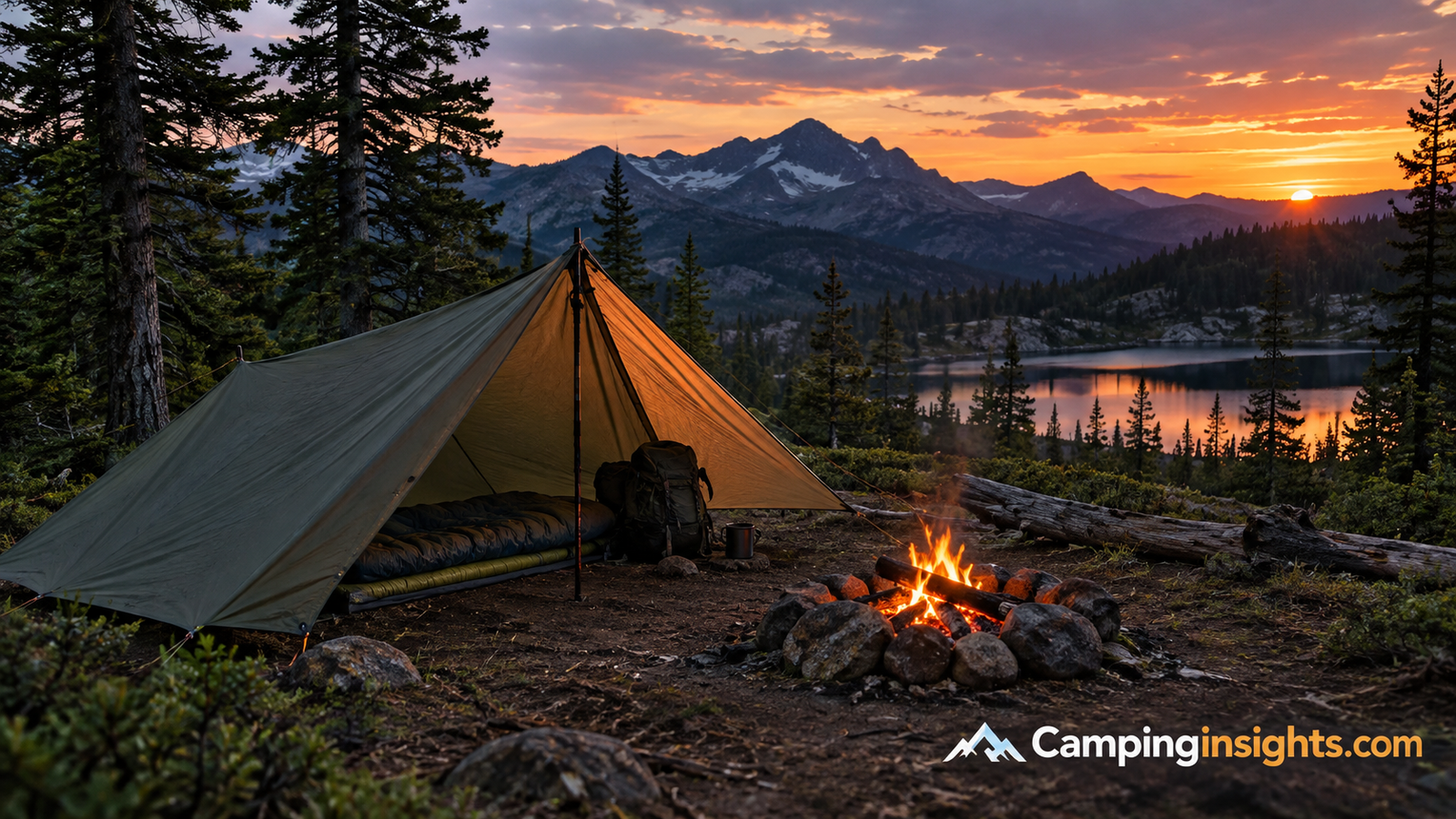
What Is Primitive Camping? The Complete Guide to Camping Off the Grid
There’s a particular kind of quiet that only shows up once you’re far enough from a parking lot. No generators humming two sites over, no string lights, no bathroom line — just wind moving through trees and the small sounds you make setting up camp. That’s the draw of primitive camping, and it’s exactly what this guide is going to unpack: what the term actually means, how it’s different from the car camping and glamping most people picture when they hear “camping trip,” and everything you need to know to try it yourself without getting in over your head.
Whether you stumbled on the phrase while researching a where-to-go-camping question or you’re already deep into planning a backcountry trip, this guide covers the definition, the gear, the site selection process, the safety considerations, and the mistakes that trip up almost everyone the first time.Primitive camping isn’t a single fixed activity so much as a spectrum, and where you land on it depends on how much self-sufficiency you’re comfortable with on a given trip. Some people ease into it by picking a designated primitive site with a fire ring a short drive from their car; others go straight to fully undeveloped dispersed camping on national forest land with no marked sites at all. Neither approach is more “correct” than the other — the right starting point is whichever one matches your current comfort level with navigation, water treatment, and being genuinely on your own if something goes wrong.
What Is Primitive Camping?
Primitive camping refers to camping in a location with no developed amenities — no bathrooms, no running water, no electrical hookups, no picnic tables, and often no marked campsite at all. You bring in everything you need and you pack out everything you brought, including trash. It sits at the far end of the camping spectrum from a paved RV pad with full hookups, and it overlaps heavily with terms like backcountry camping, dispersed camping, and wilderness camping, though each has its own subtle distinctions that we’ll break down in the next section.
The defining feature isn’t remoteness by itself — you can find primitive sites just a short walk from a trailhead — it’s the absence of infrastructure. If a site has a vault toilet and a fire ring built by the land manager, it’s usually still considered “primitive” in the loose sense most campers use, but a truly primitive site has nothing: you dig your own cathole, filter your own water, and set up wherever durable ground allows.
Public land agencies like the U.S. Forest Service and the Bureau of Land Management manage huge amounts of primitive camping terrain, often for free, precisely because it requires so little upkeep. That’s part of the appeal for campers too — no reservation systems, no camp host, no neighbors within earshot.
It’s worth separating the term from its close cousins for a second, because people use “primitive,” “rustic,” and “backcountry” almost interchangeably online and it muddies the picture. “Rustic” usually refers to a developed campground that’s simply lower-frills — pit toilets and a hand pump for water, but still a designated site with a number on a post. “Backcountry” typically refers to sites reached only on foot, often requiring a permit, deep inside a wilderness area or national park. Primitive camping can overlap with both, but the core idea stays the same across all of them: minimal to no built infrastructure, and an expectation that you’re self-sufficient for the duration of your stay.
Historically, primitive camping is really just camping in its original form — before campgrounds, fee stations, and paved loop roads existed, every camping trip was primitive by definition. What’s changed is that most people’s baseline experience now starts at a developed site, which is why primitive camping gets treated as a specialized subcategory rather than the default. For a lot of long-time campers, going primitive is less about seeking out hardship and more about returning to what camping looked like before it got standardized.
One more distinction worth making early: primitive camping doesn’t require a long drive or a multi-day hike. Plenty of national forests have primitive pullouts less than fifteen minutes from a paved highway. The lack of amenities, not the distance from civilization, is what defines the category — which is exactly why it’s such an accessible entry point for people who want to try it without committing to a full backcountry expedition.
Setting up your first primitive camp?
Shop Backpacking TentsPrimitive vs. Car, Dispersed & Stealth Camping
These terms get used interchangeably online, which causes a lot of confusion for beginners. Here’s how they actually differ in practice.
| Style | Amenities | Access | Typical Cost |
|---|---|---|---|
| Primitive Camping | None to minimal (maybe a fire ring) | Drive-up or short hike | Free to low-cost |
| Car Camping | Often has tables, toilets, sometimes water | Park next to your site | Low to moderate |
| Dispersed Camping | None — undesignated public land | Drive on forest roads, park, camp | Free |
| Stealth Camping | None, plus staying hidden from view | Wherever you can camp discreetly | Free |
Dispersed camping is really a subcategory of primitive camping — the “primitive” part describes the lack of amenities, while “dispersed” describes the legal framework (spread out across undesignated public land rather than a fixed lot). Stealth camping adds a layer of discretion on top, usually because you’re camping somewhere overnight stays aren’t officially sanctioned. Car camping is the opposite end of the spectrum: you can still be at a rustic site, but you’ve got a vehicle and usually some basic facilities nearby.
The practical difference shows up most in how much you have to plan ahead. With car camping, a forgotten item usually means a short drive to a camp store or a neighbor willing to lend a hand. With primitive or dispersed camping, a forgotten water filter or an underpacked first-aid kit is a problem you solve yourself, often miles from the nearest help. That’s not meant to scare anyone off — it’s just the trade-off that comes with the solitude and cost savings, and it’s the main reason gear checklists matter so much more once you leave developed campgrounds behind.
Stealth camping deserves its own callout because it’s legally murkier than the other three categories. It typically comes up in the context of camping near trailheads, urban green spaces, or on public land where overnight stays technically require a permit you don’t have — the goal being to camp discreetly enough that you’re gone before anyone notices. It’s more common among thru-hikers and vanlifers than weekend campers, and it carries real legal risk depending on jurisdiction, so it’s worth reading our dedicated what is stealth camping guide before trying it rather than assuming the same rules apply as regular dispersed camping.
Comparing setups before your trip?
Browse Camping EssentialsWhy People Choose Primitive Camping
Ask ten primitive campers why they do it and you’ll get ten slightly different answers, but a few themes come up constantly.
Solitude
Developed campgrounds fill up fast, especially on weekends near popular parks. Primitive sites, by contrast, rarely see another party — sometimes you’ll have an entire drainage or ridge to yourself.
Cost
Most primitive camping on public land is free. For frequent campers, that adds up fast compared to $30–$60 nightly fees at developed campgrounds.
Flexibility
No reservation system means no planning six months out. If a spot’s full, you drive to the next pullout.
The Actual Experience
There’s a skill-building, self-reliant quality to primitive camping that a lot of people find genuinely rewarding — learning to read terrain, manage water, and be comfortable without a safety net of amenities nearby.
Access to Better Scenery
Developed campgrounds are often clustered near the most heavily trafficked parts of a park or forest, which also tend to be the most photographed and most crowded. Primitive sites, especially ones reached by forest road rather than paved highway, frequently sit in spots with better views, closer proximity to trailheads, or quieter access to water — simply because the infrastructure cost of developing them wasn’t worth it to the land manager. Campers who get comfortable with primitive camping often say the scenery upgrade alone was worth the learning curve.
A Slower Pace
Without a camp store, a shower building, or a scheduled ranger program, there’s less structure pulling your attention away from the actual site you’re at. Meals take longer to prepare, water has to be managed deliberately, and there’s more unstructured time in general — which a lot of primitive campers describe as the actual point of the trip, rather than a side effect of the lack of amenities.
Want to try it this weekend?
Shop Trip-Ready GearWhere to Find Primitive Camping Spots
The best starting points are National Forests and BLM land, both of which generally allow dispersed camping outside of developed recreation sites unless posted otherwise. State-run wildlife management areas and some state forests allow it too, though rules vary a lot by state, so always check the specific unit’s website or call the ranger district before you go.
Apps and tools worth knowing:
- National Forest MVUM maps — show which roads are open to vehicles, which matters for finding legal dispersed sites
- Onward apps and public-land layer maps — help you visualize the boundary between public and private land in real time
- Ranger district offices — the most reliable source for current fire restrictions and closures
If you’re still narrowing down a region, our guide on where to go camping breaks down how to pick an area based on season, skill level, and what kind of scenery you’re after. And once you’ve got a general area, our piece on how to plan a camping trip walks through building out the full itinerary.
A few practical tips for the search itself: call the ranger district directly rather than relying only on a website, since dispersed camping rules and fire restrictions change more frequently than most agency pages get updated. Ask specifically about vehicle access — some forest roads that show as “open” on older maps have since washed out or been gated. And if you’re camping during a holiday weekend or peak season, plan to arrive earlier in the day; popular dispersed corridors near well-known trailheads fill up just as fast as developed campgrounds do, even without a reservation system.
It’s also worth building in a backup plan. Primitive camping areas can be temporarily closed for wildfire risk, active logging, or wildlife management without much advance notice, and cell service in these areas is unreliable at best. Identify a second and third option in the same general region before you leave home, so a closed gate or a full pullout doesn’t turn into a wasted trip.
Need offline navigation for remote areas?
Shop GPS & NavigationEssential Gear for Primitive Camping
Since there’s no store, no water spigot, and often no cell signal, your gear list needs to cover every basic need self-sufficiently.
Must-Haves
- Sturdy, weather-appropriate tent
- Sleeping bag rated for the coldest expected night
- Water filter or purification tablets
- Portable camp stove and fuel
- First-aid kit
- Headlamp + backup batteries
- Map, compass, or offline GPS
Easy to Forget
- Trowel for digging catholes
- Trash bags (pack it all out)
- Extra tent stakes for rocky or soft ground
- Tent repair patches
- Bug protection for dawn/dusk hours
- A backup fire-starting method
For sleeping systems specifically, check our reviews on the best sleeping pad for winter camping and the best camping cot for side sleepers if ground sleeping isn’t for you. If you’re heading into rocky terrain, our guide to the best tent stakes for rocky ground is worth a look before your trip, and it’s smart to throw in a tent repair kit since there’s no gear shop to bail you out.
Think of your gear list in layers rather than a single flat checklist: a shelter layer (tent, footprint, stakes), a sleep layer (bag, pad, pillow), a water layer (filter, backup tablets, storage capacity), a kitchen layer (stove, fuel, cookware, food storage), and a safety layer (first aid, navigation, communication, repair items). Building the list this way makes it much easier to spot gaps — if you can’t name at least two items in each layer, that’s the part of your kit most likely to fail you on a primitive trip.
Redundancy matters more here than it does for a car camping trip, simply because you can’t drive to a store to replace something that breaks. A second fire-starting method, a spare headlamp battery, and a backup water treatment option (tablets alongside a filter, for example) are all small, lightweight additions that solve real problems if your primary gear fails on night one instead of night three.
Build out your kit
Shop Stoves & Water FiltersChoosing a Campsite
With no marked sites, choosing where to actually pitch your tent is one of the biggest skill gaps for people new to primitive camping. A few non-negotiables:
- Durable surfaces — bare dirt, rock, or gravel over living vegetation, moss, or fragile alpine plants
- 200 feet from water — protects water sources and wildlife travel corridors
- Away from dead trees — a dead standing tree (“widowmaker”) near your tent is a real hazard in wind
- Not in a drainage or dry wash — flash floods happen fast and with little warning
- Already-impacted sites — using a spot that’s clearly been camped on before minimizes new impact
Our full breakdown on how to choose a campsite goes deeper into reading topography and wind exposure, which matters even more once you’re outside a groomed campground.
Timing your arrival matters too. Showing up with an hour or more of daylight left gives you room to actually evaluate a few options rather than settling for the first flat spot you find in fading light — which is how a lot of poor site choices happen. Walk the immediate area before committing: check for overhead hazards, look at how water would drain across the site in a downpour, and note wind direction relative to your tent door and any cooking area.
If you’re camping with a group, look for a site that has enough already-impacted ground for everyone rather than spreading tents across new, undisturbed vegetation to fit the group. Concentrating impact on a durable surface that’s already been used is almost always better for the land than dispersing a group’s footprint across a wider, previously untouched area — even if it means a slightly tighter camp layout than everyone would prefer.
Pitching on uneven or rocky ground?
Shop Tent FootprintsWater Sourcing and Purification
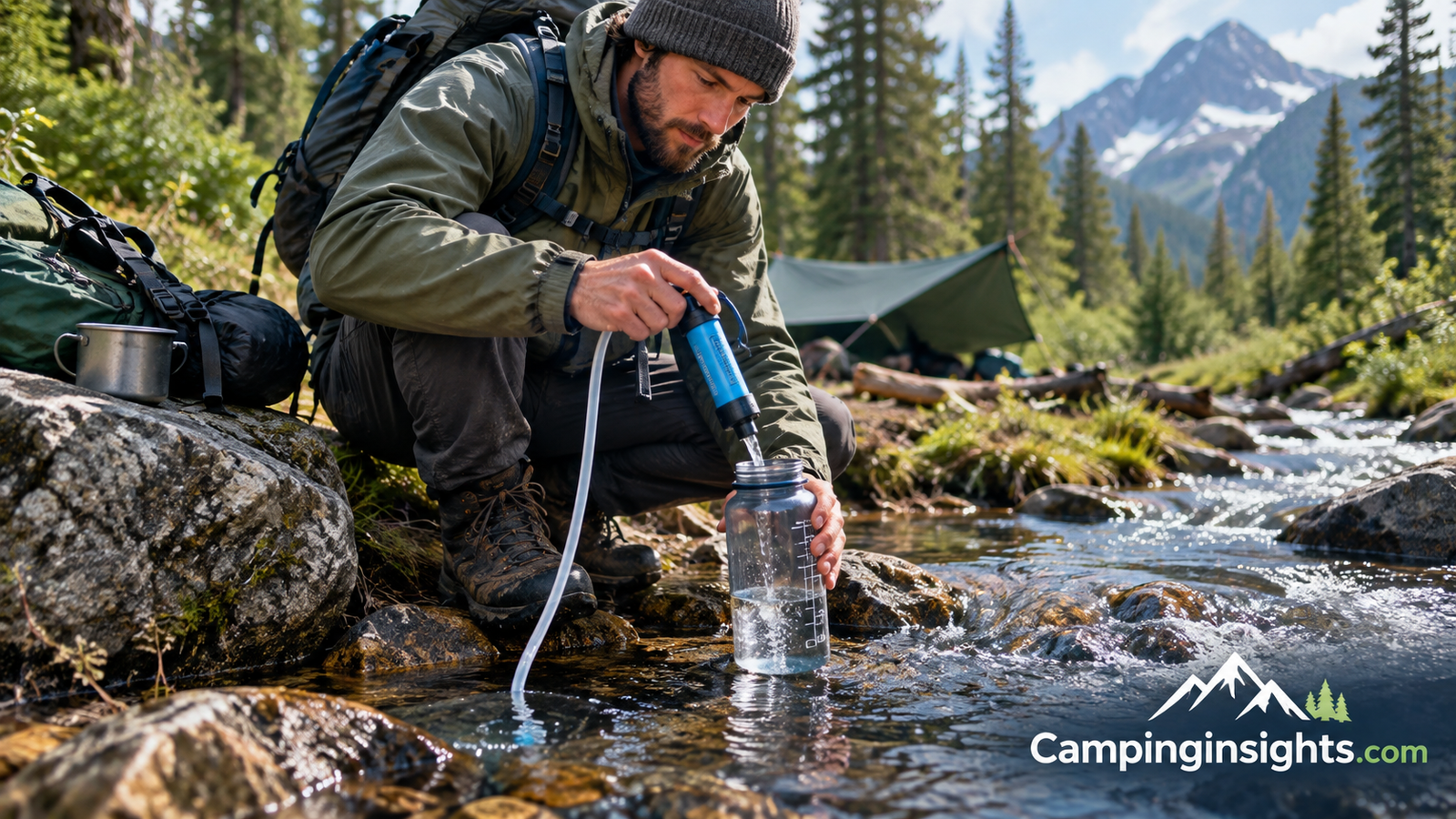
Unless you’re carrying every drop in, you’ll be relying on natural water sources — streams, lakes, or springs — and every one of them needs to be treated before you drink it. Giardia and other pathogens don’t care how clear or remote the water looks.
Common purification methods
- Pump or squeeze filters — fast, reusable, removes protozoa and bacteria (not viruses)
- Chemical treatment (tablets/drops) — lightweight backup, takes longer to work
- UV purifiers — quick, but battery-dependent
- Boiling — the most reliable fallback if your filter fails
Plan your route around known water sources, and always carry more capacity than you think you’ll need — sources can be dry or seasonal even when a map marks them as reliable.
A good rule of thumb for consumption planning is roughly one liter per two to three hours of moderate hiking in mild conditions, more in heat or at altitude, plus additional water for cooking and basic cleanup. If you’re relying on a single water source for an overnight stay, filter and store more than you expect to drink that evening, since filtering in the dark with a headlamp is far less pleasant — and easier to do carelessly — than filtering in daylight.
Water quality varies more than people expect even within a single trip. Fast-moving mountain streams are generally lower-risk than stagnant ponds or slow-moving water downstream of grazing land, but “generally lower-risk” is not the same as safe, and every source still needs treatment. If a source looks silty or cloudy, let it settle in a container before filtering, since sediment clogs pump and squeeze filters quickly and can shorten the life of your equipment significantly.
Stock up on purification gear
Shop Water FiltersFood Storage and Cooking Without Amenities
Cooking primitive-style usually means a compact backpacking or camp stove rather than a fire, both for reliability and because fire restrictions are common on public land during dry months. Whatever fuel type you choose, pack enough for a day or two beyond your planned trip length in case weather delays your exit.
Food storage matters as much as cooking. In bear country, that means a bear canister or a proper hang, at least 100 feet from your sleeping area and well away from your cooking area too — never store food in your tent. Even outside bear country, rodents and other wildlife will chew through anything left accessible overnight.
For meal ideas that travel well without refrigeration, our camping food ideas guide has a full list organized by how much cooking effort each one takes.
Fuel choice depends heavily on trip length and season. Canister stoves are the easiest to use and clean but lose efficiency in cold temperatures and can be hard to gauge remaining fuel by weight alone. Liquid-fuel stoves handle cold weather better and are refillable from a bulk bottle, but they require more maintenance and a slightly steeper learning curve. For short overnight trips in mild weather, a simple canister setup is usually all you need; for cold-weather or multi-day trips, the extra reliability of a liquid-fuel stove is often worth the added weight and complexity.
Cleanup deserves its own plan, too. Food scraps and dirty dishwater both count as attractants for wildlife, so strain solids into your trash bag and scatter strained gray water well away from camp and at least 200 feet from any water source — never dump it directly into a stream or lake, even if it seems diluted enough to not matter.
Pack the right cooking setup
Shop Camp StovesLeave No Trace Principles for Primitive Camping
Primitive camping only stays sustainable if the people using it minimize their impact — and land managers do respond to widespread damage by closing areas to dispersed camping entirely. The seven Leave No Trace principles apply directly here:
- Plan ahead and prepare
- Travel and camp on durable surfaces
- Dispose of waste properly — pack out all trash, and bury human waste in a cathole 6–8 inches deep, 200 feet from water
- Leave what you find
- Minimize campfire impact — use existing fire rings, keep fires small, and know current restrictions
- Respect wildlife — store food properly and observe from a distance
- Be considerate of other visitors
These aren’t just etiquette — in a lot of areas, they’re the difference between dispersed camping staying open to the public and getting shut down after repeated abuse.
Campfire impact deserves special attention because it’s the single most visible sign of overuse in primitive camping areas. A ring of blackened rocks and scattered ash can persist for years and often prompts new arrivals to build yet another fire ring nearby rather than using the existing one, multiplying the damage. If you do have a fire, keep it small, burn wood down completely to ash, and make sure it’s fully cold before you leave — never bury still-smoldering coals, since they can smolder underground and reignite hours or even days later.
Land managers do track dispersed camping impact, whether through direct site visits, satellite imagery, or visitor reports, and closures aren’t hypothetical — several popular dispersed corridors near well-known trailheads have been closed to overnight camping in recent years specifically because of trash, human waste, and vegetation damage. Treating Leave No Trace as optional rather than standard practice is part of why those closures happen in the first place.
Leave no trace, pack it all out
Shop LNT GearSafety Considerations
Without a camp host or nearby help, self-sufficiency becomes a safety issue, not just a convenience one. A few things worth planning around before you go:
- Tell someone your plan — location, route, and expected return date
- Carry a satellite communicator if you’re heading somewhere without cell signal
- Know basic first aid — help may be hours away, not minutes
- Check fire restrictions before you leave, not after you arrive
- Bring a dog? Read our camping with a dog guide for water, wildlife, and heat considerations specific to pets
For a more complete rundown, our camping safety tips article covers wildlife encounters, navigation backups, and emergency signaling in more depth.
It helps to think through a few specific scenarios ahead of time rather than relying on general preparedness alone. What’s your plan if someone twists an ankle a mile from camp with no cell signal? What if your only water source turns out to be dry when you arrive? What if a storm rolls in faster than forecast and you need to break camp in the dark? None of these need a complicated answer, but having thought through them once, calmly, before you’re standing in the situation, makes a real difference in how clearly you’re able to respond.
Wildlife awareness is worth a specific mention beyond food storage. Know what you might realistically encounter in the area you’re camping — black bears, mountain lions, snakes, or simply more aggressive rodents than you’re used to — and understand the basic, area-specific guidance for each before you arrive rather than looking it up after a close encounter. A quick check of the managing agency’s website usually covers exactly what’s been reported recently in that area.
Prepare for the unexpected
Shop First-Aid KitsWeather Preparedness
Weather hits harder when there’s no bathhouse to duck into or camp store to buy a tarp from. Rain, cold, and wind all need a plan before you leave, not after the first drops fall.
If rain is in the forecast, our guide to camping in the rain covers site selection and gear setup that keeps you dry, and how to make a tent waterproof is worth reading before a wet-season trip. Waking up to a damp tent interior is common enough that we wrote a dedicated piece on why your tent is wet inside and a companion guide on how to stop condensation in a tent.
Cold-weather trips bring their own checklist — see how to keep your tent warm at night and, for deeper winter conditions, how to keep a tent warm in winter.
Wind is the most underestimated weather factor for primitive camping, largely because it’s harder to plan around than temperature or precipitation. A site that looks perfectly sheltered from the road can sit directly in a wind funnel once you’re actually camped there. Look for natural windbreaks — a rise in terrain, a stand of trees, a rock outcropping — and orient your tent door away from the prevailing wind direction rather than discovering the problem at 2 a.m.
Temperature swings between day and night are often more extreme at primitive sites than most people expect, especially at elevation or in open, exposed terrain without the microclimate effect that trees and structures create in developed campgrounds. Packing for the overnight low rather than the daytime high is the single most common gap in cold-weather primitive camping, and it’s an easy one to fix with layered sleep systems and a sleeping bag liner as a lightweight backup.
Weatherproof your setup
Shop Rain ProtectionCommon Beginner Mistakes
What Trips People Up
- Underestimating how much water they’ll need
- Camping too close to water or on fragile vegetation
- Not checking fire restrictions beforehand
- Skipping a paper map as backup
- Bringing a tent not rated for expected conditions
- Leaving food accessible to wildlife
Easy Fixes
- Scout your route and water sources ahead of time
- Use already-impacted sites over pristine ground
- Call the ranger district before you leave
- Download offline maps and carry paper backup
- Match gear to season, not just to budget
- Hang or canister-store food every night
Most of these come down to one theme: primitive camping removes the safety net that developed campgrounds provide, so the planning has to happen before you leave rather than once you’re there. Our full camping checklist for beginners and what-to-bring checklist are both built specifically to catch these gaps.
One mistake worth calling out on its own: treating the first primitive trip like a stress test rather than a learning experience. It’s tempting to head straight for the most remote, most ambitious location you can find once the idea of primitive camping sounds appealing, but a short, close-to-the-car trial run teaches you far more about your own gear and habits than a long trip into unfamiliar terrain. Use that first trip to find the gaps in your kit while you’re still within easy driving distance of help, then scale up distance and remoteness on the trips that follow.
Don’t forget the basics
Shop Camping BundlesFrequently Asked Questions
Is primitive camping legal?
Yes, on most National Forest and BLM land, and on some state land, as long as you follow local rules on duration, distance from roads and water, and fire restrictions. Always confirm with the managing agency for the specific area.
Do I need a permit for primitive camping?
Often no, but some high-use areas, wilderness zones, and national parks require a permit even for dispersed sites. Check the specific land unit’s website before you go.
How long can I stay at a primitive site?
Many National Forest districts cap dispersed camping at 14 days within a set period (often 30 days), after which you must move a minimum distance away. Rules vary by district.
Is primitive camping safe for beginners?
It can be, with preparation. Start with a site close to your vehicle, tell someone your plans, and bring more water and first-aid supplies than you think you’ll need.
What’s the difference between primitive and dispersed camping?
Primitive describes the lack of amenities; dispersed describes camping on undesignated public land rather than a marked site. Most dispersed camping is also primitive, but you can find primitive designated sites too (a fire ring and nothing else, for example).
Can I have a campfire while primitive camping?
Only where it’s currently allowed — check fire restrictions before you go, since they change quickly during dry seasons. Use an existing fire ring where possible and keep fires small.
How do I find water while primitive camping?
Plan your route around mapped streams, lakes, or springs, and always carry a filter or purification method, since even clear-looking water can carry pathogens.
What should I do with trash and human waste?
Pack out all trash, including food scraps. Bury human waste in a cathole 6–8 inches deep and at least 200 feet from any water source.
Do I need a special tent for primitive camping?
Not necessarily special, but it should match the season and conditions you’re camping in — a 3-season tent is fine for most trips, but winter or high-wind conditions call for a sturdier setup.
Can I bring my dog primitive camping?
Yes, in most areas, though you should plan extra water, check for wildlife risks, and confirm leash rules for the specific land unit.
Is primitive camping free?
Most dispersed and primitive camping on public land is free. Some designated primitive sites with a fire ring or vault toilet charge a small fee.
What’s the biggest mistake beginners make?
Underestimating water needs and not scouting a route or campsite ahead of time — both are easy to fix with a bit of planning before the trip.
How do I choose between primitive camping and a developed campground?
If you want solitude, flexibility, and lower cost and are comfortable being self-sufficient for water, waste, and navigation, primitive camping is a good fit. If you’d rather have a picnic table, a toilet nearby, and a reserved spot waiting for you, a developed campground makes more sense — there’s no wrong choice, just different trade-offs.
What size group is realistic for primitive camping?
Small groups generally have an easier time finding a site with enough already-impacted ground to fit everyone without spreading onto undisturbed vegetation. Larger groups should scout ahead or split into two nearby sites rather than force a single oversized footprint into one location.
Final Thoughts
Primitive camping strips away almost everything that makes a developed campground convenient, and that’s exactly the point — it trades amenities for solitude, cost savings, and a genuinely different kind of outdoor experience. The learning curve is real, but it’s also short: match your gear to the season, plan your water and food carefully, follow Leave No Trace, and tell someone your plan before you go. Once those basics are locked in, primitive camping opens up a huge amount of public land that most campers never bother to explore.
Shop Primitive Camping Essentials