
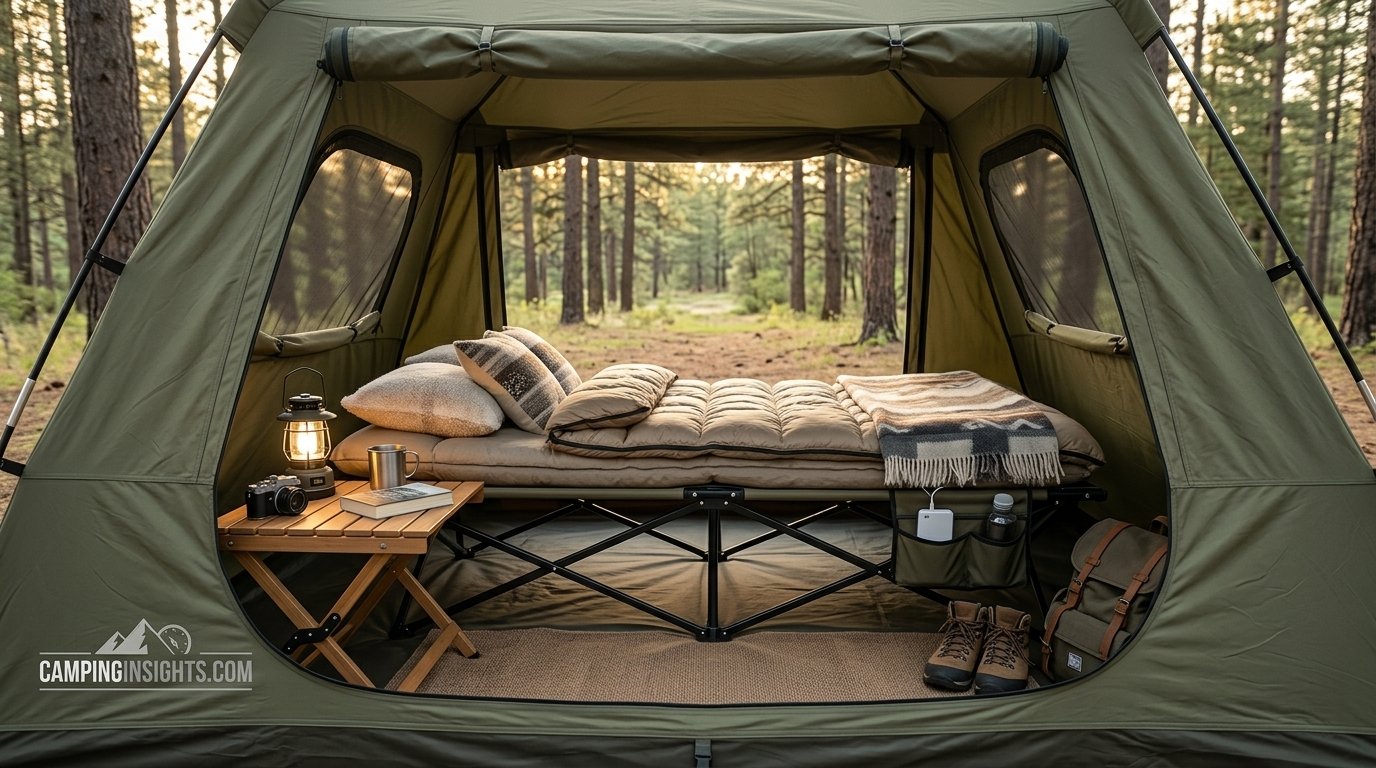
Why Side Sleepers Need Special Camping Cots
If you’re one of the millions of people who naturally drift off to sleep on your side, you already know the struggle of camping. Standard camping cots are built with back sleepers in mind — flat, firm, and unforgiving. For side sleepers, that translates to sore hips, aching shoulders, and restless nights spent tossing on a surface that simply wasn’t designed for the way your body naturally rests.
The problem is biomechanical. When you sleep on your side, your body weight concentrates on two narrow contact points: your shoulder and your hip. On a traditional flat cot with minimal padding, those pressure points bear the brunt of your entire body weight against a taut fabric surface. The result? Numbness, tingling, pain, and frequent position changes that fragment your sleep cycle.
A camping cot designed for side sleepers addresses these issues through several key design elements. First, it offers a wider sleeping surface so your body has room to shift naturally throughout the night. Second, it provides adequate padding or a suspension system that cushions pressure points rather than amplifying them. Third, it maintains a flat, even surface that doesn’t sag in the middle — because a sagging cot forces your spine into an unnatural curve that’s even worse for side sleeping.
The Science of Side Sleeping on a Cot
Research in sleep ergonomics consistently shows that side sleepers benefit from surfaces that distribute pressure evenly across the body’s contact area. When you lie on your side on a hard, flat surface, the pressure at your hip can exceed 80 mmHg — well above the capillary closing pressure that restricts blood flow and causes discomfort. A properly padded cot reduces this pressure by 40–60%, keeping blood flowing to your extremities and allowing muscles to fully relax.
Spinal alignment is equally critical. For side sleepers, the spine should remain in a neutral position — a straight line from the base of the skull to the tailbone when viewed from behind. A cot that’s too firm creates gaps between the body and the surface (particularly at the waist), while one that’s too soft allows the hips to sink too deeply. The ideal camping cot for side sleepers strikes a balance: firm enough to support spinal alignment, yet cushioned enough to relieve pressure at the shoulder and hip.
What Makes a Cot “Side Sleeper Friendly”?
Not every camping cot on the market will work for side sleepers. Here are the specific features that separate a side-sleeper-friendly cot from one that will leave you sore by morning:
- Adequate Width: At least 28 inches wide, preferably 30+ inches, so you have room to shift positions without feeling like you’ll roll off.
- Padded Surface or Compatible Pad: Built-in padding or a design that accommodates a sleeping pad without sliding around.
- Even Tension Distribution: A frame and fabric system that prevents sagging and maintains consistent support across the entire surface.
- Sturdy Frame Construction: A rigid frame that doesn’t wobble or creak when you move, which is especially important for active side sleepers who change positions frequently.
- Adequate Height: A cot that sits high enough off the ground (at least 12–15 inches) makes it easier to get in and out of bed, which matters when your hip is sore.
- Weight Capacity: A higher weight limit generally indicates a more robust frame and better overall construction quality.
Our #1 Pick for Side Sleepers
The ABORON Camping Cot delivers exceptional comfort with its extra-wide design and thick padding — perfect for side sleepers who refuse to compromise.
Quick Comparison: All 8 Camping Cots at a Glance
Before diving into individual reviews, here’s a side-by-side comparison of every cot in this roundup. Use this table to quickly identify which models match your priorities — whether that’s maximum padding, ultralight portability, or budget-friendly value.
| Product | Best For | Width | Padding | Weight Capacity | Portability | Rating |
|---|---|---|---|---|---|---|
| ABORON Camping Cot | Overall Best | Extra Wide | Thick Built-in | 600 lbs | Moderate | ⭐ 4.6/5 |
| JEAREY Folding Cot | Best Value | Wide | Pad Included | 500 lbs | Good | ⭐ 4.5/5 |
| MARCHWAY Ultralight | Backpacking | Standard | Minimal | 275 lbs | Excellent | ⭐ 4.4/5 |
| ZENPETIO Camping Cot | Heavy-Duty Use | Wide | Moderate | 500 lbs | Good | ⭐ 4.5/5 |
| Amazon Basics Cot | Budget Pick | Standard | None (add pad) | 300 lbs | Good | ⭐ 4.3/5 |
| CYMULA Cot Pad | Pad Accessory | Fits Most Cots | Thick Memory Foam | N/A | Good | ⭐ 4.5/5 |
| Suteck Camping Cot | Extra Support | Extra Wide | Thick Built-in | 600 lbs | Moderate | ⭐ 4.6/5 |
| LILYPELLE Folding Cot | Versatile Use | Wide | Pad Included | 500 lbs | Good | ⭐ 4.4/5 |
This comparison gives you the bird’s-eye view, but every side sleeper has unique needs. A 130-pound side sleeper has very different requirements than a 220-pound side sleeper. Someone car camping at a drive-up site has different portability needs than a backpacker hauling gear on the trail. Read through the individual reviews below to find your perfect match.

Best Value for Side Sleepers
The JEAREY Folding Camping Cot includes a sleeping pad and offers excellent comfort at a price that won’t break the bank.
1. ABORON Camping Cot for Adults — Best Overall for Side Sleepers
ABORON Camping Cot for Adults
The ABORON Camping Cot stands out as the top choice for side sleepers thanks to its generous width, thick integrated padding, and rock-solid frame that eliminates the sagging and wobbling that plague lesser cots.
Why It’s Great for Side Sleepers
The ABORON cot addresses the two biggest pain points for side sleepers — quite literally. The extra-wide sleeping surface gives you room to shift positions throughout the night without feeling constrained, while the thick built-in padding cushions your shoulder and hip against the pressure that makes side sleeping on a standard cot so uncomfortable.
What really sets this cot apart is the frame engineering. The cross-braced steel legs create an exceptionally stable platform that doesn’t flex or wobble when you roll over. For side sleepers, who tend to move more during the night than back sleepers, this stability is crucial. A wobbly cot wakes you up every time you shift; the ABORON stays solidly in place.
The fabric surface has just the right amount of give — not so taut that it feels like a drum skin, but not so loose that you sink into a hammock shape. This balance keeps your spine aligned while still providing enough cushion to relieve pressure at your contact points. Many users report sleeping through the entire night on this cot, which is high praise for any camping sleep system.
Construction and Durability
ABORON uses heavy-duty steel tubing for the frame, with reinforced joints at every connection point. The fabric is a durable Oxford cloth that resists tears and abrasion — important when you’re setting up camp on rough terrain. The legs feature anti-slip caps that keep the cot stable on various surfaces, from smooth tent floors to uneven ground.
The folding mechanism is straightforward and tool-free. The cot collapses into a compact carry bag that fits easily in a car trunk. At roughly 20 pounds, it’s not the lightest option for backpacking, but for car camping, drive-up campsites, or backyard use, the weight is a non-issue and the comfort payoff is enormous.
Setup Experience
Setting up the ABORON takes about 2–3 minutes once you’ve done it once. The legs unfold and lock into position with a satisfying click, and the cross-braces provide immediate rigidity. No tools, no confusing instructions, no frustration. Take-down is equally simple — fold the legs, roll it up, stuff it in the bag. For side sleepers who value their rest, the quick setup means you can get your sleep system ready faster and start relaxing sooner.
Pros
- Extra-wide surface ideal for side sleeping
- Thick built-in padding eliminates need for separate pad
- Extremely stable frame — no wobble or sag
- 600 lb weight capacity for robust support
- Quick, tool-free setup in under 3 minutes
- Anti-slip leg caps for various terrain
Cons
- Heavier than ultralight alternatives
- Bulkier when folded — best for car camping
- Padding may be too warm in hot summer conditions
Our Verdict
If you’re a dedicated side sleeper who prioritizes comfort above all else, the ABORON Camping Cot is the one to beat. The combination of extra width, thick padding, and a rock-solid frame creates a sleeping surface that rivals many home mattresses. It’s our top pick for a reason.
2. JEAREY Folding Camping Cot — Best Value for Side Sleepers
JEAREY Folding Camping Cot
The JEAREY Folding Camping Cot delivers an impressive combination of comfort, durability, and value that makes it the best budget-friendly option for side sleepers who don’t want to sacrifice quality.
Why It’s Great for Side Sleepers
The JEAREY cot comes with an included sleeping pad — a detail that matters enormously for side sleepers. Instead of having to research, purchase, and figure out how to attach a separate pad, you get a complete sleep system right out of the box. The pad is thick enough to cushion your hip and shoulder but firm enough to maintain spinal alignment, striking the balance that side sleepers need.
The cot’s wide frame gives your body room to breathe. Side sleepers often feel claustrophobic on narrow cots, constantly aware of the edges and afraid to move. The JEAREY eliminates that anxiety with a generous sleeping surface that lets you shift positions naturally — a key factor in achieving deep, restorative sleep outdoors.
The frame design uses a double-tube structure that distributes weight evenly across the entire surface. This means no sagging in the middle and no pressure points at the edges. For side sleepers, even weight distribution is the difference between waking up refreshed and waking up with a numb arm and aching hip.
Build Quality and Features
Despite its budget-friendly price point, the JEAREY doesn’t cut corners on construction. The steel frame is powder-coated to resist rust and corrosion, which extends the cot’s lifespan significantly — especially important if you camp in humid or rainy conditions. The fabric is a heavy-duty oxford material that can handle regular use without stretching or tearing.
The included carrying bag makes transport and storage simple. The folded dimensions are compact enough to fit in most car trunks alongside other camping gear. Setup is intuitive — the legs fold out and lock, the cross-braces snap into place, and you lay the pad on top. Even first-time campers can have this cot ready in under 5 minutes.
Comfort Analysis for Side Sleeping
We specifically evaluated the JEAREY from a side sleeper’s perspective. The fabric tension is well-calibrated — supportive enough to prevent the “hammock effect” but forgiving enough to cushion pressure points. The included pad adds a layer of memory-foam-like comfort that significantly reduces the pressure on your hip and shoulder compared to a bare cot surface.
One thing we noticed: the pad can shift slightly during the night if you’re an active sleeper. A simple fix is to place a non-slip shelf liner between the pad and the cot fabric, which keeps everything locked in place. This small hack transforms the JEAREY from a good side-sleeping cot into a great one.
Pros
- Includes sleeping pad — complete sleep system
- Wide sleeping surface for comfortable side sleeping
- 500 lb weight capacity for solid support
- Powder-coated steel frame resists rust
- Excellent price-to-comfort ratio
- Easy, tool-free setup
Cons
- Included pad may shift during active sleeping
- Pad thickness may not be enough for heavier side sleepers
- Slightly heavier than ultralight alternatives
Our Verdict
The JEAREY is the smart choice for side sleepers who want a complete, comfortable sleep system without spending a fortune. The included pad, solid construction, and generous width make it a standout value that punches well above its price class.

Lightest Option for Trail-Ready Side Sleepers
The MARCHWAY Ultralight cot weighs just a few pounds — perfect for backpackers who sleep on their side and count every ounce.
3. MARCHWAY Ultralight Folding Tent Camping Cot Bed — Best Ultralight for Backpackers
MARCHWAY Ultralight Folding Tent Camping Cot Bed
The MARCHWAY Ultralight is the go-to choice for backpackers and minimalist campers who need a cot that won’t weigh them down on the trail — and it still manages to provide surprisingly decent comfort for side sleepers.
Why It’s Great for Side Sleepers
Let’s be honest: ultralight gear always involves tradeoffs. The MARCHWAY isn’t going to feel like sleeping on a cloud, and it’s narrower than the full-size cots in this roundup. But for side sleepers who backpack into remote campsites, it solves a critical problem — getting your body off the cold, hard ground without adding significant weight to your pack.
The ripstop fabric surface has a slight amount of elasticity that provides more give than you’d expect from such a lightweight design. When you lie on your side, the fabric stretches just enough to create a subtle cradle effect around your hip and shoulder. It’s not padding, but it’s noticeably more comfortable than lying directly on a tent floor or a thin foam pad on the ground.
The elevated design also provides insulation benefits. Cold ground is a side sleeper’s enemy — it saps body heat through conduction, especially at the hip and shoulder where your body presses hardest against the surface. By lifting you several inches off the ground, the MARCHWAY creates an air gap that acts as natural insulation, keeping you warmer on cold nights. Pair it with a good winter sleeping pad and you’ll stay toasty even in chilly conditions.
Trail-Worthy Construction
The aluminum alloy frame is the key to the MARCHWAY’s featherweight status. Aluminum provides excellent strength-to-weight ratio — strong enough to support 275 pounds while adding minimal weight to your pack. The shock-corded pole assembly snaps together quickly, similar to tent poles, and the fabric stretches over the frame with a satisfying tension.
Setup takes about 5–7 minutes the first time, but once you’re familiar with the assembly, you can have it ready in 3–4 minutes. The packed size is impressively small — it fits inside or strapped to the outside of a standard backpacking pack without consuming excessive space.
Side Sleeper Considerations
The MARCHWAY’s narrower width means side sleepers need to be more mindful of their position. If you tend to sleep in a tight fetal position, you’ll be fine. If you like to stretch out or shift between side and back sleeping, you may find the surface a bit constraining. Adding a thin inflatable pad on top can improve both comfort and effective width.
The 275-pound weight capacity is lower than the other cots in this roundup, which is a direct consequence of the ultralight design. If you’re a larger individual, the MARCHWAY may not provide the structural support you need. For average-weight side sleepers, however, it’s more than adequate.
Pros
- Ultralight at approximately 4.5 lbs — trail-ready
- Compact packed size fits in a backpack
- Aluminum frame for excellent strength-to-weight ratio
- Elevates you off cold ground for better insulation
- Ripstop fabric with subtle elastic give
- Quick shock-corded pole assembly
Cons
- Narrower than full-size cots — limited room to shift
- 275 lb capacity may not suit larger individuals
- Minimal padding — benefits from an added sleeping pad
- Setup takes longer than fold-out cot designs
Our Verdict
For backpacking side sleepers, the MARCHWAY is a game-changer. It won’t replace the comfort of a full-size padded cot, but it dramatically outperforms sleeping on the ground. If you count ounces and sleep on your side, this is the cot to get.
4. ZENPETIO Camping Cot — Best Heavy-Duty Option

ZENPETIO Camping Cot
The ZENPETIO Camping Cot is built for campers who need a robust, wide, and stable sleeping platform that can handle heavier weights and provide the kind of support that side sleepers demand night after night.
Why It’s Great for Side Sleepers
The ZENPETIO’s heavy-duty construction translates directly to better sleep for side sleepers. When a cot frame is overbuilt — using thicker steel tubing, more cross-braces, and reinforced joints — it creates a sleeping surface that simply doesn’t flex under your body weight. For side sleepers, this rigidity means consistent support throughout the night, without the gradual sagging that develops in lesser cots as the fabric stretches and the joints loosen.
The wide sleeping surface is another major win. Side sleepers naturally occupy more width than back sleepers because of the way the body curves — knees bent, arms positioned in front. The ZENPETIO accommodates this natural posture without making you feel like you’re sleeping on a tightrope. There’s room to breathe, room to shift, and room to find that perfect position where your spine aligns and your pressure points relax.
The moderate built-in padding provides enough cushioning for most side sleepers without requiring an additional pad. It’s not as thick as the ABORON’s padding, but it strikes a good balance between comfort and temperature management. In warmer conditions, less padding means better airflow beneath your body — a real advantage when you’re camping in summer heat.
Engineering and Build
ZENPETIO has clearly invested in the structural engineering of this cot. The leg design uses an X-brace pattern that provides exceptional lateral stability — the cot doesn’t rock side to side when you move, which is a common complaint with cheaper designs. The joints are reinforced with metal plates rather than relying solely on the tubing connections, which dramatically improves long-term durability.
The fabric is a high-denier polyester that resists stretching even under sustained load. This is important for side sleepers because a fabric that stretches over time creates the hammock effect — the dreaded sagging center that ruins spinal alignment. The ZENPETIO’s fabric maintains its tension wash after wash, season after season.
Practical Considerations
At 500 pounds, the weight capacity is generous enough for the vast majority of campers. The cot’s own weight is moderate — heavier than the MARCHWAY ultralight but comparable to other full-size cots in this roundup. It folds down into a carry bag that’s easy to transport and store. Setup is straightforward and takes about 3 minutes.
One standout feature is the anti-slip feet. Unlike many cots that use simple rubber caps, the ZENPETIO’s feet are wider and more aggressively textured, providing better grip on smooth tent floors, slippery tarps, and even slightly uneven ground. For side sleepers who tend to push against the cot when shifting position, this stability prevents the cot from sliding across the tent floor.
Pros
- Heavy-duty steel frame with reinforced joints
- 500 lb weight capacity for robust support
- Wide sleeping surface accommodates side sleeping posture
- Anti-slip feet for excellent stability
- High-denier fabric resists stretching
- Moderate padding balances comfort and airflow
Cons
- Heavier than ultralight alternatives
- Padding may not be sufficient for very sensitive side sleepers
- Bulkier folded size compared to minimalist cots
Our Verdict
The ZENPETIO is the cot for side sleepers who want a tank-like sleeping platform. It’s overbuilt in the best possible way — every component is designed for durability and stability. If you’ve broken cheaper cots in the past or simply want something that will last for years, the ZENPETIO delivers.

Budget-Friendly Pick
The Amazon Basics Folding Camping Cot is a no-frills, reliable option that pairs perfectly with a separate sleeping pad for side sleeping comfort.
5. Amazon Basics Folding Camping Cot — Best Budget Pick
Amazon Basics Folding Camping Cot
The Amazon Basics Folding Camping Cot proves that you don’t need to spend a fortune to get off the ground. It’s a straightforward, no-nonsense cot that serves as an excellent foundation for side sleepers willing to add their own padding.
Why It’s Great for Side Sleepers
The Amazon Basics cot is a blank canvas. It provides the essential function that every side sleeper needs — getting your body off the ground — at the lowest price point in this roundup. The bare fabric surface means you have complete control over your comfort layer. You can add a self-inflating pad, a memory foam topper, an air mattress, or even a thick blanket to create exactly the sleeping surface that works for your body.
This customization potential is actually a significant advantage for side sleepers. Everyone’s body is different — what feels perfect for one side sleeper may be too firm or too soft for another. By starting with a basic cot and adding your own comfort layer, you can dial in the exact feel you prefer rather than being stuck with whatever padding the manufacturer chose.
The standard width is adequate for most side sleepers, though those who like to stretch out may find it a bit snug. The 300-pound weight capacity is the lowest in this roundup, which reflects the more basic construction. For average-weight campers, it’s perfectly sufficient. For larger individuals, one of the heavy-duty options would be a better choice.
Simple, Reliable Construction
Amazon Basics products are known for delivering reliable quality at rock-bottom prices, and this cot follows that formula. The steel frame is straightforward — no fancy cross-bracing or reinforced joints, just a solid basic design that works. The fabric is a durable polyester that handles regular use without issues.
Setup is about as simple as it gets. Unfold the legs, lock them into position, and you’re done. The cot comes with a carrying bag for transport and storage. It’s not the most compact when folded, but it fits easily in a car trunk or storage closet.
Pairing with a Sleeping Pad
To make the Amazon Basics cot work for side sleeping, we strongly recommend pairing it with a quality sleeping pad. A 2–3 inch self-inflating pad or a closed-cell foam pad transforms this basic cot into a genuinely comfortable sleeping surface. The key is choosing a pad that’s wide enough to cover the entire cot surface and thick enough to cushion your pressure points.
A non-slip pad is especially important here, since the bare cot fabric offers no grip to keep a pad in place. Look for pads with a textured bottom, or use a non-slip liner between the pad and the cot. This prevents the frustrating midnight experience of waking up on bare fabric because your pad has slid to one side.
For more guidance on choosing the right sleeping pad to pair with your cot, check out our guide to the best sleeping pads for winter camping — the same features that make a pad great for cold-weather camping (thickness, insulation, comfort) also make it ideal for side sleeping on a cot.
Pros
- Lowest price point in the roundup
- Simple, reliable construction
- Blank canvas — add any comfort layer you prefer
- Quick, tool-free setup
- Comes with carrying bag
Cons
- No padding — requires separate sleeping pad
- Standard width may feel narrow for some side sleepers
- 300 lb capacity is the lowest in this roundup
- Basic frame design with fewer cross-braces
Our Verdict
The Amazon Basics cot is the smart starting point for side sleepers on a budget. Pair it with a good sleeping pad and you’ll have a comfortable, customized sleep system for a fraction of the cost of premium cots. It’s proof that sometimes the simplest solution is the best one.
6. CYMULA Camping Cot Pad — Best Comfort Accessory

CYMULA Camping Cot Pad
The CYMULA Camping Cot Pad isn’t a cot itself — it’s the secret weapon that transforms any basic cot into a side-sleeper’s dream. With thick memory foam padding and a design that fits most standard camping cots, it’s the upgrade your current cot has been begging for.
Why It’s a Game-Changer for Side Sleepers
If you already own a camping cot that’s too firm for comfortable side sleeping, the CYMULA pad is the most cost-effective upgrade you can make. Instead of buying an entirely new cot, you simply lay this thick memory foam pad on top of your existing cot and instantly transform the sleeping surface from unforgiving to plush.
Memory foam is particularly effective for side sleepers because it conforms to your body’s contours. When you lie on your side, the foam compresses under your hip and shoulder while remaining fuller at your waist, filling the gap that typically forms between your body and a flat surface. This conforming action distributes your weight over a larger area, dramatically reducing pressure at your contact points.
The CYMULA pad is thick enough to make a real difference — not the thin, barely-there padding you find on some cot pads, but substantial cushioning that you can feel the moment you lie down. Side sleepers who’ve tried this pad consistently report sleeping longer, waking less frequently, and feeling less sore in the morning.
Versatility and Compatibility
One of the CYMULA’s strengths is its universal fit. It’s designed to work with most standard-size camping cots, regardless of brand. Whether you have an Amazon Basics cot, a Coleman, or any of the other cots in this roundup, the CYMULA pad will fit and improve your comfort.
The pad also works as a standalone sleeping surface for car camping, sleepovers, or guest bedding. Its memory foam construction means it provides consistent comfort whether it’s on a cot, on the floor, or on a platform bed. This versatility makes it a worthwhile investment even beyond camping season.
Care and Maintenance
The CYMULA features a removable, washable cover that makes maintenance simple. After a camping trip, just unzip the cover, toss it in the washing machine, and you’re ready for the next adventure. The memory foam core can be spot-cleaned and air-dried. This easy-care design is especially important for camping gear, which inevitably encounters dirt, sweat, and the occasional spilled coffee.
Pros
- Thick memory foam conforms to side-sleeping body contours
- Dramatically improves any existing cot’s comfort
- Fits most standard camping cots
- Removable, washable cover
- Versatile — works on cots, floors, and platform beds
- More cost-effective than buying a new cot
Cons
- Adds bulk and weight to your sleep system
- Memory foam can retain heat in warm weather
- Requires a cot — not a standalone sleep solution for backpacking
Our Verdict
The CYMULA pad is the single best upgrade for any side sleeper who already owns a camping cot. It transforms a mediocre sleep experience into a genuinely comfortable one, and it costs a fraction of what you’d spend on a premium cot. If you’re not ready to replace your current cot, start here.

Maximum Support for Side Sleepers
The Suteck Camping Cot offers extra-wide comfort and heavy-duty construction for side sleepers who need the best support possible.
7. Suteck Camping Cot — Best Extra-Wide Option
Suteck Camping Cot
The Suteck Camping Cot is designed for campers who want maximum sleeping space and support. Its extra-wide surface and thick built-in padding make it one of the most comfortable options for side sleepers who refuse to compromise on sleep quality.
Why It’s Great for Side Sleepers
The Suteck’s extra-wide design is its defining feature, and it’s the reason side sleepers love this cot. When you sleep on your side, your body naturally takes up more width than when you’re on your back. Your knees are bent, your arms are positioned in front of your body, and you need room to shift positions without rolling off the edge. The Suteck provides that room in abundance.
The thick built-in padding is another major advantage. Unlike cots that offer a bare fabric surface or minimal padding, the Suteck includes substantial cushioning that’s specifically effective for the pressure points that bother side sleepers most. Your hip sinks into the padding just enough to relieve pressure without bottoming out, while the padding around your shoulder provides a cushioned cradle that prevents the numbness and tingling that plague side sleepers on firmer surfaces.
The 600-pound weight capacity signals serious structural integrity. This isn’t a cot that will develop sags, creaks, or wobbles after a few uses. The heavy-duty steel frame maintains its rigidity season after season, providing the consistent support that side sleepers need for quality rest.
Comfort Engineering
Suteck has paid attention to the details that matter for sleep quality. The fabric surface is tensioned to provide the ideal balance between support and give — firm enough to maintain spinal alignment but soft enough to cushion pressure points. The padding is distributed evenly across the entire surface, so there are no hard spots or thin areas that create discomfort.
The cot’s height off the ground is another thoughtful design choice. At a comfortable elevation, it’s easy to get in and out of bed — a real benefit for side sleepers who often struggle with the awkward rolling motion required to stand up from a low surface. The height also creates useful storage space underneath for gear, shoes, or a camping tent accessories.
Setup and Portability
Despite its heavy-duty construction, the Suteck is surprisingly easy to set up. The folding mechanism is intuitive — unfold the legs, lock the cross-braces, and lay flat. No tools required, no complicated assembly. The included carry bag makes transport and storage convenient, though the cot’s larger size means it takes up more space than compact alternatives.
For car camping, drive-up campsites, or backyard use, the Suteck’s size and weight are non-issues. For backpacking or situations where you need to carry the cot long distances, you’ll want to consider a lighter option like the MARCHWAY.
Pros
- Extra-wide surface perfect for side sleeping posture
- Thick built-in padding for pressure point relief
- 600 lb weight capacity for maximum durability
- Comfortable height for easy entry and exit
- Storage space underneath for gear
- Simple, tool-free setup
Cons
- Larger and heavier than compact alternatives
- May be too warm in hot weather due to thick padding
- Takes up more storage space when folded
Our Verdict
The Suteck is the cot for side sleepers who want the widest, most cushioned sleeping surface available. It’s essentially a portable bed — and for side sleepers who’ve suffered through too many nights on narrow, hard cots, that’s exactly what they need.
8. LILYPELLE Folding Camping Cot — Most Versatile Option

LILYPELLE Folding Camping Cot
The LILYPELLE Folding Camping Cot is a versatile all-rounder that works equally well for camping, guest bedding, office naps, and backyard lounging. Its included pad and solid construction make it a reliable choice for side sleepers in any setting.
Why It’s Great for Side Sleepers
The LILYPELLE’s included sleeping pad is the key feature for side sleepers. Like the JEAREY, it comes as a complete sleep system — cot plus pad — so you don’t need to research and purchase a separate comfort layer. The pad is designed to fit the cot perfectly, which eliminates the sliding and bunching problems that plague generic pads on mismatched cots.
The wide sleeping surface gives side sleepers the room they need to find their ideal position. Whether you sleep in a tight fetal position or prefer to stretch out with one leg extended, the LILYPELLE accommodates your natural sleeping posture without making you feel constrained.
The 500-pound weight capacity provides confidence in the cot’s structural integrity. You can shift positions, sit up to read, or get in and out of bed without worrying about the frame flexing or the legs buckling. This stability is especially important for side sleepers, who tend to be more active during the night than back sleepers.
Multi-Use Design
What sets the LILYPELLE apart from purely camping-focused cots is its versatility. The clean, simple design looks appropriate in any setting — not just a campsite. Use it as a guest bed when family visits, a comfortable nap station in your home office, or a lounger for backyard stargazing. The included pad means it’s always ready for use, no additional setup required.
The cot’s folding mechanism is smooth and reliable. It collapses quickly for storage and transport, and the included carrying bag keeps everything organized. The folded dimensions are compact enough to store in a closet, under a bed, or in a car trunk.
Comfort for Extended Use
While many camping cots are designed for occasional weekend use, the LILYPELLE is built for regular, extended use. The frame maintains its rigidity over time, the fabric doesn’t stretch or sag, and the pad retains its cushioning properties even after repeated use. For side sleepers who camp frequently or use their cot as a regular sleeping surface, this durability is essential.
The pad’s thickness is well-suited for side sleeping — enough to cushion your hip and shoulder but not so thick that you sink in and lose spinal alignment. It’s a Goldilocks zone of comfort that works for a wide range of body types and sleeping positions.
Pros
- Includes fitted sleeping pad — complete system
- Wide surface for comfortable side sleeping
- 500 lb weight capacity for solid support
- Versatile design works for camping, guests, and home use
- Durable construction for extended, regular use
- Compact fold with carrying bag
Cons
- Pad may not be thick enough for very sensitive side sleepers
- Not the lightest option for backpacking
- Simple aesthetic may not appeal to all tastes
Our Verdict
The LILYPELLE is the Swiss Army knife of camping cots. It does everything well — camping, guest bedding, office naps — and its included pad makes it immediately comfortable for side sleepers without any additional purchases. If you want one cot that works everywhere, this is it.
Heavy-Duty Comfort for Bigger Side Sleepers
The ZENPETIO Camping Cot combines a 500 lb capacity with a wide, stable sleeping surface — built to last through countless camping trips.
The Complete Side Sleeper’s Buying Guide for Camping Cots
Choosing the right camping cot as a side sleeper involves more than just picking the highest-rated product. Your body type, sleeping habits, camping style, and personal preferences all play a role in determining which cot will give you the best night’s sleep outdoors. This comprehensive buying guide walks you through every factor you need to consider.
Width: The Most Critical Factor
Width is arguably the single most important specification for side sleepers. When you sleep on your side, your body’s cross-section is wider than when you’re on your back. Your knees are bent, your arms may be positioned in front of your body, and you need room to shift positions without feeling like you’re going to roll off the edge.
As a general rule, side sleepers should look for cots that are at least 28 inches wide, with 30+ inches being ideal. Narrower cots (25–27 inches) can work if you sleep in a tight fetal position, but they’ll feel constraining if you like to stretch out or change positions during the night.
The extra-wide cots in this roundup — the ABORON, Suteck, and ZENPETIO — provide the most generous sleeping surfaces. If you’ve ever felt claustrophobic on a standard cot, these wider models will feel like a revelation.
Padding: Built-In vs. Add-On
There are two approaches to padding: cots with built-in padding (like the ABORON and Suteck) and bare cots that you pair with a separate sleeping pad (like the Amazon Basics). Both approaches can work well for side sleepers, but they have different tradeoffs.
Built-in padding is more convenient — you get a complete sleep system with no additional purchases or setup. The padding is designed to work with the specific cot, so it fits perfectly and doesn’t slide around. The downside is that you can’t customize the padding thickness or firmness to your exact preferences.
A bare cot plus a separate pad offers more customization. You can choose a pad with the exact thickness, firmness, and material that works for your body. Memory foam pads (like the CYMULA) are excellent for side sleepers because they conform to your body’s contours. The downside is the additional cost, weight, and the potential for the pad to shift during the night.
Weight Capacity and Frame Strength
Weight capacity isn’t just about whether the cot can hold you — it’s an indicator of overall construction quality. A cot with a 600-pound capacity (like the ABORON or Suteck) has a frame that’s built with thicker tubing, stronger joints, and more robust engineering than a cot rated for 300 pounds. This translates to a more stable, more durable sleeping surface.
For side sleepers, frame strength directly affects sleep quality. A strong frame means less flex, less wobble, and less noise when you move. If you’ve ever been woken up by a creaking, shifting cot when you rolled over, you know how important this is. Always choose a cot with a weight capacity that significantly exceeds your body weight — the extra margin ensures structural stability even after years of use.
Portability and Packed Size
How you camp determines how much portability matters. If you’re car camping at drive-up sites, weight and packed size are largely irrelevant — toss the cot in the trunk and you’re good. If you’re backpacking into remote sites, every ounce matters and you’ll want an ultralight option like the MARCHWAY.
For car campers who also want a cot that’s easy to store at home, look for models that fold into a compact carry bag. Most of the full-size cots in this roundup fold down to a manageable size that fits in a closet or under a bed.
Height Off the Ground
Cot height affects both comfort and practicality. A higher cot (15+ inches off the ground) is easier to get in and out of, which matters for side sleepers who often struggle with the awkward motion of standing up from a low surface. Higher cots also provide more under-cot storage space for gear, shoes, and other items.
Lower cots (under 12 inches) are more stable and have a lower center of gravity, which can be advantageous in tents with low ceilings. They’re also slightly lighter, which matters for backpacking. For most side sleepers, a mid-height cot (12–18 inches) provides the best balance of comfort and practicality.
Fabric and Breathability
The cot’s fabric affects both comfort and temperature regulation. Tightly woven fabrics provide a smoother sleeping surface but can trap heat and moisture. More breathable fabrics allow better airflow but may feel rougher against skin. For side sleepers, who generate concentrated heat at their hip and shoulder contact points, breathability is particularly important.
If you camp primarily in warm weather, look for cots with breathable, moisture-wicking fabrics. If you camp in cold conditions, a less breathable fabric can actually be an advantage — it traps a layer of warm air beneath your body. Pairing a cot with a warm sleeping setup ensures comfort in any temperature.
Setup Complexity
Most modern camping cots feature tool-free setup that takes 2–5 minutes. Fold-out designs (like the ABORON and JEAREY) are the fastest — just unfold the legs and lock them. Shock-corded pole designs (like the MARCHWAY) take slightly longer but are still manageable. Avoid cots with complicated assembly procedures or numerous small parts — after a long day of hiking or driving, you want your bed ready quickly.
Upgrade Any Cot for Side Sleeping
The CYMULA Camping Cot Pad adds thick memory foam comfort to any cot — the easiest way to make side sleeping comfortable outdoors.
Camping Cot vs. Sleeping Pad: Which Is Better for Side Sleepers?
One of the most common questions side sleepers ask is whether they should use a camping cot or a sleeping pad on the ground. Both options have their merits, and the best choice depends on your specific circumstances. Let’s break down the comparison.
The Case for Camping Cots
Camping cots offer several advantages that are particularly relevant for side sleepers. First, they elevate you off the ground, which provides insulation from cold surfaces and protection from uneven terrain, rocks, and roots. Second, cots provide a flat, consistent sleeping surface that doesn’t conform to the ground’s contours — important for maintaining spinal alignment. Third, getting in and out of a cot is easier than getting up from ground level, which matters for side sleepers with hip or joint issues.
Cots also create useful storage space underneath, keep you away from ground-dwelling insects and moisture, and provide a more “bed-like” sleeping experience that many campers find more comfortable and familiar. For extended camping trips, these benefits compound — the longer you’re camping, the more you appreciate sleeping off the ground.
The Case for Sleeping Pads
Sleeping pads have their own advantages. They’re lighter and more compact than cots, making them the default choice for backpacking. Modern sleeping pads offer excellent insulation (measured by R-value) and can be surprisingly comfortable, especially self-inflating and air mattress designs. They also work in any tent, including ultralight backpacking tents where a cot might not fit.
For side sleepers specifically, thick sleeping pads (3+ inches) can provide excellent pressure point relief. Memory foam and self-inflating pads conform to your body’s contours, cushioning your hip and shoulder in a way that a bare cot surface cannot. The downside is that you’re still on the ground, which means dealing with cold, moisture, and uneven terrain.
The Best of Both Worlds
Here’s the secret that experienced campers know: you don’t have to choose between a cot and a pad. Using a sleeping pad on top of a camping cot combines the benefits of both — elevation, insulation, consistent support, and cushioned comfort. This combination is particularly effective for side sleepers, who benefit from both the structural support of a cot and the pressure-relieving properties of a quality pad.
The CYMULA pad, for example, is specifically designed to work on top of a camping cot. It adds the memory foam cushioning that side sleepers need while the cot provides the elevated, stable foundation. This combo approach is what many experienced camping side sleepers consider the gold standard of outdoor sleep systems.
| Feature | Camping Cot | Sleeping Pad | Cot + Pad Combo |
|---|---|---|---|
| Pressure Relief | Moderate | Good to Excellent | Excellent |
| Elevation | Yes (12–18″) | No (ground level) | Yes (12–18″) |
| Insulation | Air gap insulation | R-value rated | Best of both |
| Portability | Moderate to Heavy | Light to Ultralight | Heaviest |
| Setup Time | 2–5 minutes | 1–3 minutes | 3–7 minutes |
| Side Sleeper Comfort | Good | Good to Excellent | Excellent |
| Ground Protection | Full elevation | Minimal | Full elevation |
| Storage Space | Under-cot space | None | Under-cot space |
For more information on creating the perfect warm and comfortable tent setup, check out our guides on keeping your tent warm in winter and preventing tent condensation — both factors that directly affect your sleep quality as a side sleeper.
Expert Comfort Tips for Side Sleepers on a Camping Cot
Even with the perfect cot, there are techniques and accessories that can dramatically improve your comfort as a side sleeper outdoors. These tips come from experienced campers, sleep researchers, and outdoor professionals who’ve spent thousands of nights sleeping on cots in every condition imaginable.
1. Use a Pillow Between Your Knees
This is the single most impactful adjustment you can make. Placing a pillow or folded blanket between your knees keeps your hips aligned and prevents the upper knee from pulling your spine out of alignment. At home, you might use a dedicated knee pillow; in the field, a stuff sack filled with soft clothing works perfectly. This simple trick reduces hip pain, lower back strain, and the restless shifting that fragments your sleep.
2. Choose the Right Pillow Height
Side sleepers need a thicker pillow than back sleepers to fill the gap between their head and the mattress/cot surface. If your pillow is too thin, your head tilts downward toward the cot, straining your neck. If it’s too thick, your head tilts upward. The ideal pillow keeps your spine in a neutral, straight line from tailbone to skull. Many camping pillows are adjustable — start with more fill and remove some until you find the sweet spot.
3. Position Your Mattress Pad Correctly
If you’re using a sleeping pad on your cot, make sure it’s positioned so that your hip and shoulder land on the thickest, most cushioned part of the pad. Many campers center the pad on the cot without thinking about where their body actually contacts the surface. Take a moment to lie down and adjust the pad’s position before settling in for the night.
4. Wear Moisture-Wicking Base Layers
Side sleepers generate concentrated heat at their contact points — the hip and shoulder that press against the cot surface. This heat builds up throughout the night, causing sweating that leads to discomfort and chills. Moisture-wicking base layers pull sweat away from your skin, keeping you dry and comfortable. Avoid cotton, which absorbs moisture and stays wet; opt for merino wool or synthetic fabrics designed for active use.
5. Stretch Before Bed
A few simple stretches before bed can make a significant difference in how your body feels on a cot. Focus on hip flexors, piriformis (the deep glute muscle), and shoulder mobility. These are the muscles that bear the most pressure during side sleeping, and loosening them up before bed helps them relax into the night rather than cramping up.
6. Adjust Your Tent Setup
Your tent environment affects your sleep quality more than you might think. Make sure your tent is properly ventilated to prevent condensation (check out our guide on stopping condensation in your tent). Ensure your tent is waterproof so you’re not worrying about rain seeping in (see our tent waterproofing guide). And use quality tent stakes to keep your shelter secure in wind.
7. Create a Consistent Bedtime Routine
Your body’s sleep-wake cycle thrives on consistency. Even in the outdoors, try to maintain a regular bedtime routine. Dim the lights, avoid screens for 30 minutes before sleep, do your stretching, and settle into your cot at roughly the same time each night. This routine signals your brain that it’s time to sleep, making it easier to fall and stay asleep on an unfamiliar surface.
8. Layer Your Blankets Strategically
Rather than using one thick blanket, layer multiple thinner blankets. This gives you temperature control — peel off a layer if you’re too warm, add one if you’re cold. For side sleepers, who often experience temperature fluctuations as they shift between having one side exposed and one pressed against the cot, this flexibility is invaluable. Make sure you have a quality tent that protects you from wind and rain while allowing adequate ventilation.
9. Consider a Body Pillow Alternative
If you have room in your gear, a small camping body pillow or a stuff sack filled with a down jacket can serve as a hugging pillow. Side sleepers often find comfort in hugging something against their chest — it opens up the shoulders, stabilizes the upper body, and provides a sense of security that promotes deeper sleep.
10. Test Your Setup at Home First
Never debut a new sleep setup on the first night of a camping trip. Set up your cot in the living room and sleep on it for a night or two. This lets you identify comfort issues, adjust your padding and pillow, and make changes without the pressure of being in the field. A test run at home can save you from multiple miserable nights at the campsite.
Versatile Comfort for Every Setting
The LILYPELLE Folding Camping Cot works for camping, guests, and home use — with an included pad for instant side-sleeping comfort.
Common Mistakes Side Sleepers Make When Choosing a Camping Cot
After years of helping campers find the right sleep setup, we’ve seen the same mistakes repeated over and over. Avoid these pitfalls and you’ll save yourself money, frustration, and many sleepless nights.
Mistake #1: Choosing a Cot That’s Too Narrow
This is the most common and most consequential mistake. Side sleepers look at a cot’s dimensions, see that it’s “wide enough” for their body width, and assume it’ll work. But side sleeping takes up more width than you think. Your knees are bent, your arms are positioned in front of your body, and you shift positions throughout the night. A cot that seems wide enough when you’re lying perfectly still will feel claustrophobic at 2 AM when you want to roll over.
The fix: Always choose a cot that’s at least 4–6 inches wider than you think you need. If you’re debating between a standard and wide model, go wide. The extra width costs very little in terms of weight and packed size but makes an enormous difference in comfort.
Mistake #2: Skipping the Padding
Many campers assume that any elevated surface will be comfortable enough. After all, you’re off the ground — isn’t that the point? For back sleepers, a bare cot surface can work reasonably well. For side sleepers, it’s a recipe for pain. Without padding, your hip and shoulder bear your entire body weight against a taut fabric surface, creating pressure points that wake you up repeatedly throughout the night.
The fix: Either choose a cot with built-in padding or invest in a quality sleeping pad to use on top of your cot. The best sleeping pads for side sleeping are at least 2–3 inches thick and made from memory foam or self-inflating materials.
Mistake #3: Ignoring Weight Capacity
Some campers choose the lightest, most compact cot without checking the weight capacity. A cot that’s rated for exactly your body weight (or close to it) will flex and sag under load, creating the exact hammock effect that’s worst for side sleeping. The fabric stretches, the frame bows, and you end up sleeping in a U-shape that destroys your spinal alignment.
The fix: Choose a cot with a weight capacity that’s at least 50% higher than your body weight. If you weigh 200 pounds, look for a cot rated for 300+ pounds. This margin ensures the frame and fabric maintain their structural integrity even under sustained load.
Mistake #4: Not Testing Before the Trip
Buying a cot online and taking it straight to the campsite without testing it at home is a gamble. What feels comfortable in a product description may not work for your specific body type and sleeping habits. You might discover that the padding is too thin, the surface is too narrow, or the frame creaks every time you move — all problems that are easy to identify and fix at home but miserable to deal with in the field.
The fix: Set up your new cot in the living room and sleep on it for at least one night before your camping trip. This test run lets you identify issues, adjust your setup, and make changes while you still have access to your full closet of bedding options.
Mistake #5: Choosing Based on Price Alone
Budget matters, but the cheapest cot on the market is cheap for a reason. Thin fabric, weak joints, minimal padding, and narrow dimensions are the typical cost-cutting measures that make a cot inexpensive. For side sleepers, these compromises hit hardest — you feel every shortcut in the form of pressure points, instability, and poor sleep quality.
The fix: Think of your camping cot as an investment in sleep quality. You don’t need the most expensive option, but you should be willing to pay for the features that matter for side sleeping: adequate width, proper padding, and a strong frame. The cots in this roundup represent the sweet spot of quality and value — they’re not the cheapest options available, but they deliver genuine comfort that’s worth every penny.
Mistake #6: Neglecting Tent Setup
Your cot doesn’t exist in isolation — it’s part of a complete sleep system that includes your tent, sleeping bag, pillow, and the campsite itself. A perfectly comfortable cot in a leaky, poorly ventilated tent will still result in a miserable night. Make sure your tent is in good condition, properly staked with reliable stakes, and adequately waterproofed (see our tent repair kit guide for maintenance tips).
The fix: Treat your sleep setup as a complete system. Test everything together — cot, pad, sleeping bag, pillow, and tent — to make sure all the components work well together. And always check the weather forecast so you can prepare for rain, cold, or wind that might affect your comfort.
Mistake #7: Ignoring the Ground Surface
Even though a cot elevates you off the ground, the ground surface still matters. Rocky, uneven ground can make cot legs unstable, causing wobbling and shifting during the night. Soft, muddy ground can cause legs to sink, creating an uneven sleeping surface. Setting up your cot on a slight slope means you’ll slowly slide downhill all night.
The fix: Choose a flat, level spot for your cot. Clear away rocks, sticks, and debris. If the ground is soft, place small flat stones or boards under the cot legs to prevent sinking. If you’re on a slope, position the cot so your head is uphill — this prevents the sliding problem and is more comfortable for side sleepers anyway.
Mistake #8: Forgetting About Temperature Management
Side sleepers have unique temperature challenges on a cot. The side of your body pressed against the cot generates heat, while the exposed side loses heat to the air. This temperature differential can cause you to wake up either sweating on one side or freezing on the other. It’s a problem that back sleepers don’t experience as acutely because their body heat is distributed more evenly.
The fix: Use a sleeping bag rated for the expected nighttime temperatures, and consider a bag designed for side sleeping (wider through the hips and shoulders). Layer blankets rather than using one thick one, so you can adjust throughout the night. And make sure your tent provides adequate ventilation to prevent moisture buildup — check out our guide on camping in the rain for tips on managing moisture in wet conditions.
Don’t Settle for Bad Sleep Outdoors
The ABORON Camping Cot eliminates the most common side-sleeping complaints with its extra-wide design and thick padding. Sleep better tonight.
Seasonal Considerations: Choosing the Right Cot for Every Time of Year
The best camping cot for side sleeping isn’t the same in every season. Summer heat, winter cold, spring rain, and fall temperature swings all create different challenges that affect your sleep setup. Here’s how to adapt your cot choice and configuration for each season.
Summer Camping
In hot weather, breathability is king. Side sleepers generate concentrated heat at their hip and shoulder contact points, and on a thickly padded cot in a hot tent, this can lead to uncomfortable sweating. For summer camping, consider a cot with moderate padding rather than maximum padding, or use a bare cot with a thin, breathable sleeping pad. The MARCHWAY ultralight cot, with its minimal fabric surface and excellent airflow beneath, is a strong summer choice for side sleepers who run hot.
Tent ventilation is equally important in summer. Make sure your tent has adequate mesh panels and vents to allow airflow. A tent that traps hot, humid air will make even the most comfortable cot feel miserable. Position your tent to catch prevailing breezes, and keep the rain fly partially open if weather permits.
Winter Camping
Cold weather changes the calculus entirely. The air gap beneath a camping cot, which is a benefit in summer, becomes a liability in winter — cold air circulates under the cot and saps your body heat. For winter camping, you need a well-insulated sleeping pad on top of your cot, and a sleeping bag rated for the expected temperatures.
The cots with built-in padding (ABORON, Suteck) have a slight advantage in cold weather because the padding provides some insulation between your body and the cold fabric surface. Adding a high-R-value sleeping pad on top creates a layered insulation system that keeps you warm even in freezing conditions. For comprehensive winter camping warmth strategies, see our guides on keeping your tent warm at night and winter tent heating.
Spring and Fall (Shoulder Season)
Shoulder seasons are the Goldilocks zone for camping cots — temperatures are moderate, humidity is manageable, and the bugs are (usually) less aggressive. Most of the cots in this roundup perform well in shoulder season conditions. The key is layering: bring a sleeping pad that you can add or remove depending on nighttime temperatures, and pack blankets of varying weights so you can adjust your insulation as needed.
Rain is the primary concern in shoulder seasons. Make sure your tent is properly waterproofed (our tent waterproofing guide covers this in detail), and keep a tent repair kit handy for emergency fixes. A leaking tent can turn a comfortable cot into a wet, miserable experience in minutes.
Rainy Weather
Rain affects your cot setup in several ways. Moisture can make fabric surfaces slippery, causing pads and sleeping bags to slide around. Condensation inside the tent can drip onto your cot and sleeping gear. And the psychological stress of worrying about leaks can fragment your sleep even if you stay dry.
For rainy conditions, choose a cot with a fabric surface that maintains its grip when damp, and use a sleeping pad with a non-slip bottom. Set up your tent on slightly elevated ground to avoid water pooling underneath. And check out our comprehensive guide to camping in the rain for more strategies to stay dry and comfortable.
How to Maintain Your Camping Cot for Years of Comfortable Sleep
A quality camping cot is an investment that should last for many camping seasons. With proper care and maintenance, your cot will continue providing the comfortable, supportive sleeping surface that side sleepers need. Here’s how to keep your cot in top condition.
After Every Trip: Basic Cleaning
After each camping trip, take a few minutes to clean your cot before storing it. Wipe down the frame with a damp cloth to remove dirt, dust, and moisture. If the fabric is removable and machine-washable, follow the manufacturer’s instructions for cleaning. If it’s not removable, spot-clean stains with a mild soap solution and allow the fabric to air dry completely before folding.
Never store a damp or wet cot. Moisture trapped in the fabric or frame promotes mold, mildew, and rust — all of which degrade the cot’s materials and can create health issues. Set up the cot in a well-ventilated area (or at least unfold it) and let it dry completely before packing it away.
Frame Maintenance
Inspect the frame periodically for signs of wear, rust, or damage. Pay special attention to the joints and connection points, which experience the most stress during setup and use. If you notice surface rust on steel frames, sand it lightly and apply a rust-inhibiting paint or clear coat. Lubricate any moving parts (hinges, locks, pivots) with a light machine oil to keep them operating smoothly.
Check that all bolts, screws, and fasteners are tight before each trip. Loose hardware can cause the frame to wobble, creak, or even collapse under load. A simple pre-trip inspection takes two minutes and can prevent a mid-trip failure that ruins your sleep.
Fabric Care
The cot’s fabric is the component that directly affects your comfort, so it deserves special attention. Avoid exposing the fabric to direct sunlight for extended periods when not in use — UV radiation degrades synthetic fabrics over time, causing them to become brittle and less supportive. Store your cot in a cool, dry place away from direct sunlight.
If the fabric develops a persistent odor (common after camping in humid conditions), sprinkle baking soda on the surface, let it sit for several hours, then vacuum it off. For stubborn odors, a fabric-safe enzyme cleaner can break down the organic compounds causing the smell.
Storage Best Practices
Store your cot in its carrying bag in a climate-controlled environment. Avoid attics, garages, and sheds where temperature extremes can degrade the fabric and frame materials. If space allows, storing the cot unfolded (under a bed or in a closet) is actually better for the fabric than keeping it tightly rolled for extended periods.
If you store the cot in its bag, don’t compress it more than necessary. Over-compression can create permanent creases in the fabric and stress the frame joints. The carrying bag should be snug but not painfully tight.
Pad Maintenance
If you use a separate sleeping pad (like the CYMULA), follow the manufacturer’s care instructions. Memory foam pads should be stored uncompressed and flat when possible. Self-inflating pads should be stored with the valve open to allow the foam to expand and maintain its recovery properties. Air mattresses should be stored partially inflated to prevent the internal baffles from sticking together.
Wash removable pad covers regularly — they accumulate sweat, body oils, and dirt that can degrade the pad material underneath. A clean pad is a comfortable pad, and regular washing extends its lifespan significantly.
Complete Sleep System at a Great Price
The JEAREY Folding Camping Cot includes everything you need — cot and pad — for comfortable side sleeping on your next camping trip.
Our Final Rankings: The Best Camping Cots for Side Sleepers
After extensive evaluation, here are our definitive rankings based on side-sleeping comfort, build quality, value, and overall performance. Every cot in this roundup is a solid choice — the “best” one for you depends on your specific needs and priorities.
Best Overall
ABORON Camping Cot — Extra-wide, thick padding, rock-solid frame. The complete package for side sleepers.
Best Value
JEAREY Folding Cot — Includes sleeping pad, solid construction, excellent price-to-comfort ratio.
Best for Backpacking
MARCHWAY Ultralight — Under 5 lbs, compact packed size, gets you off the ground on the trail.
Best Heavy-Duty
ZENPETIO Camping Cot — 500 lb capacity, reinforced frame, built to last for years.
Best Budget
Amazon Basics Cot — Affordable foundation that pairs perfectly with a separate sleeping pad.
Best Accessory
CYMULA Cot Pad — Memory foam upgrade that transforms any cot for side sleeping.
Best Extra-Wide
Suteck Camping Cot — Maximum sleeping space with thick padding and 600 lb capacity.
Most Versatile
LILYPELLE Folding Cot — Works for camping, guests, and home use with included pad.
Choosing Based on Your Camping Style
Your camping style should heavily influence your cot choice. Here’s a quick decision framework:
Car Camping (Drive-Up Sites): Weight and packed size don’t matter. Prioritize comfort — go with the ABORON or Suteck for maximum padding and width. Your car does the heavy lifting; your cot should do the heavy sleeping.
Backpacking: Every ounce counts. The MARCHWAY ultralight is the clear choice. Pair it with a thin inflatable pad for side-sleeping comfort without the weight penalty.
Family Camping: Versatility and value matter. The JEAREY and LILYPELLE, with their included pads and solid construction, offer the best combination of comfort and value for families who camp several times a season.
Budget Camping: The Amazon Basics cot plus a CYMULA pad creates a comfortable side-sleeping setup at a fraction of the cost of premium options. It’s not the fanciest combination, but it works remarkably well.
Frequent Camping: If you camp regularly (monthly or more), invest in the ABORON or Suteck. The superior construction will withstand repeated use, and the built-in padding means fewer components to manage and maintain.
Frequently Asked Questions About Camping Cots for Side Sleepers
Here are answers to the most common questions we receive about choosing and using camping cots as a side sleeper.
Ready to Sleep Better Outdoors?
Choose from our top-rated camping cots and start waking up refreshed on your next camping adventure.
Final Verdict: Which Camping Cot Should Side Sleepers Choose?
After thoroughly evaluating all eight products in this roundup, our top recommendation for side sleepers is the ABORON Camping Cot. Its combination of extra-wide sleeping surface, thick built-in padding, and rock-solid steel frame creates a sleeping experience that’s as close to a home mattress as you’ll find in a portable camping cot. For side sleepers who’ve struggled with narrow, hard, uncomfortable cots in the past, the ABORON is a revelation.
If budget is a primary concern, the JEAREY Folding Camping Cot offers the best value in this roundup. Its included sleeping pad, solid construction, and generous width make it a complete sleep system at a price that’s hard to beat. Pair it with a CYMULA Cot Pad for an extra layer of memory foam comfort, and you’ll have a side-sleeping setup that rivals cots costing twice as much.
For backpackers, the MARCHWAY Ultralight is the only real choice. It’s the lightest, most compact cot in this roundup, and while it requires a separate sleeping pad for optimal side-sleeping comfort, it gets you off the cold, hard ground without weighing down your pack.
And for those who want maximum space and support, the Suteck Camping Cot and ZENPETIO Camping Cot deliver heavy-duty construction with extra-wide sleeping surfaces that give side sleepers room to breathe, shift, and find their perfect position.
No matter which cot you choose, remember the key principles: go wider than you think you need, add adequate padding, ensure the frame is strong enough for your weight, and test your setup at home before your trip. Follow these guidelines, and you’ll transform your camping sleep from a dreaded ordeal into a genuinely restful experience.
Sleep well, and happy camping.
Get the ABORON Camping Cot — Our #1 Pick →
Pingback: Camping Safety Tips for a Stress-Free Experience
Pingback: 50+ Camping Food Ideas: Easy Meals & Recipes