Table of Contents
Finding the right camping stove can feel overwhelming. The market is flooded with options — from ultralight canister stoves that fit in your palm to full-size two-burner units that turn your campsite into a kitchen. After spending weeks testing seven of the most talked-about models in real-world conditions — boiling water at dawn, simmering pasta sauces at dusk, and cooking in light rain and wind — we’ve put together this comprehensive guide to help you choose the best camping stove for your needs.
Whether you’re a weekend car camper, a thru-hiker counting every gram, or a family looking for reliable campfire-free cooking, there’s something on this list for you. We evaluated each stove on heat output, fuel efficiency, build quality, ease of use, portability, and overall value. Along the way, we learned a few things about what makes a great camping stove — and what separates the keepers from the forgettable.
Before we dive into individual reviews, let’s talk about what we look for in a camping stove, how we tested them, and what you should consider before making your pick. If you’re planning a camping trip, you might also want to check out our complete camping checklist for beginners so you don’t forget anything important.
How We Tested These Camping Stoves
Every stove on this list was put through a rigorous testing process designed to simulate real camping conditions. We didn’t just boil water in a kitchen — we took these stoves out into the field and pushed them to their limits.
Boil Time
Timed how quickly each stove brought 1 liter of water to a rolling boil at sea level
Fuel Efficiency
Measured how many liters of water each stove could boil per 100g of fuel
Wind Performance
Tested each stove’s ability to maintain a flame and boil in moderate crosswinds
Simmer Control
Evaluated how well each stove could maintain a low, steady simmer for delicate cooking
Setup Speed
Timed from opening the case to first flame for each model
Durability
Assessed build quality, materials, and long-term reliability
We also considered ease of cleaning, availability of replacement parts, warranty coverage, and overall value for the price. Our testing took place across a range of environments — from sea-level coastal campsites to high-altitude mountain settings — to ensure each stove was evaluated fairly. If you’re heading to a campsite for the first time, our guide on how to choose a campsite will help you pick the perfect spot.
Why Your Choice of Camping Stove Matters More Than You Think
A good camping stove isn’t just about boiling water. It’s the centerpiece of your outdoor kitchen — the tool that transforms raw ingredients into a hot meal after a long day of hiking, swimming, or exploring. The right stove can mean the difference between a delightful camp dinner and a frustrating, cold evening of failed cooking attempts. The wrong stove can ruin a trip faster than rain, mosquitoes, or a forgotten sleeping bag.
Think about the moments that make camping special: the smell of coffee brewing at dawn, the sound of bacon sizzling on a griddle, the satisfaction of a one-pot pasta simmering under the stars. All of these experiences depend on having a stove that performs reliably when you need it. That’s why we take this review process seriously — we know that for many campers, the stove is the most important piece of gear they’ll pack.
The camping stove market has evolved dramatically over the past decade. Where once you had a choice between a bulky propane burner and a flimsy alcohol stove, today’s options range from ultralight canister stoves that weigh less than your car keys to premium two-burner systems that rival indoor kitchen performance. Fuel technology has improved, ignition systems are more reliable, and innovative designs like the BioLite CampStove are pushing the boundaries of what a camping stove can do.
But with more options comes more confusion. How do you know which stove is right for you? What features actually matter, and which are just marketing fluff? How do you compare a $30 ultralight stove with a $300 premium system? That’s exactly what this guide answers. We’ve cut through the noise, tested the products, and distilled everything into a clear, honest review that helps you make the right decision for your specific camping style.

Editor’s Pick: Gas One GS-3400P
Best overall value with dual-fuel flexibility and reliable performance.
Check Price on AmazonQuick Comparison Table
Here’s a side-by-side snapshot of all seven stoves we reviewed. Scroll right on mobile to see the full table.
| Stove | Type | Burners | Weight | Boil Time (1L) | Fuel | Price | Rating |
|---|---|---|---|---|---|---|---|
| Gas One GS-3400P | Canister | 1 | 3.1 lbs | ~3.5 min | Propane/Butane | $$ | |
| Coleman Triton | Canister | 2 | 11.4 lbs | ~4 min | Propane | $$ | |
| Jetboil Flash | Integrated | 1 | 13.1 oz | ~1.5 min | Isobutane | $$$ | |
| MSR PocketRocket 2 | Ultralight | 1 | 2.6 oz | ~3.5 min | Isobutane | $ | |
| Camp Chef Everest 2X | Canister | 2 | 12 lbs | ~3 min | Propane | $$$ | |
| BioLite CampStove 2+ | Wood | 1 | 2 lbs | ~5 min | Wood/Biomass | $$$ | |
| MSR WhisperLite | Liquid Fuel | 1 | 11.2 oz | ~3.5 min | Multi-fuel | $$$ |
1Gas One GS-3400P — Best Overall Camping Stove
Editor’s Choice
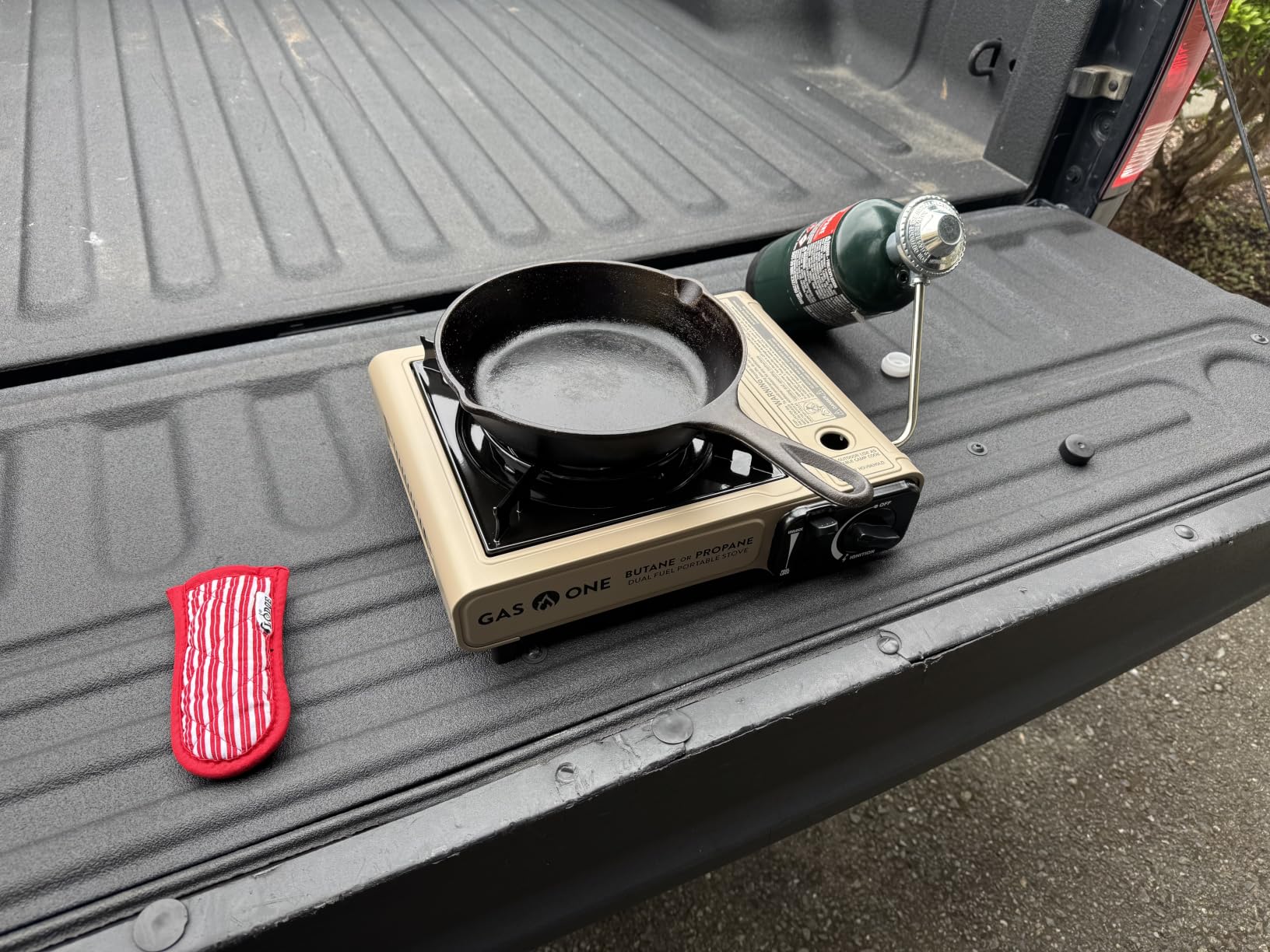
The Gas One GS-3400P earns our top pick for its rare combination of versatility, performance, and value. This dual-fuel stove accepts both propane and butane canisters, giving you the flexibility to use whichever fuel is available or most affordable at your destination. In an era where fuel prices fluctuate and availability varies by region, this adaptability is genuinely useful rather than just a marketing gimmick.
Setup is refreshingly simple — twist the canister onto the base, turn the knob, and ignite. The built-in piezo igniter works reliably in dry conditions, though we’d recommend keeping a backup lighter handy for damp mornings (a tip that applies to any stove with an integrated igniter). Once lit, the GS-3400P puts out a solid 7,650 BTUs, which is enough to boil a liter of water in about three and a half minutes. That’s competitive with stoves that cost significantly more.
The flame control deserves special mention. Unlike many budget stoves that offer only a crude high/low binary, the GS-3400P provides genuinely usable simmer control. We successfully made scrambled eggs without burning them — a test that many camp stoves fail spectacularly. The stainless steel body feels solid, the pot supports are stable even with larger cookware, and the whole unit fits neatly in a carrying case that’s surprisingly compact for a stove of this capability.
✅ Pros
- Dual-fuel compatibility (propane + butane) is genuinely useful
- Excellent simmer control for a stove at this price
- Sturdy build with stainless steel construction
- Built-in piezo igniter works well
- Compact carrying case included
- Great value for the feature set
❌ Cons
- Piezo igniter may fail in very humid conditions
- Single burner limits cooking options
- Not the lightest option for backpacking
- Wind guard could be taller
Score Breakdown
Heat Output:
Fuel Efficiency:
Build Quality:
Ease of Use:
Value for Money:
Get the Gas One GS-3400P
The most versatile camping stove we tested — handles propane and butane with ease.
Buy on Amazon2Coleman Triton — Best Two-Burner for Families
Best Value
The Coleman Triton is the workhorse of car camping stoves. If you’ve ever gone camping with family or friends, chances are you’ve seen a Coleman two-burner on the picnic table. The Triton continues that legacy with a refined design that balances power, simplicity, and affordability. With two burners delivering a combined 22,000 BTUs, this stove can handle real cooking — not just boiling water.
We regularly cooked full breakfasts on the Triton: bacon on one burner, eggs on the other, and a pot of coffee percolating on the side. The two independent burners give you real multitasking ability, and the wind-blocking panels do a decent job of shielding the flames from moderate gusts. The Instastart ignition means you don’t need matches, and the chrome-plated grate is easy to wipe down after meals.
Where the Triton really shines is in its predictability. Coleman has been making these stoves for decades, and the design has been refined to the point where there are very few surprises. Replacement parts are widely available, the propane canisters are sold everywhere, and the cooking performance is consistent from one trip to the next. It’s not exciting, but it’s exactly what you want when you’re cooking for a group in the wilderness.
✅ Pros
- Two burners with independent controls for real cooking
- Excellent wind-blocking design
- Instastart ignition works reliably
- Easy to clean chrome-plated grate
- Decades of proven reliability
- Widely available replacement parts
❌ Cons
- Heavier and bulkier than single-burner options
- Requires dedicated carrying space in a vehicle
- Propane canisters can be hard to recycle
- Limited simmer control — better for boiling than sauteing
Score Breakdown
Heat Output:
Fuel Efficiency:
Build Quality:
Ease of Use:
Value for Money:
3Jetboil Flash — Fastest Boil Time
Premium Pick
The Jetboil Flash is the Formula One car of camping stoves — engineered for one thing and doing it better than almost anything else on the market. That one thing is boiling water, fast. Jetboil claims a 100-second boil time for one liter of water, and in our testing, we consistently hit times between 90 and 110 seconds. Nothing else we tested came close.
The secret is Jetboil’s FluxRing technology — a finned heat exchanger that wraps around the bottom of the included cooking cup. This design dramatically increases the surface area exposed to the flame, extracting far more heat from each canister of fuel than a traditional burner. The result is blazing speed and exceptional fuel efficiency. You’ll use fewer canisters over time, which partially offsets the higher upfront cost.
The Flash is an integrated system, meaning the burner and cooking vessel are designed to work together. The 1.0-liter cup snaps onto the burner with a satisfying click, the insulated cozy keeps your food warm, and the color-changing heat indicator tells you when water is ready without you having to stare at it. Setup takes about 10 seconds. Breakdown takes about 15. It’s the most streamlined cooking experience we’ve ever had in the backcountry.
The limitations are worth noting. This is a single-purpose system — it excels at boiling water for dehydrated meals, coffee, and oatmeal, but it’s not great for cooking actual meals. The narrow cup isn’t ideal for frying or simmering, and the heat control is less precise than a traditional stove. But for its intended purpose, it’s unmatched.
✅ Pros
- Insane boil speed — under 2 minutes consistently
- Exceptional fuel efficiency saves money on canisters
- Integrated system is incredibly compact and lightweight
- Color-change indicator is clever and useful
- Push-button ignition is reliable
- Insulated cup keeps food and drinks warm
❌ Cons
- Designed primarily for boiling water, not general cooking
- Narrow cup limits cooking versatility
- Integrated design means you can’t use other pots
- Premium price tag for a single-burner system
- Requires specific Jetboil accessories
Score Breakdown
Heat Output:
Fuel Efficiency:
Build Quality:
Ease of Use:
Value for Money:
Get the Jetboil Flash
The fastest boiling camping stove on the market — perfect for backcountry coffee lovers.
Buy on Amazon4MSR PocketRocket 2 — Best Ultralight Stove
Ultralight Champion
At just 2.6 ounces, the MSR PocketRocket 2 is almost impossibly small and light. It screws directly onto an isobutane canister, unfolds three pot supports, and you’re ready to cook. That’s it. There’s no case, no accessories, no learning curve — just a tiny piece of engineering brilliance that’s been a backpacker’s favorite for years.
Don’t let the size fool you. The PocketRocket 2 puts out 8,200 BTUs, which is enough to boil a liter of water in about three and a half minutes. That’s remarkably fast for something that weighs less than a deck of cards. The three-pronged pot supports fold out to create a stable platform for small to medium pots, and the simmer control is precise enough for real cooking — not just boiling.
We’ve used the PocketRocket 2 on multi-day backpacking trips, and it consistently impresses. The piezo igniter works well in dry conditions, though we recommend carrying a backup lighter for wet weather. The stove fits inside most 1-liter pots along with a small fuel canister, creating a complete cooking kit that weighs under a pound. For weight-conscious backpackers, this is the gold standard.
One thing to keep in mind: isobutane canisters don’t perform well in extreme cold. If you’re winter camping at high elevations, you’ll want to look at the MSR WhisperLite Universal on our list, which handles liquid fuel as well. But for three-season backpacking, the PocketRocket 2 is nearly perfect.
✅ Pros
- Incredibly lightweight at just 2.6 ounces
- Folds down to fit inside a 1-liter pot
- Strong output for its size — 8,200 BTU
- Excellent simmer control
- Very affordable price point
- Proven reliability over thousands of trips
❌ Cons
- Small pot supports can feel wobbly with larger cookware
- Piezo igniter can be finicky in wet conditions
- Isobutane canisters are not the most eco-friendly
- Struggles in extreme cold weather
Score Breakdown
Heat Output:
Fuel Efficiency:
Build Quality:
Ease of Use:
Value for Money:
Get the MSR PocketRocket 2
Ultralight performance at a price that won’t break the bank — the backpacker’s go-to.
Buy on Amazon5Camp Chef Everest 2X — Best Premium Two-Burner
Premium Pick
If the Coleman Triton is the family sedan of camping stoves, the Camp Chef Everest 2X is the luxury SUV. This is a serious cooking machine designed for people who want to replicate their home kitchen experience at the campsite. With a massive 40,000 BTU output across two high-performance burners, the Everest 2X can handle anything from searing steaks to simmering delicate sauces.
The build quality immediately sets it apart from cheaper alternatives. The stainless steel construction feels premium in hand, the matchless ignition system fires up consistently, and the three-sided windscreen keeps your flames stable even on blustery days. Each burner has independent temperature control, and the range from full blast to a gentle simmer is impressively wide.
We tested the Everest 2X at a family campsite where we cooked everything from pancakes to stir-fry, and it performed flawlessly. The large cooking surface accommodates full-size pots and pans, making it possible to cook a proper meal for four to six people without feeling cramped. The griddle compatibility (sold separately) opens up even more cooking possibilities.
The main trade-off is portability. At 12 pounds, this isn’t a stove you’ll be throwing in a backpack. But for car camping, RV trips, and basecamp setups where cooking performance matters more than weight, the Everest 2X is in a league of its own. If you enjoy cooking in the outdoors and want the best two-burner experience available, this is it.
✅ Pros
- Massive 40,000 BTU output across two burners
- Premium stainless steel build quality
- Excellent wind protection with three-sided screen
- Wide simmer range for versatile cooking
- Griddle-compatible for expanded cooking options
- Matchless ignition system works reliably
❌ Cons
- Heavy at 12 lbs — car camping only
- Higher price point than the Coleman Triton
- Takes up significant storage space
- Propane hose connection can be tricky in cold weather
Score Breakdown
Heat Output:
Fuel Efficiency:
Build Quality:
Ease of Use:
Value for Money:
Get the Camp Chef Everest 2X
Restaurant-grade heat output for campsite chefs who demand the best.
Buy on Amazon6BioLite CampStove 2+ — Most Innovative Design
Most Innovative
The BioLite CampStove 2+ is unlike anything else on this list — or in the camping world, for that matter. It’s a wood-burning stove that generates electricity from its own heat, allowing you to charge phones, lights, and other USB devices while you cook. It’s the kind of product that makes you wonder why nobody thought of it sooner.
The concept is elegantly simple. You feed twigs, sticks, and other biomass into the combustion chamber, and the heat creates airflow through an internal fan. That airflow generates a thermoelectric charge, which powers the integrated 2,200mAh battery and USB output port. The result is a stove that never needs a fuel canister — you’re literally cooking with whatever you can find on the forest floor.
In practice, the CampStove 2+ works well for what it is, but it comes with caveats. Boiling water takes longer than with gas stoves — we averaged about 5 minutes for a liter. You need to continuously feed it small sticks to maintain a consistent flame, which can be time-consuming if you’re trying to cook quickly. And in wet conditions, finding dry fuel becomes a challenge.
Where this stove truly shines is in off-grid situations. If you’re camping somewhere without access to fuel canisters, or if you want to reduce your reliance on disposable propane bottles, the CampStove 2+ is genuinely useful. The USB charging feature is more than a novelty — we charged our phone from 20% to 80% during a single cooking session. The integrated LED firelight on the base provides ambient lighting, and the whole system packs down surprisingly small.
For most campers, the CampStove 2+ will be a secondary stove rather than a primary one. But for ultralight backpackers, bushcraft enthusiasts, and anyone interested in sustainable camping technology, it’s a fascinating piece of gear that pushes the boundaries of what a camping stove can be.
✅ Pros
- Fuel-free operation using sticks and biomass
- USB charging from heat is genuinely useful
- Sustainable and eco-friendly design
- Built-in LED firelight for ambient lighting
- Integrated 2,200mAh battery stores charge
- Unique and conversation-starting design
❌ Cons
- Slower boil times compared to gas stoves
- Requires continuous fuel feeding
- Harder to use in wet or windy conditions
- More complex cleaning and maintenance
- Limited flame control for precise cooking
- Higher price for the technology involved
Score Breakdown
Heat Output:
Fuel Efficiency:
Build Quality:
Ease of Use:
Value for Money:
Get the BioLite CampStove 2+
Cook with sticks and charge your phone — the future of camping stoves is here.
Buy on Amazon7MSR WhisperLite Universal — Best Multi-Fuel Stove
Expedition Grade
The MSR WhisperLite Universal is the stove you pack when failure is not an option. Designed for expeditions, international travel, and extreme conditions, this multi-fuel stove can burn white gas, kerosene, unleaded auto fuel, and isobutane-propane canisters. That versatility makes it the most reliable camping stove in the world — no matter where you are or what fuel is available, this stove will keep you fed.
The WhisperLite name comes from its remarkably quiet operation. Unlike many liquid fuel stoves that roar like a jet engine, the WhisperLive produces a soft, steady hiss that’s almost meditative. But don’t mistake quiet for weak — with 10,200 BTUs of output, it boils a liter of water in about three and a half minutes on white gas. The performance is impressive for something that weighs just 11.2 ounces.
The dual-fuel capability is the real story here. The stainless steel and aluminum construction is built to withstand years of hard use, and the field-serviceable design means you can clean and maintain the stove without specialized tools. MSR’s Shaker Jet technology makes cleaning the fuel line simple — just shake the stove and the built-in cleaning needle clears any blockages.
The learning curve is steeper than canister stoves. You’ll need to prime the stove by preheating the fuel line, which takes a bit of practice. And you’ll need to carry liquid fuel in a separate bottle, which adds weight and complexity. But for winter camping, high-altitude expeditions, and international travel where isobutane canisters might not be available, the WhisperLite Universal is irreplaceable.
If you’re heading out for a winter camping adventure, this stove pairs perfectly with a warm tent setup and a reliable set of tent stakes to handle harsh conditions.
✅ Pros
- Burns virtually any liquid fuel available worldwide
- Excellent cold-weather performance
- Field-serviceable design for easy maintenance
- Remarkably quiet operation for a liquid fuel stove
- Dual-fuel capability with canister adapter included
- Built to expedition-grade standards
❌ Cons
- Requires priming — steeper learning curve
- More complex setup than canister stoves
- Requires carrying liquid fuel bottles
- Higher upfront cost
- Needs regular maintenance for optimal performance
Score Breakdown
Heat Output:
Fuel Efficiency:
Build Quality:
Ease of Use:
Value for Money:
Get the MSR WhisperLite Universal
The expedition-grade stove that burns anything, anywhere — the last stove you’ll ever need.
Buy on AmazonHead-to-Head: The Ultimate Stove Showdowns
Choosing between two great stoves can be agonizing. To make your decision easier, we’ve broken down the most common head-to-head matchups and explained exactly when each stove wins — and why.
Gas One GS-3400P vs. Coleman Triton
This is the most common decision for car campers who want a single-burner versus a two-burner setup. The Gas One GS-3400P wins on versatility — its dual-fuel capability means you can use whichever canister type is cheapest or most available. It also has better simmer control, making it better for actual cooking rather than just boiling. The Coleman Triton wins on capacity — two burners mean you can cook two things simultaneously, which is invaluable when cooking for more than two people. If you camp solo or as a couple, the Gas One is the better choice. For families and groups, the Coleman Triton is the way to go.
Jetboil Flash vs. MSR PocketRocket 2
This is the classic speed-versus-versatility debate. The Jetboil Flash boils water faster than anything we’ve tested — it’s not even close. If your camping meals are primarily dehydrated food and instant coffee, the Flash is the superior tool. The MSR PocketRocket 2 is lighter, more versatile, and more affordable. It works with any pot or pan, giving you real cooking flexibility. The Flash is a specialized tool that excels at one job. The PocketRocket is a generalist that does many jobs well. For ultralight backpackers who cook real meals, the PocketRocket wins. For fast-and-light hikers who just need hot water, the Flash wins.
Camp Chef Everest 2X vs. Coleman Triton
Both are two-burner propane stoves, but they’re designed for different levels of cooking seriousness. The Camp Chef Everest 2X has nearly double the total BTU output (40,000 vs. 22,000), better wind protection, and superior build quality. It’s the choice for people who genuinely enjoy cooking and want performance that approaches a home kitchen. The Coleman Triton is the practical choice for families who want reliable two-burner cooking without the premium price. It does everything most people need at the campsite, and the money you save can go toward other gear. If cooking is a hobby, get the Everest. If cooking is a task, get the Triton.
MSR PocketRocket 2 vs. MSR WhisperLite Universal
Both are made by MSR, but they serve completely different purposes. The PocketRocket 2 is an ultralight canister stove designed for three-season backpacking where weight is the primary concern. The WhisperLite Universal is an expedition-grade multi-fuel stove designed for extreme conditions where fuel availability is uncertain. The PocketRocket weighs 2.6 ounces; the WhisperLite weighs 11.2 ounces. The PocketRocket uses only isobutane canisters; the WhisperLite burns white gas, kerosene, auto fuel, and isobutane. Choose the PocketRocket for everyday backpacking. Choose the WhisperLite for winter camping, international travel, and situations where you need guaranteed stove performance regardless of conditions.
BioLite CampStove 2+ vs. Any Canister Stove
The BioLite is in a category of its own. No canister stove can generate electricity, and no wood-burning stove offers USB charging. But comparing their cooking performance reveals important trade-offs. Canister stoves are faster to boil, more consistent in output, easier to use, and work in all weather conditions. The BioLite requires fuel gathering, takes longer to boil, and needs continuous feeding. However, the BioLite never needs fuel canisters, is more sustainable, and provides electricity from waste heat. The BioLite is best viewed as a complementary stove rather than a replacement. Keep a canister stove as your primary cooking tool and use the BioLite for supplemental charging and eco-friendly cooking when conditions allow.
Camping Stove Price Guide — What to Expect at Every Budget
Camping stoves range from budget-friendly options under $30 to premium systems that cost $300 or more. Understanding what you get at each price point helps you set realistic expectations and find the best value for your needs.
Budget Tier ($20 – $50)
At this price range, you’ll find basic single-burner canister stoves and simple alcohol stoves. These stoves get the job done — they boil water and can cook basic meals — but they typically lack refined simmer control, reliable ignition systems, and durable construction. The MSR PocketRocket 2 sits at the top of this range and punches well above its weight class, offering build quality and performance that rivals stoves costing twice as much. If you’re new to camping or on a tight budget, a stove in this range is a perfectly reasonable starting point.
Mid-Range ($50 – $100)
The mid-range is where you’ll find the best balance of features, quality, and value. Stoves in this range offer better simmer control, more reliable ignition, sturdier construction, and often include useful accessories like carrying cases and wind guards. The Gas One GS-3400P and Coleman Triton both fall into this category and represent the sweet spot for most campers. You get genuinely good cooking performance without paying the premium for expedition-grade materials or cutting-edge technology.
Premium Tier ($100 – $200)
Premium camping stoves offer significant upgrades in build quality, performance, and features. You’ll find better materials (stainless steel, titanium), more precise flame control, faster boil times, and more thoughtful design details. The Jetboil Flash and Camp Chef Everest 2X occupy this space and deliver experiences that justify their higher price. These stoves are for campers who have moved past the “will this work?” stage and are now asking “how well does this work?” If you camp regularly and appreciate quality gear, investing in a premium stove pays dividends over years of reliable service.
Expedition Tier ($200+)
At the top of the market, you’ll find expedition-grade stoves designed for the most demanding conditions on Earth. The MSR WhisperLite Universal and BioLite CampStove 2+ fall into this category for different reasons — the WhisperLite for its unparalleled fuel versatility and cold-weather performance, the BioLite for its innovative thermoelectric charging technology. These are specialized tools for specific needs. Unless you’re planning winter expeditions, international travel, or off-grid adventures, a mid-range stove will serve you better and cost less.
Camping Stove Fuel Types — What You Need to Know
Understanding fuel types is just as important as choosing the right stove. Each fuel type has its own advantages, limitations, and ideal use cases. Here’s a breakdown to help you make an informed decision.
| Fuel Type | Boil Speed | Cold Weather | Weight | Availability | Best For |
|---|---|---|---|---|---|
| Isobutane Canister | Fast | Moderate | Light | Outdoor stores | Backpacking, 3-season use |
| Propane | Fast | Excellent | Heavy | Everywhere | Car camping, basecamps |
| Butane | Moderate | Poor | Light | Most stores | Indoor/calm conditions |
| White Gas | Fast | Excellent | Moderate | Outdoor stores | Winter, expeditions |
| Kerosene | Moderate | Good | Moderate | Global | International travel |
| Wood/Biomass | Slow | Depends on wood | Free | Everywhere | Survival, eco-camping |
Isobutane Canisters
Isobutane-propane blend canisters are the most popular fuel for backpacking stoves. They’re lightweight, easy to use, and ignite with a simple twist-and-click. The main drawback is performance in cold weather — as temperatures drop below freezing, the pressure inside the canister decreases, reducing output. If you’re camping in winter, you’ll want a liquid fuel stove instead.
Propane
Propane is the fuel of choice for car camping stoves like the Coleman Triton and Camp Chef Everest. The familiar green 1-lb bottles are sold everywhere, and propane performs exceptionally well in cold weather. The downside is weight and bulk — propane canisters are heavier than isobutane, and the 1-lb bottles are single-use, creating waste.
Multi-Fuel (White Gas / Kerosene)
Multi-fuel stoves like the MSR WhisperLite Universal are the most versatile option. They can burn white gas, kerosene, unleaded auto fuel, and even isobutane with an adapter. This makes them ideal for international travel where specific fuel types might not be available. The trade-off is a steeper learning curve and the need to carry fuel in separate bottles.
How to Choose the Best Camping Stove for Your Needs
With so many options on the market, choosing the right camping stove comes down to matching the stove to your specific camping style. Here are the key factors to consider before making your purchase.
1. How Will You Camp?
The most important factor is your camping style. Car campers who drive to a site and set up a basecamp have no weight restrictions and should prioritize cooking performance, burner count, and ease of use. Backpackers need to balance weight, pack size, and fuel efficiency. Winter campers need stoves that perform in freezing temperatures. Match the stove to how you actually camp, not how you imagine camping.
2. Number of Burners
Single-burner stoves are lighter, more compact, and cheaper — ideal for solo campers and backpackers. Two-burner stoves offer real multitasking ability, letting you boil water and cook food simultaneously. If you regularly cook for more than two people, a two-burner stove will make your campsite cooking experience dramatically more enjoyable. For solo adventurers, a sturdy tent and a single-burner stove are all you need.
3. Weight and Pack Size
If it’s going in your backpack, every ounce matters. Ultralight stoves like the MSR PocketRocket 2 weigh under 3 ounces and pack into tiny spaces. Car camping stoves can weigh 10+ pounds without concern. Be honest about your weight sensitivity — it’s better to carry a slightly heavier stove that meets your needs than a featherweight stove that frustrates you.
4. Fuel Availability and Cost
Consider where you’ll be camping and what fuel is available. Isobutane canisters are widely available in outdoor stores but harder to find in remote areas. Propane bottles are sold at gas stations and grocery stores everywhere. If you’re camping internationally, a multi-fuel stove that burns kerosene or unleaded auto fuel gives you the most flexibility.
5. Simmer Control
If you want to do more than boil water — if you want to saute vegetables, scramble eggs, or simmer a pasta sauce — simmer control is essential. Many stoves offer only crude temperature control, jumping from full blast to off. Stoves with precise simmer valves, like the Gas One GS-3400P and MSR PocketRocket 2, give you the heat range needed for real cooking.
6. Wind Resistance
Wind is the enemy of campsite cooking. It steals heat, wastes fuel, and makes boiling times unpredictable. Look for stoves with built-in wind guards or windshields. Two-burner stoves like the Coleman Triton and Camp Chef Everest have natural wind protection from their folding lid design. Single-burner stoves may need aftermarket wind screens.
7. Ignition System
Built-in piezo igniters are convenient but can fail, especially in wet conditions. We recommend always carrying a backup lighter or waterproof matches regardless of which stove you choose. Some expedition-grade stoves like the WhisperLite use manual ignition, which is more reliable but requires a bit more skill.
8. Ease of Cleaning
Camping stoves get dirty — that’s inevitable. But some are much easier to clean than others. Removable grates, non-stick surfaces, and accessible burner heads make post-meal cleanup faster. If you hate cleaning (and who doesn’t?), prioritize stoves with wipe-clean surfaces and simple designs.
Solo backpacker? MSR PocketRocket 2 — ultralight and affordable.
Fast boiling for dehydrated meals? Jetboil Flash — nothing is faster.
Family car camping? Coleman Triton — reliable two-burner workhorse.
Serious outdoor cook? Camp Chef Everest 2X — premium performance.
Versatile single-burner? Gas One GS-3400P — best overall value.
Off-grid / eco camping? BioLite CampStove 2+ — innovative and sustainable.
Extreme conditions? MSR WhisperLite Universal — goes anywhere, burns anything.
Common Camping Stove Mistakes to Avoid
Even experienced campers make stove-related mistakes that waste fuel, create frustration, or even pose safety risks. Here are the most common pitfalls we’ve observed — and how to avoid them.
Using the Wrong Pot Size
One of the most overlooked factors in camp stove efficiency is pot size relative to the burner. A tiny burner under a large pot wastes enormous amounts of heat around the edges. Conversely, a large burner under a small pot wastes fuel by heating air instead of your food. Match your pot size to your burner for maximum efficiency. For single-burner stoves, a 1-liter pot is ideal for solo use, while a 1.5-liter pot works well for two people. For two-burner stoves, use pots that cover the burner without extending more than an inch beyond the flame radius.
Ignoring Altitude Adjustments
At higher elevations, lower air pressure means less oxygen available for combustion. This causes stoves to burn less efficiently, with reduced flame temperature and longer boil times. Above 5,000 feet, you’ll notice a decrease in performance. Above 10,000 feet, the effect is significant. To compensate, use a slightly larger pot, allow more time for boiling, and be patient with simmer control. Liquid fuel stoves like the MSR WhisperLite handle altitude better than canister stoves because their pressurized fuel delivery system is less affected by ambient air pressure changes.
Storing Fuel Improperly
Fuel storage is both a safety issue and a performance issue. Propane and butane canisters should never be stored in direct sunlight, in a hot car, or near heat sources. Excessive heat can cause dangerous pressure buildup. Conversely, storing fuel in extreme cold doesn’t damage the canister but does reduce its immediate output — warm the canister in your hands or sleeping bag before use in cold weather. Liquid fuels should be stored in approved containers, away from ignition sources, and never in living spaces.
Not Testing Before the Trip
We’ve said it before, but it bears repeating: always test your stove at home before heading into the wilderness. A five-minute test burn at home can prevent a cold, frustrating dinner at camp. Check that the igniter works, the flame is clean and blue (yellow flames indicate incomplete combustion), the simmer control responds smoothly, and all connections are tight. If anything seems off, now is the time to fix it — not when you’re miles from the nearest store.
Cooking With the Wrong Fuel
Always use the fuel type your stove is designed for. Using the wrong fuel can damage the stove, create safety hazards, and produce poor cooking results. Isobutane canister stoves need isobutane-propane blend canisters. Propane stoves need propane bottles. Liquid fuel stoves need the specific fuel type they’re calibrated for (white gas, kerosene, etc.). Never mix fuel types unless your stove explicitly supports it with the proper adapter and configuration. If you’re unsure, consult the stove’s manual or contact the manufacturer.
Forgetting About Ventilation
Burning any fuel produces combustion byproducts, including carbon monoxide — an odorless, colorless gas that can be lethal in enclosed spaces. Never use a combustion stove inside a tent, enclosed vehicle, or any space without adequate ventilation. Even open tent vestibules can accumulate dangerous levels of CO if the ventilation is poor. Always set up your cooking area in the open air, with at least several feet of clear space around the stove. This is the most important safety rule in camping stove use, and there are zero exceptions.
Overlooking Fuel Canister Disposal
Empty fuel canisters are not regular trash. Isobutane and propane canisters are pressurized containers that require proper disposal. Most outdoor retailers accept empty canisters for recycling. Never puncture or incinerate a canister — even “empty” ones can contain residual fuel that can ignite. Check with your local waste management facility for canister recycling options in your area. Some communities have special collection events for pressurized containers.
Camping Stove Care and Maintenance Tips
A well-maintained camping stove can last for decades. A neglected one will fail when you need it most. Here’s how to keep your stove performing at its best.
After Every Trip
- Wipe down the stove body with a damp cloth to remove grease and food residue
- Clean the burner head with a soft brush to remove any debris or spider webs
- Check the fuel line and connections for any signs of wear or damage
- For canister stoves, detach the canister before storing
- For liquid fuel stoves, empty the fuel bottle and run a small amount of fuel through the system to keep the line clean
Seasonal Maintenance
- Inspect O-rings and seals for cracks or hardening — replace as needed
- Clean or replace the jet/nozzle if you notice reduced flame or uneven heating
- Lubricate pump cup on liquid fuel stoves with a small amount of fuel-grade lubricant
- Check pot supports for warping or loose connections
- For wood-burning stoves like the BioLite, clean the ash chamber thoroughly
Storage Tips
- Store your stove in a dry location to prevent rust and corrosion
- Keep fuel canisters and bottles away from heat sources and direct sunlight
- For long-term storage, slightly loosen the fuel cap on liquid fuel bottles to prevent pressure buildup
- Use the original carrying case or a dedicated bag to protect the stove during transport
- Never store a stove with fuel still in the lines or bottle
Camp Cooking Tips From Our Testers
After spending hundreds of hours cooking on camping stoves in every condition imaginable, our team has gathered a wealth of practical tips that can elevate your camp cooking game. These aren’t just theoretical suggestions — they’re hard-won lessons from the field that will help you cook better meals with less frustration.
Prep at Home, Cook at Camp
One of the biggest mistakes new campers make is doing all their food preparation at the campsite. Chopping vegetables, measuring spices, and marinating proteins at home saves enormous amounts of time and reduces the amount of gear you need to bring. Pre-cut vegetables in zip-lock bags, pre-mixed spice blends in small containers, and pre-marinated meats in sealed bags all make camp cooking faster and more enjoyable. This is especially important when you’re using a single-burner stove where efficiency matters.
Master the One-Pot Meal
One-pot meals are the holy grail of camp cooking. They minimize cleanup, reduce the number of pots and pans you need to carry, and work perfectly on single-burner stoves. Chili, pasta with pre-made sauce, stir-fry with instant rice, soup with pre-chopped vegetables — all of these can be cooked in a single pot with delicious results. The key is adding ingredients in the right order: hardest vegetables first, softer ingredients later, and delicate items like fresh herbs at the very end.
Bring More Fuel Than You Think
Running out of fuel mid-cook is one of the most common camping stove mistakes. Always bring more fuel than your planned cooking requires — at least 50% more. This accounts for windy conditions (which increase fuel consumption), failed cooking attempts that require starting over, and the simple fact that cooking at altitude uses more fuel than cooking at sea level. For weekend car camping trips, we recommend bringing at least two 1-lb propane bottles per burner per day of cooking.
Learn to Love Cast Iron
If you car camp, cast iron cookware is a game-changer. A cast iron skillet heats evenly, retains heat beautifully, and can go from the stove directly to the campfire coals. Steaks sear better in cast iron, cornbread bakes perfectly, and even pancakes turn out great. The only downside is weight, but when you’re cooking from a vehicle, that doesn’t matter. A 10-inch cast iron skillet and a Dutch oven give you the ability to cook virtually anything at the campsite.
Don’t Forget the Sides
Most camp cooking guides focus on main courses, but side dishes are what elevate a camp meal from adequate to memorable. Pre-made coleslaw, fresh fruit salad, store-bought hummus with crackers, and simple green salads all complement camp stove cooking without requiring additional burner time. Having cold sides ready means you can focus your stove time on the main event while still serving a complete, satisfying meal.
Practice Before You Go
This tip is especially important for first-time camp stove owners. Set up your stove at home and cook a meal on it before your trip. This helps you understand the flame control, learn the ignition process, and identify any issues before you’re in the wilderness. We’ve seen too many campers struggle with new stoves at the campsite because they assumed it would work the same as their kitchen stove. A 20-minute practice session at home can save hours of frustration at camp.
Wind Matters More Than You Think
Even a light breeze can dramatically increase boil times and fuel consumption. If you don’t have a stove with a built-in windscreen, create one using a piece of aluminum foil wrapped around a semi-circle. Position your stove with the wind at your back, and if possible, set up your cooking area behind a natural windbreak like a large rock, log, or the side of your vehicle. This simple step can reduce boil times by 30-40% and save significant amounts of fuel over a multi-day trip.
The Two-Zone Cooking Method
Even on a single-burner stove, you can create effective cooking zones by managing heat distribution. Push your pot to one side of the burner for direct high heat, or center it for even low heat. On two-burner stoves, designate one burner as your high-heat zone for boiling and searing, and the other as your low-heat zone for simmering and keeping food warm. This approach mimics the two-zone cooking technique used by professional chefs and works brilliantly at the campsite.
Frequently Asked Questions About Camping Stoves
What is the best type of camping stove for beginners?
Can I use a camping stove in the rain?
How long does a camping stove fuel canister last?
Are wood-burning camping stoves allowed at campsites?
What’s the difference between a camping stove and a backpacking stove?
Can I cook a full meal on a single-burner camping stove?
Is it safe to use a camping stove inside a tent vestibule?
What should I do if my camping stove won’t light?
How many BTUs do I need in a camping stove?
Can I use a camping stove for emergency preparedness?
What cookware works best with camping stoves?
How do I prevent condensation issues while camping?
Final Verdict — Which Camping Stove Should You Buy?
After testing all seven stoves extensively, here’s our final recommendation. For most campers, the Gas One GS-3400P hits the sweet spot of performance, versatility, and value. Its dual-fuel capability, excellent simmer control, and reasonable price make it the safest all-around choice.
If you’re a backpacker who counts every gram, the MSR PocketRocket 2 is an unbeatable combination of weight, performance, and price. Families who car camp will love the Coleman Triton for its reliable two-burner performance and decades of proven durability. And if you’re a serious outdoor cook who wants the best cooking experience at the campsite, the Camp Chef Everest 2X is worth every penny.
No matter which stove you choose, remember that the best camping stove is the one that matches your camping style, your cooking needs, and your budget. Take the time to consider how you actually camp, and you’ll make the right choice.
Shop the Gas One GS-3400P Shop the MSR PocketRocket 2 Shop the Coleman Triton