Camping Safety Tips: The Complete Guide to a Safer Trip Into the Wild
Everything you need to know before you pitch your tent — from weather prep and fire safety to wildlife encounters, first aid, and emergency planning.
There’s a particular kind of quiet that settles over a campsite once the tent is up, the fire is crackling, and the trail dust has finally started to wash off your hands. That quiet is the whole point of camping — the reason so many of us keep coming back to the woods, the desert, the lakeshore, or the high alpine meadow year after year. But that peaceful evening only happens when the hours before it were spent making smart, deliberate choices. Camping safety isn’t about fear; it’s about preparation that lets you actually relax once you get there.
This guide walks through every layer of camping safety that matters, whether you’re heading out for a single night at a drive-up campground or a multi-day trip deep into the backcountry. We’ll cover planning, weather, campsite selection, fire management, wildlife, water, first aid, navigation, gear, group and family safety, and what to do if something actually goes wrong. Consider it the checklist you wish someone had handed you before your first trip.
1. Camping Safety Fundamentals: The Mindset Before the Gear
Before diving into checklists and gear lists, it helps to understand the underlying philosophy of camping safety. Most outdoor incidents aren’t caused by a single dramatic failure — a bear attack, a flash flood, a lightning strike. They’re caused by a slow accumulation of small oversights: skipping the weather check, underestimating a hike’s distance, forgetting to tell anyone your route, packing the first aid kit but never actually opening it to see what’s inside. Layered together, those small gaps are what turn a minor hiccup into a real emergency.
The single most useful habit you can build is what search-and-rescue teams call “situational awareness” — constantly asking yourself what could go wrong here, and what you’d do about it. This doesn’t mean camping anxiously. It means glancing at the sky and thinking about shelter before the clouds roll in, noticing where the nearest water source is before you’re thirsty, and knowing roughly how far you are from the trailhead before your legs are too tired to get back.
The Three Pillars of Camping Safety
Nearly every camping safety practice falls under one of three categories: prevention, preparation, and response. Prevention is everything you do to avoid a problem in the first place — checking forecasts, scouting a site, storing food properly. Preparation is what you carry and know in case prevention fails — first aid supplies, a map, a backup light source. Response is what you actually do in the moment something goes wrong, which is why practicing skills like fire-starting or basic first aid at home, before you need them under pressure, matters so much.
If you’re new to camping altogether, our complete camping guide is a good place to build foundational knowledge before layering on these safety specifics.
Why Experience Level Changes the Equation
A first-time camper and a twenty-year backcountry veteran are, in a very real sense, facing two different sports. The veteran has internalized a thousand small judgment calls — how a certain cloud formation tends to behave in a specific mountain range, how far a “short walk to water” on a map usually turns out to be, which sounds at 2 a.m. are worth investigating and which aren’t. None of that comes from a checklist. It comes from repetition, mistakes made in low-stakes situations, and paying attention afterward.
If you’re newer to camping, the honest move is to deliberately choose lower-consequence trips while you build that judgment. A front-country campground with cell signal, bathrooms, and other campers nearby is not a lesser trip — it’s the correct training ground before a remote, multi-day backcountry route. Skipping that progression is one of the most common root causes behind camping incidents involving inexperienced groups: the trip’s difficulty outpaced the group’s accumulated judgment, not just their gear or their fitness.
Matching the Trip to the Group, Not the Group to the Trip
It’s tempting to plan a trip around a bucket-list location and then figure out logistics afterward. Safer trips work the other way around — you look honestly at your group’s slowest hiker, your least experienced member, your oldest and youngest participants, and you plan the itinerary around what that person can handle comfortably, not what the strongest person in the group could handle if pushed. A trip that leaves your most vulnerable member exhausted, dehydrated, or frightened has already failed at safety, even if nothing “goes wrong” in the dramatic sense.
Building a Personal Risk Tolerance Framework
Every camper, whether they’ve thought about it explicitly or not, operates with an internal risk tolerance — a sense of what level of exposure feels acceptable. Making that framework explicit, even informally, pays off. Ask yourself before a trip: what’s the worst reasonably foreseeable outcome here, and am I genuinely prepared for it, or am I just hoping it doesn’t happen? There’s a meaningful difference between accepting a risk you’ve prepared for and simply not thinking about a risk at all. The former is legitimate outdoor decision-making. The latter is how avoidable incidents happen.

Check Price on Amazon
2. Pre-Trip Planning and Campsite Research
Good camping safety starts days before you leave the driveway. Planning isn’t just about picking a pretty photo off a website — it’s about understanding the terrain, the regulations, the risks specific to that location, and whether your group’s skill level actually matches the trip you’ve chosen.
Research the Location Thoroughly
Look up recent trip reports, not just the official park page. Trip reports from other campers, posted within the last few weeks, tell you about trail closures, high water crossings, recent wildlife activity, or fire restrictions that an official page might not have updated yet. Check whether the area requires permits, has fire bans in effect, or has any seasonal hazards like flash flood zones or avalanche terrain.
Share Your Itinerary
This is one of the cheapest, most effective safety measures that campers skip constantly. Tell a friend or family member exactly where you’re going, which trail or road you’re taking to get there, when you expect to arrive, and when you expect to be back. Include your vehicle’s make, model, and license plate. If you don’t check in by an agreed time, that person should know to contact local authorities. This single step has saved more lost or injured campers than almost any piece of gear.
| Planning Step | Why It Matters | When to Do It |
|---|---|---|
| Check permits & regulations | Avoids fines, ensures site availability | 1–4 weeks before |
| Read recent trip reports | Surfaces hazards not on official pages | 3–7 days before |
| Share itinerary with a contact | Enables rescue if you don’t check in | Day before departure |
| Check fire restrictions | Prevents wildfire risk and citations | 1–2 days before |
| Confirm gear condition | Avoids equipment failure in the field | 2–3 days before |
Once you’ve settled on a destination, it’s worth reviewing our guide on how to choose a campsite so the location itself works in your favor rather than against you.
Building a Realistic Timeline
One of the quieter causes of camping mishaps is simple over-scheduling. A route that looks reasonable on a map — six miles in, set up camp, explore, six miles out the next day — can turn into a rushed, exhausting slog if you underestimate elevation gain, trail conditions, or how much slower a group moves compared to a solo hiker’s pace. Build in buffer time deliberately. If you estimate a hike will take four hours, plan your day assuming five, and treat the extra hour as a bonus rather than a shortfall you’re racing to make up.
Understanding Permit and Regulation Nuances
Permits aren’t just bureaucratic hoops — they often exist because land managers are actively tracking hazard conditions in that area: recent wildlife activity, trail damage, water availability, or fire danger. When you apply for or pick up a permit, take the extra two minutes to actually talk to a ranger or read the posted bulletin board rather than just grabbing your paperwork and moving on. That conversation frequently surfaces information that never makes it onto a website, like a bridge washout or a bear that’s been active near a specific loop trail.
Packing a Trip-Specific Gear List
Generic packing lists are a fine starting point, but the safest approach is to build a list specific to your actual trip: expected temperature swings, water availability along the route, terrain type, and group size. A desert trip and a high-alpine trip share almost nothing in terms of critical gear, even if both are technically “camping.” Cross-reference your planned route against the season and elevation, and adjust clothing layers, water capacity, and shelter accordingly rather than defaulting to whatever worked on your last trip somewhere else.
| Trip Type | Extra Planning Focus |
|---|---|
| Desert camping | Water caching, shade availability, overnight temperature drop |
| Alpine/high elevation | Altitude acclimatization, sudden weather shifts, limited water sources |
| Coastal/lakeside | Tide or water level changes, wind exposure, storm surge risk |
| Dense forest | Navigation difficulty, limited satellite/GPS reception under canopy |
Double-Checking Your Emergency Contact Plan
Beyond simply telling someone your route, spell out exactly what “overdue” means for your trip and what that person should do about it. A vague “call someone if you don’t hear from me” leaves your contact uncertain and hesitant right when speed matters most. Give them a specific time, a specific number to call (park dispatch or local sheriff’s non-emergency line, not just 911 by default if there’s a more direct contact for that area), and the key trip details — route, vehicle description, expected return.

Check Price on Amazon
3. Weather Awareness and Preparedness
Weather is the single most common disruptor of camping trips, and also one of the most predictable dangers if you take the time to actually look. A forecast that says “20% chance of thunderstorms” isn’t a reason to cancel, but it is a reason to plan your campsite, your daily schedule, and your gear around that possibility.
Reading a Mountain or Regional Forecast
Weather in forested, mountainous, or high-desert terrain can shift dramatically within a few miles or a few thousand feet of elevation. Use a forecast source specific to the area, not just the nearest town’s general forecast. Pay close attention to overnight lows, wind speed, and precipitation timing, not just the daily high temperature.
Lightning Safety
Lightning is one of the more underestimated backcountry hazards. If you hear thunder, you’re already within striking range. Avoid open fields, ridgelines, lone tall trees, and bodies of water during a storm. Get to a lower, wooded area away from the tallest objects around you, and spread your group out if you’re together so a single strike can’t affect everyone.
Smart Weather Habits
- Check forecasts the morning of and the night before
- Pack layers even for “warm” forecasts
- Watch the sky, not just your phone
Common Weather Mistakes
- Trusting a forecast checked a week prior
- Ignoring sudden temperature or wind shifts
- Pitching a tent in a low spot prone to flooding
If your trip involves wet conditions, our guides on camping in the rain and how to make a tent waterproof cover practical steps for staying dry and safe when the forecast doesn’t cooperate.
Recognizing Weather Shifts in Real Time
Forecasts get you started, but real-time observation is what keeps you safe once you’re actually out there, especially somewhere signal drops out. A sudden drop in temperature, a shift in wind direction, or towering cumulus clouds building rapidly in the afternoon are all classic precursors to a storm, particularly in mountain environments where afternoon thunderstorms are common in warmer months. Get in the habit of glancing at the sky every 20–30 minutes during exposed sections of a hike, rather than only noticing weather once it’s already arrived.
Heat and Cold as Weather Hazards
Weather safety isn’t only about storms. Extreme heat and extreme cold are both weather-driven hazards that cause more camping-related medical emergencies overall than lightning or flooding. Heat exhaustion can develop over hours of exertion in high temperatures, especially with inadequate water intake, and can progress to heat stroke, a genuine medical emergency, if ignored. Hypothermia, meanwhile, doesn’t require freezing temperatures — it can develop in wet, windy conditions even in the 50s Fahrenheit if a camper is under-layered and exposed for long enough.
| Condition | Early Signs | Response |
|---|---|---|
| Heat exhaustion | Heavy sweating, weakness, nausea, headache | Move to shade, rehydrate, rest, cool the body |
| Heat stroke | Confusion, hot dry skin, very high body temp | Emergency — cool immediately, seek help |
| Hypothermia (mild) | Shivering, clumsiness, slurred speech | Add dry layers, warm drinks, get out of wind |
| Hypothermia (severe) | Shivering stops, confusion, slow breathing | Emergency — warm gradually, seek help immediately |
Wind as an Underrated Hazard
High wind rarely gets the same attention as rain or lightning, but it deserves it. Wind can collapse poorly staked tents, drive down wind chill dramatically even on a mild day, send loose gear tumbling into a fire or off a cliff edge, and dramatically increase wildfire spread risk near an active campfire. If forecasts mention sustained wind above 20–25 mph, reconsider campsite exposure, secure loose items, and lower your fire’s size or skip it altogether.
Adjusting Plans Without Ego
The hardest weather-related skill to build isn’t reading a forecast — it’s actually being willing to change plans because of one. Turning back before a summit, delaying a departure, or relocating camp because clouds look wrong takes a certain amount of humility, especially if you drove hours to get there or coordinated a group’s schedule around the trip. Experienced outdoorspeople consistently describe this willingness to adjust as one of the biggest differentiators between campers who avoid trouble and those who don’t.

Check Price on Amazon
4. Choosing and Setting Up a Safe Campsite
Where you pitch your tent affects nearly every other safety factor on this list — from flooding risk to falling branches to how quickly you could evacuate if needed. Take ten extra minutes at arrival to actually evaluate the site instead of grabbing the first flat spot you see.
Look Up, Down, and Around
Look up for dead branches or “widowmakers” hanging in the canopy above your tent site — these can fall without warning, especially after rain or wind. Look down for signs of water flow, like a slight depression or dry creek bed, which becomes a real hazard during a storm. Look around for animal trails, ant nests, poison ivy, or steep drop-offs nearby.
Distance From Hazards
Set up at least 200 feet from any water source when possible — this reduces the chance of an unexpected water level rise reaching your tent and keeps you out of the path animals use to reach the water at night. Keep a reasonable distance from your fire ring as well, factoring in wind direction and spark drift.
- No dead branches or leaning trees overhead
- Ground is flat, dry, and slightly elevated — not in a low spot
- At least 200 feet from water sources and game trails
- Clear path to a bathroom area and back to the vehicle or trailhead
- Fire ring, if used, is a safe distance from tent and any dry brush
For help finding solid ground even in rocky or uneven terrain, see our breakdown of the best tent stakes for rocky ground, and pair that with our roundup of the best camping tents if you’re due for an upgrade.
Reading the Ground Beneath You
Not all “flat” ground is created equal. Sandy or loose soil can shift under a tent’s stakes during wind, while hard-packed clay can turn into a slick, water-pooling surface during rain. Before committing to a spot, press your palm into the soil and note how it responds — does it feel like it will hold a stake firmly, or does it crumble and shift easily? A slight natural slope, just enough to let water run off rather than pool, is often safer than perfectly flat ground in a low spot.
Wind Exposure and Natural Windbreaks
A site that’s fully exposed to prevailing wind will be miserable and potentially unsafe in a storm, while a site tucked too tightly against dense brush can trap moisture and limit your visibility of approaching weather or wildlife. The safest middle ground is usually a site with a partial natural windbreak — a rock outcrop, a stand of trees at a safe distance, or a gentle rise — without being so enclosed that you lose sightlines.
Setting Up for a Fast Exit
Every campsite should be set up with a “what if I need to leave quickly” mindset baked in, even if you never expect to need it. Keep your vehicle or the trail back to it reasonably close and unobstructed. Store essential items — headlamp, shoes, first aid kit, car keys — in predictable, easy-to-find locations inside the tent, not buried at the bottom of a stuff sack. In the dark, during a stressful moment, fumbling for a headlamp you can’t locate wastes precious time.
- Soil holds stakes firmly and won’t pool water
- Partial windbreak present without blocking visibility
- Vehicle or exit route accessible without obstruction
- Essential items stored in consistent, findable spots
- Site rechecked after dark for hazards not visible in daylight
Reassessing After Dark
A site that looks perfectly safe at 4 p.m. can reveal new information after dark — a nearby animal trail becomes obvious from fresh sounds, a slight slope becomes more noticeable once you’re lying down, or a “sheltered” spot turns out to funnel wind directly at your tent door. It’s worth a short flashlight walk around your immediate site after dinner, checking for anything you missed during initial setup.

Check Price on Amazon
5. Fire Safety at Camp
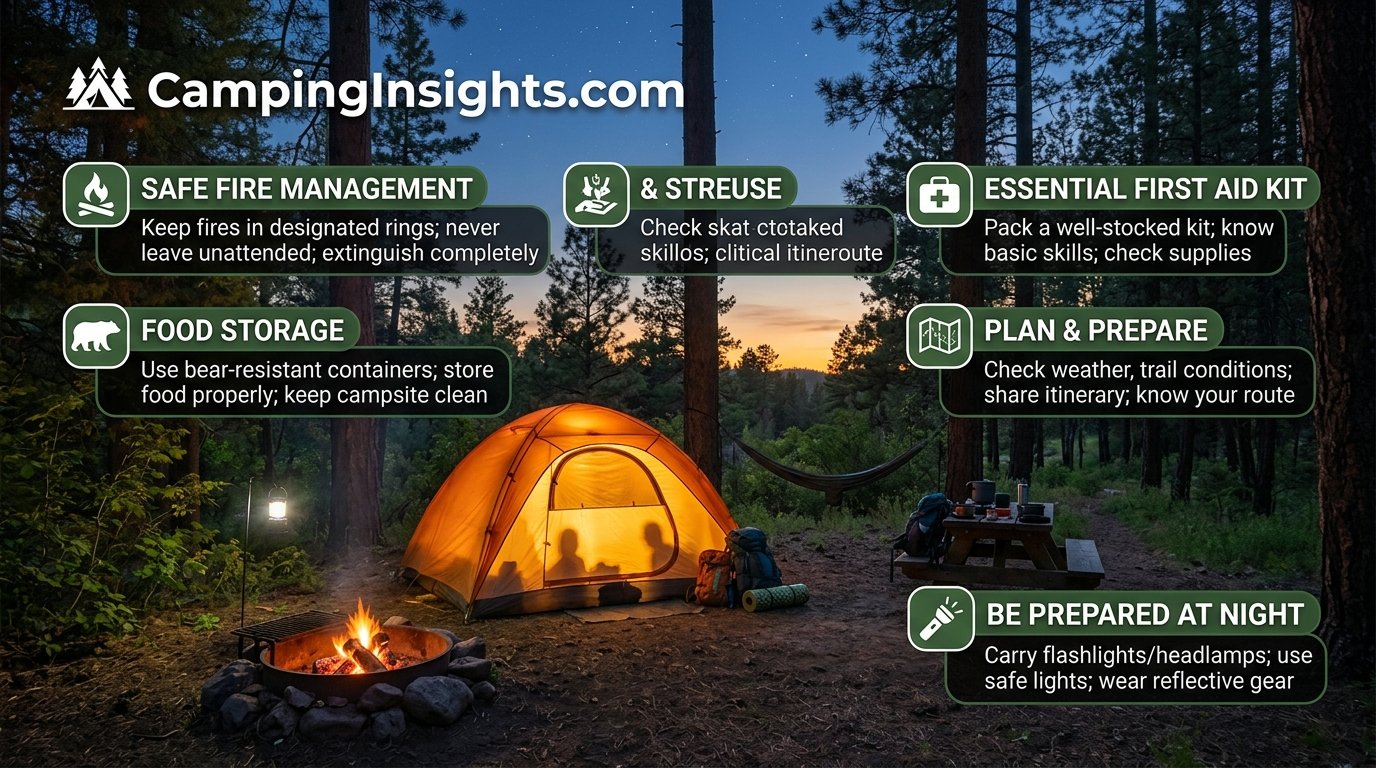
A campfire is one of camping’s great pleasures and also one of its most consistent sources of preventable accidents and wildfires. Responsible fire management is non-negotiable, both for your own safety and for the land you’re camping on.
Know Before You Light
Always check current fire restrictions for the area — many regions impose seasonal bans during dry months, and violating them can carry serious fines, not to mention the very real risk of starting a wildfire. Only build fires in designated fire rings or pits where permitted, and never in high wind conditions.
Fire Management Basics
- Keep a bucket of water or dirt within arm’s reach at all times
- Never leave a fire unattended, even for a few minutes
- Clear a wide radius of leaves, twigs, and dry brush around the fire ring
- Fully extinguish the fire before sleeping or leaving — stir ashes and douse until cool to the touch
- Keep children and pets at a safe distance from flames and hot coals
| Fire Task | How to Do It Safely |
|---|---|
| Starting the fire | Use dry tinder, build gradually, avoid accelerants like fuel |
| Maintaining the fire | Keep it small, never leave it unattended |
| Extinguishing | Drown, stir, drown again — repeat until cold |
If a campfire isn’t practical or permitted, a properly used camping stove is a safer alternative for cooking, and pairs well with ideas from our camping food ideas guide.

Check Price on Amazon
6. Wildlife Safety and Food Storage
Encountering wildlife is part of what makes camping special, but it also carries real risk when animals become habituated to human food. Most dangerous wildlife encounters are the result of improperly stored food, not random bad luck.
Food Storage Rules
Store all food, trash, and scented items — toothpaste, sunscreen, even chapstick — in a bear-proof container or hung from a bear bag at least 100 feet from your tent, ten feet off the ground, and four feet from the trunk or any climbable branch. Never keep food inside your tent, even sealed. Cook and eat away from your sleeping area, ideally 100 yards if the terrain allows.
What to Do If You Encounter Wildlife
Do
- Stay calm, back away slowly
- Make yourself look larger, speak firmly
- Give the animal a clear escape route
Don’t
- Run — it can trigger a chase response
- Approach for a photo
- Leave food or trash accessible, “just this once”
Smaller wildlife matters too — check bedding and boots for insects each morning, and be aware of snake habitat in warmer climates. Our best camping backpack guide covers packs with dedicated, sealed compartments that make scent-proofing food easier on the trail.

Check Price on Amazon
7. Water Safety and Hydration
Water is both a resource you need constantly and a hazard you need to respect, whether it’s a river crossing, a lakeside campsite, or simply your own hydration levels in the heat.
Drinking Water Safety
Never assume backcountry water is safe to drink untreated, no matter how clear it looks. Filter or purify all water from natural sources using a filter, purification tablets, or boiling for at least one minute (three minutes at higher elevations). Carry more water than you think you’ll need, and know where refill points are along your route.
Swimming and Water Crossings
Currents in rivers and lakes can be far stronger than they appear from the bank. Check depth and current before letting kids swim unsupervised, avoid crossing fast-moving water above knee height, and unbuckle backpack straps before any crossing so you can shed weight quickly if you’re swept off your feet.
Wondering why your tent felt damp despite a dry forecast? It’s usually condensation, not a leak — our guide on how to stop condensation in a tent and companion piece why is my tent wet inside explain the difference.

Check Price on Amazon
8. First Aid and Emergency Medical Preparedness
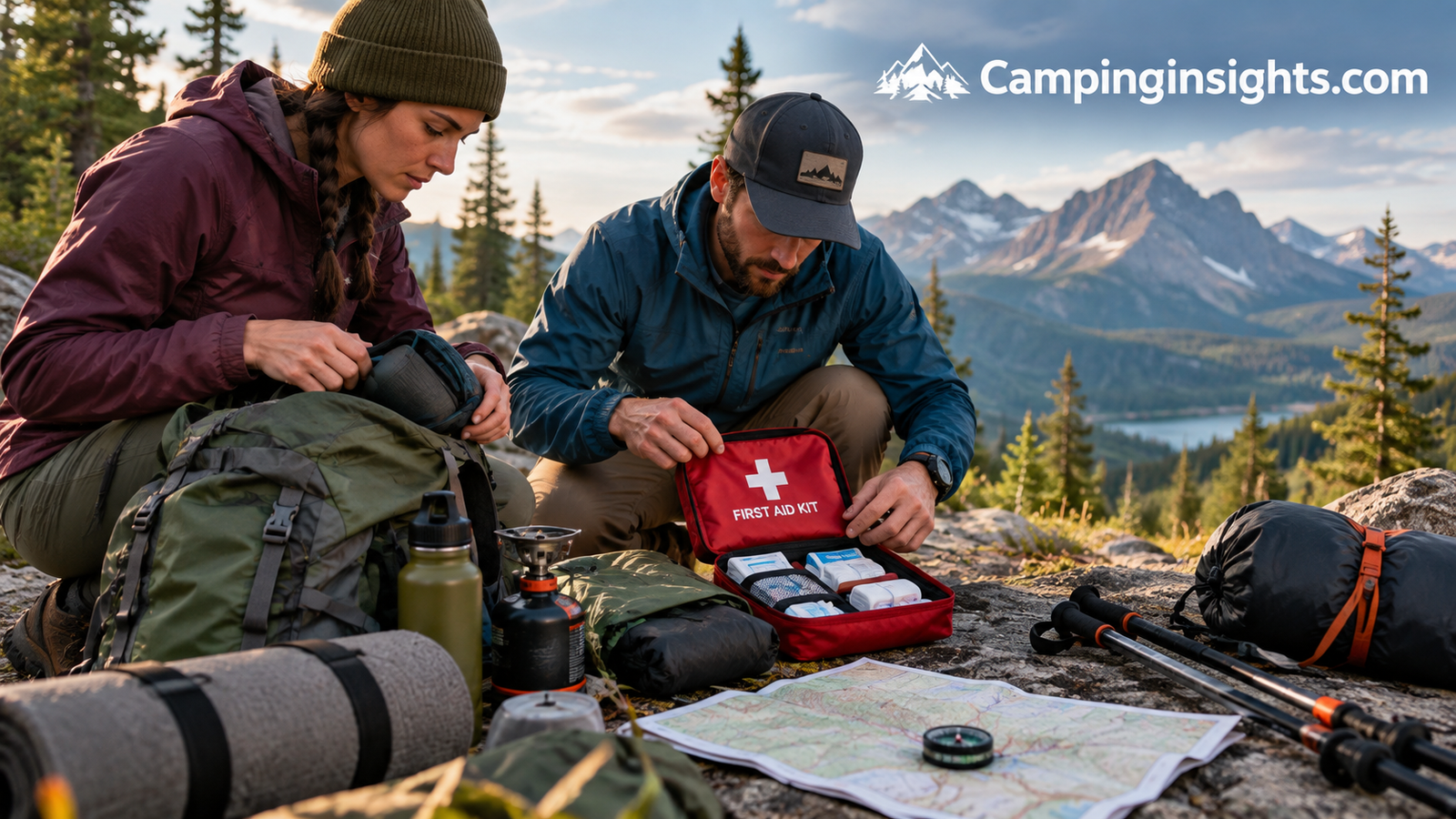
Even a well-planned trip can include a twisted ankle, a burn, a bad blister, or a bee sting. A well-stocked first aid kit is only useful if you actually know how to use what’s in it, so pair your kit with at least basic first aid knowledge before you go.
Building a Trip-Appropriate Kit
Your kit should scale with your group size, trip length, and remoteness. A weekend at a front-country campground needs less than a five-day backcountry trip far from a trailhead. At minimum, include adhesive bandages, gauze, medical tape, antiseptic wipes, tweezers, blister treatment, pain relievers, any personal medications, and a basic guide card for common injuries.
| Kit Type | Best For | Key Additions |
|---|---|---|
| Basic day kit | Day hikes, short trips | Bandages, antiseptic, pain relievers |
| Standard group kit | Weekend campground trips | Splint material, burn gel, tick removal tool |
| Backcountry kit | Multi-day, remote trips | SAM splint, irrigation syringe, emergency blanket, satellite communicator |
Basic Skills Worth Learning
- Treating minor cuts, burns, and blisters
- Recognizing signs of heat exhaustion and hypothermia
- Basic splinting for sprains or suspected fractures
- CPR and how to respond to choking
A short wilderness first aid course is one of the highest-value investments any regular camper can make — far more valuable, in an emergency, than any single piece of gear.

Check Price on Amazon
9. Navigation and Not Getting Lost
Getting turned around is one of the most common ways a routine hike turns into a search-and-rescue call. Good navigation habits cost nothing but a few minutes of attention.
Carry Redundant Navigation Tools
Don’t rely solely on your phone. Battery life, signal, and screen glare can all fail you at the worst moment. Carry a paper map and compass as backup, and actually know how to use them — a compass in a pocket you’ve never practiced with isn’t much help under stress.
Landmark Awareness
Periodically turn around on the trail and look back the way you came — trails look completely different in reverse, and this simple habit dramatically improves your odds of retracing your steps if needed. Note obvious landmarks: a distinctive rock formation, a stream crossing, a trail junction.
Comfortable, reliable footwear and gear also reduce fatigue-driven navigation mistakes — see our picks for a best camping backpack that won’t slow you down on longer routes.

Check Price on Amazon
10. Gear Safety Essentials
Reliable gear isn’t just about comfort — it’s a genuine safety factor. A tent that fails in a storm, a stove that malfunctions, or a sleeping bag rated for the wrong temperature can all turn a normal night into a dangerous one.
Test Gear Before You Go
Set up a new tent in your backyard before the trip, not for the first time at the campsite in the dark. Test your stove, check your headlamp batteries, and inspect ropes, stakes, and zippers for wear. Small failures are easy to fix at home and hard to fix in the field.
Gear Habits That Prevent Problems
- Pack a repair kit (tape, cordage, spare stakes)
- Bring backup batteries or a power bank
- Match your sleeping bag rating to real overnight lows
Common Gear Mistakes
- Using gear for the first time on the trip itself
- Ignoring a known equipment issue “for now”
- Underpacking layers for elevation or overnight drops
If something does tear or break mid-trip, a good tent repair kit can save the whole trip, and a reliable camping cot or sleeping pad helps you stay warm and rested enough to think clearly if conditions turn.

Check Price on Amazon
11. Kids and Group Camping Safety
Camping with children or a larger group adds another layer of coordination. The core principles stay the same, but supervision, communication, and pacing all need extra thought.
Keeping Kids Safe at Camp
- Set clear, simple boundaries — how far they can wander, where the fire’s “safe zone” is
- Give each child a whistle and teach them the three-blast distress signal
- Dress kids in brighter colors so they’re easier to spot at a distance
- Establish a “buddy system” so no one is ever exploring alone
Coordinating Larger Groups
With bigger groups, assign roles clearly — who’s managing the fire, who’s tracking the first aid kit, who has the map. Establish a group meeting point and a check-in schedule if people split up during the day, and make sure everyone, not just the trip leader, knows the basics of the plan.
- Whistle for each child, distress signal practiced beforehand
- Clear fire and water boundaries explained on arrival
- Emergency contact card in each adult’s pocket
- Headcount taken at regular intervals, especially near dusk
For a broader head start, our camping checklist for beginners is a solid companion to this section, especially for first-time family trips.

Check Price on Amazon
12. Emergency Communication and Evacuation Planning
Even the most careful campers occasionally face a situation that requires outside help. Knowing how you’ll communicate and evacuate before you need to is the difference between a controlled response and a panicked one.
Communication Options Beyond Cell Signal
Cell coverage in many camping areas is unreliable or nonexistent. A satellite communicator or personal locator beacon (PLB) can summon emergency help from almost anywhere, and many now support two-way texting as well as SOS alerts. A basic two-way radio is also useful for keeping a spread-out group in contact locally.
Building a Simple Evacuation Plan
Before you settle in, identify the fastest route out of your campsite, the nearest road access point, and roughly how far you are from help. If you’re camping in a group with vehicles, agree on a meeting point in case you need to leave in a hurry, and keep essentials — keys, phone, first aid kit — easy to grab quickly.
| Scenario | Recommended Response |
|---|---|
| Medical emergency, no cell signal | Use PLB/satellite communicator, begin basic first aid, keep patient warm and calm |
| Severe weather approaching | Move to lower, sheltered ground; avoid tents in flood-prone spots |
| Wildfire smoke or visible flame nearby | Evacuate immediately via the pre-identified route; don’t wait for official notice if danger is imminent |
| Group member missing | Stay at the last known meeting point, alert authorities if not found within a reasonable time |
If cold is a major factor in your evacuation risk, our guides on how to keep a tent warm at night and how to keep a tent warm in winter can help you avoid cold-related emergencies in the first place.

Check Price on Amazon
Frequently Asked Questions About Camping Safety
What is the single most important camping safety tip?
Tell someone your itinerary before you leave. It costs nothing, takes two minutes, and is the reason most lost or injured campers get found quickly.
Do I need a first aid kit for a single-night camping trip?
Yes. Even a short trip can involve minor cuts, burns, or blisters, and a basic kit weighs very little compared to the risk of having nothing on hand.
How far should food be stored from a tent?
At least 100 feet away, ideally in a bear-resistant canister or hung using proper bear-bag technique, to avoid attracting wildlife to your sleeping area.
Is it safe to drink water directly from a stream or lake?
Not without treating it first. Even clear-looking water can carry pathogens; always filter, purify, or boil water from natural sources before drinking.
What should I do if I hear thunder while camping?
Move away from open areas, ridgelines, and tall isolated trees or water. Seek lower, wooded terrain and spread out if you’re in a group.
How do I know if a campsite is safe from flooding?
Avoid low-lying spots, dry creek beds, or areas that show signs of past water flow. Camp on elevated, well-drained ground whenever possible.
What’s the best way to signal for help if I get lost?
Three sharp blasts on a whistle is a universally recognized distress signal. Stay in place once you realize you’re lost rather than wandering further.
Should kids carry their own safety gear while camping?
Yes — a simple whistle and a bright-colored layer make a real difference if a child wanders off or becomes separated from the group.
How do I safely extinguish a campfire?
Drown it with water, stir the ashes, and drown it again until everything is cool to the touch. Never leave a fire that’s still warm or smoking.
What’s the safest way to react to wildlife encounters?
Stay calm, avoid running, back away slowly, and make yourself appear larger while giving the animal a clear path to retreat.
Do I need a satellite communicator if I’m only camping at a campground with cell service?
It’s less critical at developed sites with reliable signal, but still useful as a backup, since coverage can be spotty even at established campgrounds in mountainous terrain.
How can I prevent condensation from making my tent feel unsafe or unhealthy overnight?
Improve ventilation by cracking vents or windows, avoid cooking inside the tent, and use a footprint or groundsheet to reduce moisture buildup from the ground.
Ready to Camp with Confidence?
Camping safety isn’t about eliminating risk entirely — it’s about stacking small, deliberate habits that let you handle whatever comes up. Plan ahead, respect the weather and wildlife, pack the right gear, and make sure someone always knows where you are. Do that consistently, and you’ll spend a lot more time enjoying the campfire and a lot less time worrying about what could go wrong.
Shop Camping Safety Essentials