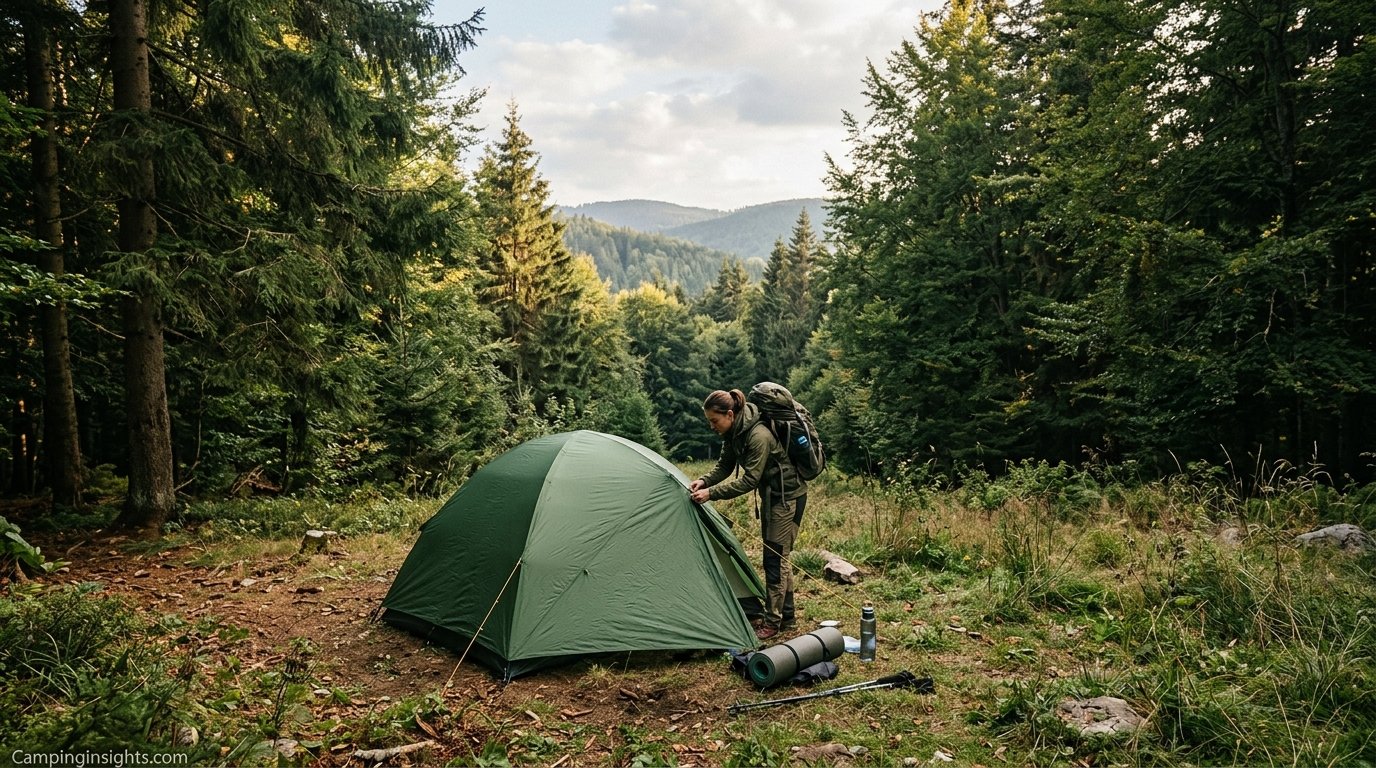
What Is Dispersed Camping? The Complete Beginner’s Guide
Everything you need to know about camping for free on public land — where it’s legal, how to find a site, what gear you actually need, and the rules that keep it that way.
What Is Dispersed Camping?
Dispersed camping means camping anywhere on qualifying public land outside of a designated, developed campground — no numbered site, no reservation system, no camp host, and usually no fee. It’s sometimes called “boondocking,” “primitive camping,” or “wild camping,” depending on who you ask, but the core idea is the same: you find your own spot, you bring everything you need, and you leave without a trace that you were ever there.
In the United States, dispersed camping is most commonly associated with land managed by the Bureau of Land Management (BLM) and the U.S. Forest Service, both of which allow camping on most of their land unless it’s specifically posted otherwise. That’s a staggering amount of territory — BLM alone oversees roughly 245 million acres, and national forests add hundreds of millions more. Compare that to the relatively small footprint of developed campgrounds, and it’s easy to see why dispersed camping has become the go-to option for anyone who wants more space, more solitude, and zero camping fees.
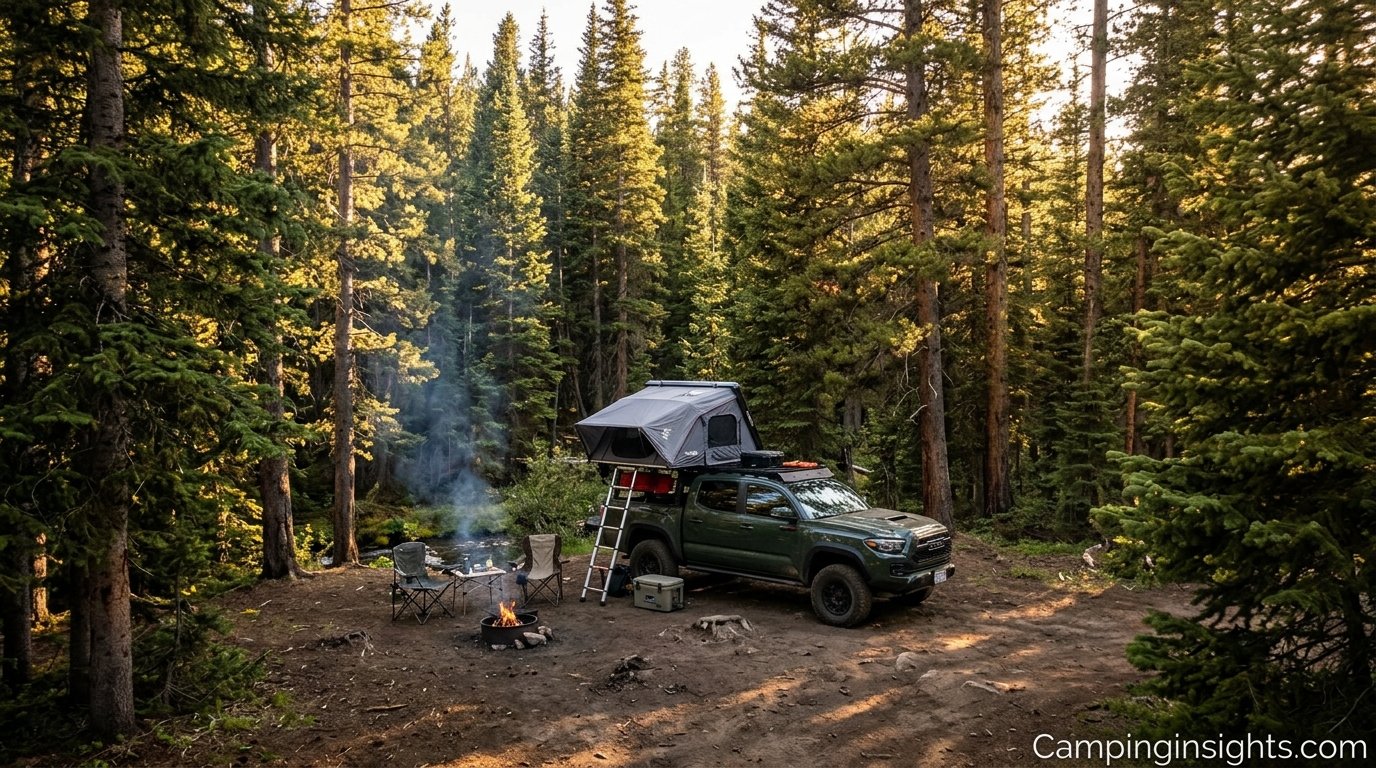
If you’ve ever pulled off a forest service road and seen a truck with a rooftop tent parked in a clearing with no picnic table, no fire ring built by a park service, and no bathroom in sight, you were looking at dispersed camping in action. It’s the opposite of the manicured, amenity-heavy state park experience — and for a growing number of campers, that’s exactly the appeal.
The term itself comes from land-management language, not camper slang. Agencies use “dispersed” to describe recreation that’s spread out across a landscape rather than concentrated into fixed, developed facilities — the same word could just as easily describe dispersed hiking access or dispersed hunting camps. Over time, campers adopted the term for exactly this style of unstructured, self-supported overnight stay, and it’s now the standard phrase you’ll see on official BLM and Forest Service websites, trip-planning apps, and camping forums alike.
It’s worth separating dispersed camping from two related but distinct ideas: backcountry camping and wild camping in countries outside the U.S. Backcountry camping usually implies hiking in on foot, often with a permit, into designated wilderness zones with their own rulebook. Dispersed camping, by contrast, is almost always vehicle-accessible — you drive to a clearing rather than hike miles into it — which is a big part of why it’s approachable for people who aren’t backpackers. In other countries, “wild camping” can mean something closer to camping on any open, unposted land, including private land in places where that’s culturally tolerated; U.S. dispersed camping is specifically tied to certain categories of public land, not private property.
Heading out for your first dispersed trip? Start with a reliable, packable tent built for unpredictable ground.
Shop Tents on AmazonDispersed vs. Developed Campgrounds
The easiest way to understand dispersed camping is to compare it directly to the developed campground experience most people grew up with. Neither one is objectively “better” — they’re built for different priorities.
| Feature | Dispersed Camping | Developed Campground |
|---|---|---|
| Cost | Usually free | $15–$60+ per night |
| Reservations | None — first-come, first-served | Often required, especially in peak season |
| Amenities | None (no water, toilets, or trash) | Restrooms, water, sometimes showers and hookups |
| Neighbors | Often none for miles | Other campers close by |
| Fire rings | Rare or self-built | Provided and maintained |
| Stay limit | Typically 14 days | Varies, often 7–14 days |
| Cell/road access | Often limited, rough roads | Usually paved and accessible |
Notice that almost every dispersed camping “downside” is really a trade-off for privacy and cost. You give up the picnic table and the pit toilet, and in exchange you get a campsite with a view that might otherwise require a $150-a-night cabin. For campers who already know how to choose a campsite with intention, dispersed land opens up options a reservation system never could.
Weather exposure is a less obvious but equally real difference. Developed campgrounds are frequently sited in sheltered valleys or established tree cover that’s been managed for decades, while dispersed sites can sit fully exposed on a ridge or open flat with nothing breaking the wind. That exposure is often exactly what delivers the sweeping views dispersed camping is known for, but it also means checking the forecast — and being ready for a rougher night — matters more than it would at a sheltered, developed site. Campers who’ve dealt with camping in the rain at an exposed dispersed site know the difference a few hundred feet of tree cover can make.
Since you won’t have a picnic table or bear box, a sturdy folding camp table and dry-storage bin earn their keep fast.
Shop Storage BinsIs Dispersed Camping Legal?
Yes — dispersed camping is legal on the vast majority of BLM and National Forest land, as well as on some land managed by state trust agencies, provided you follow the local regulations. The confusion usually comes from the fact that “public land” isn’t one single category. National Parks, for example, almost never allow dispersed camping outside designated backcountry zones with a permit. State parks are similar. But BLM land and national forests operate under a different mandate — multiple-use management — which explicitly includes recreational camping as an allowed activity.
That said, “legal by default” doesn’t mean “legal everywhere within that land.” Individual ranger districts and BLM field offices can and do close specific areas to camping — usually because of wildfire risk, habitat restoration, resource damage from overuse, or seasonal wildlife closures (elk calving grounds are a common one). The only way to know for sure is to check the specific district or field office’s website, or call ahead, before you go.
It’s also worth noting that legality and safety aren’t the same thing. Just because you’re allowed to camp somewhere doesn’t mean the access road is passable in your vehicle, or that the area is realistic for camping with a dog or kids. Do a little homework before you commit a whole weekend to a spot you’ve never seen.
Land ownership boundaries are also less obvious in the field than they look on a map. BLM parcels, national forest boundaries, and private inholdings can sit right next to each other, sometimes without a fence or sign marking the line. GPS-based land ownership apps (many of the same camping apps mentioned later in this guide include an ownership layer) are the most reliable way to confirm you’re actually on public land before you set up, rather than relying on a gate or fence that may or may not exist.
Finally, keep in mind that legality can shift with the seasons. An area that’s open to camping in summer might close temporarily for a controlled burn, a logging operation, or seasonal wildlife protection in fall or spring. Checking current alerts on the relevant BLM field office or ranger district page — not just a general search — is the only way to catch these temporary closures before you’re already there.
How to Find a Dispersed Campsite
Finding a legal, safe, and genuinely nice dispersed site used to require a paper map and a lot of luck. Today, a handful of tools make it dramatically easier:
- BLM and Forest Service land-use maps (MVUM) — Motor Vehicle Use Maps show exactly which roads are open to vehicles, which is critical since camping is usually restricted to within a set distance of an open road.
- Camping apps — Apps like FreeRoam, iOverlander, and The Dyrt crowdsource actual dispersed site locations with photos, road-condition notes, and cell signal info from other campers who’ve been there.
- Satellite imagery — Before committing to a drive, pull up the coordinates on satellite view to check for existing clearings, tree cover, and whether the “road” is actually a road.
- Calling the local office — A five-minute call to the BLM field office or ranger district will tell you about current closures, fire restrictions, and which areas see the least traffic.
Once you’re in the general area, look for existing established sites — a flat clearing with an obvious fire ring from previous campers — rather than creating a brand-new clearing yourself. Reusing existing impact is one of the simplest ways to minimize your footprint, and it usually means someone before you already found the best flat, level ground nearby.
Timing matters just as much as the tool you use to find a spot. Popular dispersed corridors within an hour or two of a major city or a national park entrance fill up fast on Friday afternoons, and by dark you may be left with whatever’s leftover — often the least level, least private options in the area. Arriving a few hours before sunset, or scouting on a weekday before a weekend trip, dramatically increases the odds of landing a genuinely good site instead of settling for the first flat patch you find in fading light.
It also helps to have a backup plan two or three sites deep. Even with good research, a site can turn out to be occupied, washed out, or simply worse in person than it looked on satellite imagery. Treating your first choice as a starting point rather than a guarantee saves a lot of stress when you’re already an hour down a dirt road with the light fading.
Cell service disappears fast on forest roads. An offline GPS unit means you’ll actually find your way back out.
Shop Offline GPS DevicesThe 14-Day Stay Limit Rule
Almost all BLM and Forest Service land enforces a 14-day stay limit within any 28-day period, in any one location. After 14 days, you’re generally required to move at least 25 miles away (this exact distance varies by district) before you can set up camp again in the same general area. This rule exists specifically to prevent dispersed camping from turning into de facto permanent residency on public land, which does happen and does cause real environmental and enforcement problems in high-traffic areas near cities.
Rangers do patrol popular dispersed corridors, especially near major trailheads and access points to national parks, and they do issue citations for overstays. If you’re planning an extended trip, it’s worth mapping out two or three legal camping zones in the same general region so you can rotate between them without a long drive.
The exact stay limit can differ by field office, so always check signage at the site or the relevant BLM/Forest Service district page rather than assuming the 14-day standard applies everywhere.
Enforcement isn’t always immediate, which can create a false sense of security for campers who push the limit. A ranger might not pass through a remote corridor for several days at a stretch, but that gap in patrols doesn’t mean the rule has quietly stopped applying — it just means enforcement is intermittent rather than constant. Treating the stay limit as a hard deadline, rather than something to test until you get caught, keeps you on the right side of both the rule and the land managers who ultimately decide whether dispersed camping stays as open and lightly regulated as it is today.
Essential Gear You’ll Actually Need
Dispersed camping doesn’t require exotic gear, but it does require self-sufficiency — there’s no camp store, no water spigot, and no one coming to help if something breaks. At minimum, plan around these categories:
- Shelter: A tent rated for the conditions you’ll actually face — check out our best camping tents roundup if you’re shopping.
- Sleep system: An insulated pad matters more off-grid than at a developed site, since ground temperatures swing harder in exposed, undeveloped terrain — see our guide to the best sleeping pad for winter camping.
- Ground anchoring: Dispersed sites are frequently rocky, root-covered, or hard-packed, so standard stakes often fail. Our best tent stakes for rocky ground guide covers what actually holds.
- Repair kit: With no gear shop for miles, a compact tent repair kit can save an entire trip.
- Cooking setup: A dedicated camp stove, since open fires aren’t always allowed — our camping stove review breaks down the top options.
- Power: A portable battery or solar setup, since there are no outlets and often no signal to call for help if you’re relying on a phone alone.
It’s tempting to over-pack for a first dispersed trip, especially after reading a list like this one, but the self-sufficiency dispersed camping demands is really about redundancy in a few key categories — water, warmth, and navigation — rather than sheer volume of gear. A camper with a solid tent, an insulated sleep system, a reliable stove, and a full water supply is genuinely well-equipped, even with a fairly minimal kit otherwise.
Layout matters more than most first-timers expect, too. Without a picnic table or a flat gravel pad, you’re responsible for creating your own functional camp — a folding table for cooking, a tarp or footprint under the tent to protect against rocky or damp ground, and a designated spot for trash and food storage well away from the sleeping area. Thinking through this layout before you leave home, rather than improvising it in the dark after a long drive, makes the whole stay noticeably smoother.
Rocky, root-filled ground is the norm on dispersed sites — pack stakes made for it, not the flimsy ones that ship with most tents.
Shop Heavy-Duty StakesWater: Sourcing and Purifying It
Water is the single biggest logistical difference between dispersed and developed camping. There’s no spigot, so you have two options: haul it in, or source and treat it on site.
Hauling it in is the simpler, more reliable approach for weekend trips. A rough planning number is one gallon per person per day for drinking and basic cooking — more if you’re washing dishes or bathing. Collapsible water containers and rigid jerry cans both work; rigid containers are more durable for repeated off-road trips.
Sourcing on site makes sense for longer stays near a creek, river, or lake, but every natural water source needs treatment before use. A combination of a mechanical filter (removes protozoa and bacteria) and a chemical or UV backup (handles viruses a filter alone might miss) is the standard for backcountry-adjacent camping. Never assume clear water is safe water — giardia and other pathogens don’t change the appearance of a stream.
Many first-time dispersed campers underestimate how much water a trip actually consumes once cooking, dish washing, and basic hygiene are factored in alongside drinking. A reasonable planning approach is to calculate drinking water separately from “everything else” water, and to treat the drinking-water number as non-negotiable even if that means cutting back on washing dishes or rinsing gear. Running short on drinking water miles from the nearest tap is a far more serious problem than a dusty pan.
If you do plan to rely partly on a natural source, scout it before committing to a nearby campsite. Flow rate, water clarity, and upstream land use (grazing allotments and old mining sites are common upstream contamination risks) all affect how much filtration and treatment you’ll realistically need, and some sources are better avoided entirely regardless of how thorough your filter setup is.
If you’re planning to source water on site, a two-stage filter setup is non-negotiable — not optional gear.
Shop Water FiltersBathroom Needs and Waste Disposal
No pit toilet, no vault toilet, no facilities of any kind — this is the part of dispersed camping that catches first-timers off guard. Managing human waste properly isn’t just about comfort; it’s a core Leave No Trace requirement, and mishandling it is one of the leading causes of area closures.
For solid waste, the standard method is a “cathole” — dig a hole at least 6–8 inches deep, at least 200 feet from any water source, trail, or campsite, and bury waste completely afterward. In high-traffic dispersed corridors near popular trailheads, portable waste-disposal systems (WAG bags or a portable toilet) are increasingly expected, and in some heavily used areas they’re required by land managers.
Toilet paper should be packed out in a sealed bag, not buried — it decomposes far slower than most people expect and is regularly dug up by animals. All greywater from dishwashing should be strained of food scraps and scattered well away from camp and water sources, never dumped in one spot.
Desert environments and high-alpine terrain deserve special mention here, since both are common dispersed camping settings and both are unusually bad at breaking down buried waste. Thin, rocky, or extremely dry soil doesn’t support the microbial activity that decomposes waste in a typical forest cathole, which is a major reason many desert BLM districts now explicitly require a portable toilet system rather than allowing catholes at all. Checking the specific waste-disposal rule for your destination — not just assuming the general cathole method applies everywhere — avoids both an environmental problem and a potential citation.
A portable camp toilet is a small investment that solves the single most awkward part of dispersed camping.
Shop Portable ToiletsCampfires and Fire Safety
Campfires feel like a given at a remote site, but dispersed camping puts more responsibility on you than a developed campground ever would — there’s no camp host checking your fire ring, and no guarantee the ground around you hasn’t been closed to open flame.
Before lighting anything, check current fire restrictions for the specific district you’re in. Many regions move through fire-danger tiers each season, and a “Stage 1” or “Stage 2” restriction can ban campfires entirely, even in an area where they’re normally allowed. Where fires are permitted, use an existing fire ring rather than building a new one, keep the fire small, and never leave it unattended, even for a few minutes.
Fully extinguishing a fire means more than letting it burn down to coals — drown it, stir the ashes, drown it again, and confirm it’s cool to the touch before you consider it out. Escaped campfires are the leading cause of human-started wildfires on public land, and dispersed camping’s remoteness means a fire that gets away from you may burn for a long time before anyone notices.
Wind is an underrated factor in dispersed-site fire safety specifically because these sites are so often exposed and open, unlike a developed campground that may be tucked into denser tree cover with more wind protection. A fire ring that felt perfectly controlled in calm evening air can throw embers well beyond its edge once wind picks up overnight, so it’s worth checking the forecast for wind gusts, not just precipitation, before deciding whether to build a fire at all.
When fires are restricted, a reliable stove is your only cooking option — worth having even if you plan to build a fire.
Shop Fire Starter KitsSafety Considerations
The trade-off for the solitude that makes dispersed camping appealing is that help, if you need it, is often far away. A few practical safety habits go a long way:
- Tell someone your plan. Share your general coordinates and expected return date with a person who isn’t with you.
- Carry a backup communication device. A satellite messenger or personal locator beacon is worth the cost if you’re regularly camping outside cell range.
- Check the weather and the road. Forest roads can wash out or become impassable after rain, and getting stuck miles from pavement is one of the most common dispersed-camping mishaps.
- Store food properly. In bear country, food and scented items need to be secured in a hard-sided container or hung, not left in a tent or an open vehicle bed.
- Plan for temperature swings. Exposed dispersed sites, especially at elevation, often see bigger day-to-night temperature drops than a sheltered developed campground — our guide on how to keep a tent warm at night covers the fundamentals.
None of this is meant to discourage dispersed camping — millions of trips happen every year without incident. It’s simply a different risk profile than a staffed campground, and treating it that way is what keeps trips safe.
A basic first-aid kit deserves more emphasis in a dispersed setting than it typically gets at a developed campground, precisely because the nearest urgent care might be an hour or more away rather than a short drive. Beyond the standard bandages and antiseptic, it’s worth including anything specific to your planned activities — blister care for hikers, an epinephrine auto-injector if anyone in your group has severe allergies, and a way to treat minor burns given how central campfires and stoves are to most dispersed trips.
Vehicle readiness is the other safety category that’s easy to overlook until it matters. A spare tire in good condition, a basic tool kit, extra fluids, a tow strap, and a clear plan for what to do if you get stuck are all more important on a rutted, unmaintained forest road than they are on pavement, where a simple breakdown is an inconvenience rather than a multi-hour wait for help to arrive.
In bear country or truly remote terrain, a hard-sided food storage container isn’t optional gear.
Shop Food StorageEtiquette and Leave No Trace
Dispersed camping’s future depends entirely on campers policing themselves — there’s no staff doing it for you. The seven Leave No Trace principles apply directly:
- Plan ahead and prepare — know the regulations before you arrive.
- Camp on durable surfaces — use existing clearings rather than trampling new vegetation.
- Dispose of waste properly — pack out everything you pack in, including trash and toilet paper.
- Leave what you find — don’t rearrange rocks, cut live branches, or take “souvenirs.”
- Minimize campfire impact — use existing rings, keep fires small, fully extinguish.
- Respect wildlife — observe from a distance and never feed animals.
- Be considerate of other visitors — keep noise and generator use reasonable, especially after dark.
Spacing also matters more than most new dispersed campers realize. Setting up within sight or earshot of another group, when there’s open land elsewhere, undercuts the exact privacy everyone came for. As a general courtesy, aim for enough distance that neither group can hear the other’s conversation at a normal volume.
A related and often-overlooked issue is condensation and site drainage — pitching in a low spot to “hide” your tent can leave you sitting in standing water after a single overnight rain, and it can also mean scraping out mud from the same clearing every camper reuses.
Generators and music are the two etiquette issues that generate the most friction between dispersed campers who otherwise came out for the same reason — quiet and space. If you’re running a generator, keeping it to reasonable daytime hours and positioning it as far from neighboring sites as your own setup allows goes a long way. The same logic applies to speakers and campfire conversation after dark; sound travels much further across open, treeless terrain than it does through the dense tree cover of a typical developed campground, so a volume that feels normal at your fire ring can carry to a site you didn’t even know was nearby.
Vehicle tracks are another form of impact that’s easy to create without noticing. Driving off an established route to get a slightly better view, or to avoid a muddy patch, widens the road’s footprint every time someone does it, and eventually turns a single-track dirt road into a braided mess of parallel ruts. Staying on the existing track, even when it’s inconvenient, keeps the access road usable and the surrounding vegetation intact for the next camper.
Pros and Cons of Dispersed Camping
Pros
- Free, in almost all cases
- No reservations or advance booking
- Far more privacy and space than a campground
- Flexibility to move if a site isn’t working out
- Access to scenery a paid site rarely matches
Cons
- Zero amenities — no water, toilets, or trash service
- Rougher, sometimes high-clearance-only access roads
- More self-reliance required for safety and navigation
- Site quality is unpredictable and unrated
- Limited or no cell signal in most locations
If you’re weighing whether dispersed camping fits your next trip, a useful gut check is whether you’d rather spend a Saturday afternoon researching a free, unknown site or paying $40 for a guaranteed spot with a bathroom fifty feet away. Neither answer is wrong — but knowing which one you are before you drive two hours down a forest road saves a lot of frustration.
It’s also worth recognizing that dispersed and developed camping aren’t mutually exclusive styles you have to pick between forever. Plenty of experienced campers mix the two depending on the trip — a developed campground for a family weekend with young kids who need a nearby bathroom, and a dispersed site for a solo trip or a couples’ getaway where the priority is quiet and a view. Treating dispersed camping as one tool in a broader camping toolkit, rather than an all-or-nothing lifestyle choice, is usually the most sustainable way to actually enjoy it long term.
Frequently Asked Questions
Is dispersed camping actually free?
In almost all cases, yes — BLM and Forest Service dispersed camping doesn’t carry a nightly fee. Some specific high-demand corridors have introduced small day-use or parking fees, so it’s worth checking the local district page if you’re headed somewhere popular.
How far off the road can I camp?
Most districts require camping within a set distance of an open road — often 150 to 300 feet — rather than allowing camping anywhere in the backcountry by vehicle access. Check the local Motor Vehicle Use Map for exact distances.
Can I dispersed camp with an RV?
Yes, as long as the access road can accommodate your vehicle’s size and clearance. Many dispersed roads are rutted, narrow, or steep enough that they’re realistically limited to trucks, vans, and smaller trailers.
Do I need a permit for dispersed camping?
Generally no permit is required on standard BLM or Forest Service land, though some specific high-use zones (often near popular trailheads) have introduced permit systems to manage overcrowding. Always check the specific area first.
Is dispersed camping safe for solo campers?
It can be, with the right preparation — reliable navigation, a shared trip plan with someone at home, and a backup communication device if you’re outside cell range. The remoteness that makes it appealing is the same factor that raises the stakes if something goes wrong.
Can I bring my dog dispersed camping?
Yes, and it’s one of the more dog-friendly forms of camping since there’s no campground leash zone to navigate. See our guide on camping with a dog for wildlife and etiquette considerations specific to remote sites.
What’s the difference between dispersed camping and boondocking?
They’re largely the same concept described by different communities — “boondocking” is more common among RV and van-life travelers, while “dispersed camping” is the official land-management term used by the BLM and Forest Service. Some RV owners also use “boondocking” more loosely to describe overnight parking in places like store lots, which isn’t the same as camping on public land and follows a completely different set of rules.
Can I have a campfire while dispersed camping?
Only if the area isn’t under a fire restriction at the time. Restrictions change seasonally based on fire danger, so always check current conditions for that specific district before assuming a fire is allowed.
How do I find bathrooms while dispersed camping?
There typically aren’t any. Plan on a cathole system for solid waste or bring a portable toilet, and pack out all toilet paper and hygiene products rather than burying them.
What happens if I stay longer than 14 days?
You risk a citation from land management rangers, who do patrol popular dispersed areas. The rule exists to prevent public land from being used as long-term or permanent housing.
Do I need four-wheel drive for dispersed camping?
Not always, but many of the best sites sit down rutted, unmaintained forest roads that a standard sedan can’t safely handle, especially after rain. Check recent trip reports on camping apps before committing your vehicle to an unfamiliar road.
Is dispersed camping allowed in national parks?
Almost never outside of designated, permitted backcountry zones. National parks are managed under a different mandate than BLM or Forest Service land, with far more restrictive camping rules.
Ready to Try Dispersed Camping?
Dispersed camping strips away the amenities, but what it gives back — free, first-come access to millions of acres of public land, real solitude, and campsites a paid reservation could never guarantee — is exactly why it’s grown from a niche practice into a mainstream way to camp. Start small: pick a nearby BLM or national forest area, check current restrictions, bring more water than you think you need, and build your confidence from there. Once you’ve camped a night with no one else in sight, it’s hard to go back to a numbered site with a neighbor twenty feet away.
Shop Dispersed Camping Essentials
Pingback: What Is Car Camping? Complete Beginner's Guide
Pingback: How to Make Coffee Camping: 6 Best Methods
Pingback: Is Wild Camping Legal in the US? State Guide