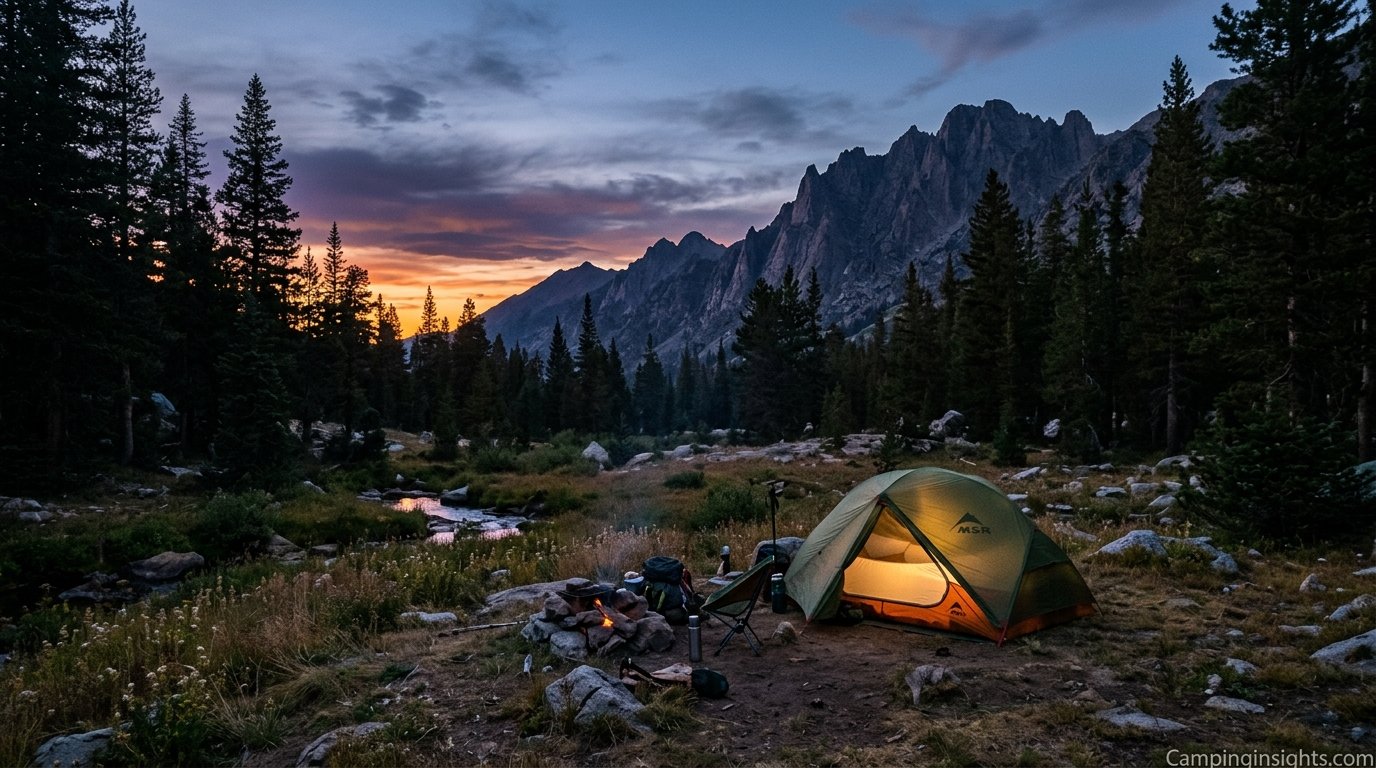
Is Wild Camping Legal in the US? The Complete State-by-State Reality Check
What “wild camping” actually means on American soil, where you can legally pitch a tent for free, and where doing the same thing gets you a citation.
1. What “Wild Camping” Actually Means in the US
In the United Kingdom, “wild camping” has a fairly narrow legal meaning tied to specific access laws. In the United States, the phrase is used far more loosely, and that looseness is exactly why so many people end up confused about whether it’s legal at all. Ask ten American campers what wild camping means and you’ll get ten slightly different answers: sleeping under the stars with no tent, pitching a tent far from any campground, parking a van on a quiet forest road, or simply camping somewhere without paying a fee.
For the purposes of US law and land management, the closest official concept is dispersed camping — camping outside of a designated, developed campground, usually with no toilets, no picnic tables, no fire rings, and no camp host. Whether that’s legal depends entirely on who owns the ground you’re standing on. The United States doesn’t have a single national “right to roam” the way some European countries do. Instead, legality is a patchwork stitched together from federal land management agencies, state governments, county ordinances, and private property law.
The short answer, before we go any deeper: yes, wild camping is legal in large parts of the US — but only on the right kind of land, and almost always with conditions attached. If you want the fuller picture, our guide on what dispersed camping actually is is a useful companion piece to this one.
Quick takeaway: There’s no single US law about wild camping. Legality is determined land-by-land — federal, state, or private — and each has its own rulebook.
It helps to understand why the US ended up with this patchwork in the first place. Unlike many European nations, the US never adopted a nationwide “freedom to roam” doctrine granting the public a general right to walk or camp across land regardless of ownership. Instead, American land law grew out of a mix of homesteading policy, federal land retention in the West, and strong private property protections in the East. The result is a country where roughly 640 million acres — about 28% of total US land area — remains in federal hands, managed by four major agencies: the Bureau of Land Management, the US Forest Service, the National Park Service, and the US Fish and Wildlife Service. Each of those agencies has its own mission, its own regulations, and its own tolerance for dispersed, unstructured camping.
That federal land is also wildly unevenly distributed. Nevada is over 80% federally owned; Connecticut is under 1%. This single fact explains more about “where can I wild camp” than almost anything else in this guide — geography, not just law, dictates opportunity. Someone based in Wyoming can drive twenty minutes and find a legal, free dispersed site. Someone based in Ohio may need to drive several hours to reach the nearest national forest with dispersed camping allowances.
It’s also worth noting that “legal” and “permitted by the managing agency” aren’t always identical once you factor in overlapping jurisdictions. A stretch of national forest might sit within a state-designated wilderness study area, layering an additional set of restrictions — no motorized access, no mechanized equipment, sometimes no campfires at all — on top of the forest’s general dispersed camping rules. Wildlife refuges managed by the US Fish and Wildlife Service add yet another wrinkle, since many prohibit overnight camping entirely except in a handful of designated areas, reflecting their primary mission of habitat protection rather than recreation. The practical lesson is the same throughout this guide: never assume one federal land label behaves identically everywhere it appears, and always check the specific unit you’re planning to visit rather than relying on a general rule of thumb.

2. Wild Camping vs. Dispersed, Stealth, and Car Camping
Before you can figure out whether something is legal, it helps to know exactly what you’re describing, because enforcement officers, land managers, and even fellow campers use these terms differently.
Dispersed camping
This is the formal term used by the US Forest Service and Bureau of Land Management. It means camping on public land outside of a designated campground, typically for free, typically with a maximum stay limit (often 14 days), and typically without any facilities. Our full breakdown of what dispersed camping involves covers the specific rules land managers apply.
Stealth camping
Stealth camping usually refers to camping (often in a vehicle) in a way designed to avoid being noticed — think sleeping in a van on a residential street or in a store parking lot overnight. It’s not automatically illegal, but it operates in much grayer legal territory than dispersed camping on open public land. We go deeper into this distinction in what stealth camping actually means.
Car camping and primitive camping
Car camping simply means camping near your vehicle, often at a developed site — see our guide to what car camping means for the full picture. Primitive camping, on the other hand, refers to camping without amenities, which overlaps heavily with dispersed and wild camping; our article on what primitive camping is untangles the overlap.
For the rest of this guide, when we say “wild camping,” we mean the broad American sense: camping outside a developed, fee-based campground, usually without hookups or facilities, on land that may or may not permit it.
Boondocking
Popular within the RV and van-life community, “boondocking” specifically describes dry camping (no water, sewer, or electric hookups) in a vehicle, whether that’s on BLM land, in a national forest pullout, or in a paved parking lot with permission. It’s essentially dispersed camping with wheels, and it follows the same land-ownership rules as tent-based wild camping — legality depends entirely on where you park, not on the fact that you’re in a vehicle rather than a tent.
Backcountry camping
This term usually applies inside national parks and designated wilderness areas, where camping away from developed sites requires a specific permit tied to a numbered zone or site. It’s the most tightly regulated version of “wild” camping covered in this guide, and we unpack exactly why in the next section.
3. BLM Land: The Backbone of Legal Wild Camping
If wild camping has a spiritual home in the US, it’s on Bureau of Land Management (BLM) land. The BLM manages roughly 245 million acres, concentrated heavily in the western states — Nevada, Utah, Arizona, Colorado, Wyoming, New Mexico, Idaho, Oregon, and California all have vast stretches of it.
On most BLM land that isn’t otherwise restricted, dispersed camping is explicitly permitted for free. The general rule of thumb used across BLM field offices is a 14-day stay limit within a 28-day period, after which you’re expected to move at least 25 miles away before camping in the same area again. Some high-traffic zones near popular destinations (Sedona-adjacent BLM land, parts of Moab, sections near Joshua Tree) have tighter restrictions, seasonal closures, or fee-based dispersed sites due to overcrowding and environmental damage.
Why BLM Land Works for Wild Camping
- Camping is free in the vast majority of areas
- No reservation system for most dispersed sites
- Enormous acreage means genuine solitude is achievable
- Vehicle access is often good via maintained dirt roads
Where It Gets Complicated
- Rules vary by individual BLM field office
- Some corridors have seasonal or permanent closures
- Water sources are often scarce or nonexistent
- Cell service and help can be very far away
Before heading out, it’s always worth checking the specific BLM field office’s website for the area you’re targeting, since local rules can override the general 14-day guideline.
It’s also worth understanding how BLM enforcement actually works in practice. Unlike a national park with a ranger station at every entrance, most BLM districts are patrolled by a small number of law enforcement rangers covering enormous territory — sometimes millions of acres per officer. In practical terms, this means casual dispersed camping rarely gets checked unless it’s in a high-traffic corridor, near a popular trailhead, or reported by another visitor. That said, “rarely checked” is not the same as “unregulated,” and the areas that do see enforcement tend to be exactly the ones getting the most attention on social media — a reminder that popularity itself can be what turns a quiet legal loophole into a closed, permit-only zone within a few seasons.

4. National Forests and Dispersed Camping Rules
The US Forest Service manages roughly 190 million acres across 154 national forests and 20 grasslands, and — like BLM land — dispersed camping is generally allowed unless a specific area is signed as closed. The main difference from BLM land is that national forests tend to have more tree cover, more established forest roads, and, in many cases, more designated dispersed camping corridors that are informally known and heavily used, especially near popular trailheads.
Common national forest rules include:
- Camping must typically be at least 100–200 feet from any water source, trail, or road (varies by forest)
- Stay limits of 14 days per 30-day period are common, mirroring BLM policy
- Campfires may require a permit even outside of fire ban periods, depending on the state
- Some forests require a free self-issued wilderness permit even for dispersed camping
Popular national forests for wild camping include the White River National Forest in Colorado, the Coconino National Forest in Arizona, and the Los Padres National Forest in California — though all three have seen enough dispersed-camping traffic that specific pullouts now get closed for restoration on a rotating basis.
If you’re planning a longer trip that mixes dispersed nights with developed campground stays, our guide to planning a camping trip walks through how to structure the logistics.
One detail that trips up a lot of first-time dispersed campers in national forests: not every forest road is open to vehicles, and camping is generally only legal within a certain distance (often around 300 feet) of a road that’s officially open for motorized travel. Forest Service Motor Vehicle Use Maps (MVUMs), available free from each forest’s website, show exactly which roads qualify. Driving off-route to find a “better” spot is one of the fastest ways to turn a legal dispersed camping trip into a resource-damage citation, since off-route travel is treated as a separate violation from the camping itself.
5. National Parks: Why Wild Camping Is Usually Banned
This is where a lot of people get tripped up. National Parks (Yellowstone, Yosemite, Zion, Grand Canyon, and the rest of the 60-plus park system) are managed by the National Park Service, which operates under a very different mandate than the BLM or Forest Service. Its core mission includes strict preservation, and that translates into far tighter camping rules.
In almost every national park, camping outside of designated, often reservation-only campgrounds is illegal unless you have a backcountry permit specifically authorizing dispersed camping in a defined zone. These backcountry permits:
- Usually require advance reservation, sometimes months ahead for popular parks
- Often carry a fee, separate from the park entrance fee
- Restrict you to specific zones or even specific numbered campsites within the backcountry
- May require food storage canisters, permits for campfires, and quotas on group size
Simply pulling off a park road and pitching a tent in Yellowstone or Zion is not “wild camping” — it’s a citable offense, and rangers actively patrol for it, particularly near popular pull-offs and viewpoints. The exception is the land immediately surrounding many national parks, which is frequently BLM or national forest land where legal dispersed camping is plentiful — this is why so many van-lifers camp just outside park boundaries rather than inside them.
There’s a practical strategy worth knowing here: nearly every major national park in the West is bordered by national forest or BLM land, and it’s common for experienced travelers to base camp for free just outside the entrance, then drive in for day trips. Grand Teton has the Bridger-Teton National Forest immediately adjacent; Zion borders Dixie National Forest and BLM land; Joshua Tree is ringed by BLM acreage. This approach avoids permit lotteries entirely while still putting you within a short drive of the park’s main attractions, and it’s one of the most reliable ways to combine “wild camping” freedom with proximity to a bucket-list destination.

6. State Parks and State Forests
State-level land adds yet another layer of variation, because each state writes its own rules. Broadly speaking:
State parks
Most state parks function like miniature national parks: camping is restricted to designated, often fee-based campgrounds, and backcountry or dispersed camping is either banned outright or limited to a small number of permitted backcountry zones (common in parts of the Adirondacks in New York, for example).
State forests and state trust lands
These tend to behave more like national forests — dispersed camping is often permitted, sometimes with a small day-use or camping permit fee, sometimes entirely free. Washington, Oregon, and Colorado all have significant state forest or state trust acreage where dispersed camping is legal with minimal restrictions. In several western states, however, state trust land is technically leased for grazing or resource extraction and may require a recreational access permit before you’re legally allowed to camp there at all.
Because the rules differ so much state to state, it’s worth checking your specific state’s department of natural resources or state parks website before assuming state land works the same way as federal land.
County and municipal land
The smallest and least consistent category is land owned by counties or municipalities — a regional park, a watershed protection area, a utility-owned buffer strip. These parcels almost never allow dispersed camping, largely because they’re managed for a narrow purpose (water quality, flood control, local recreation during daylight hours) rather than overnight backcountry use. Signage is often the only reliable indicator, and in the absence of a posted camping policy, the safest assumption is that overnight camping isn’t permitted.
7. State-by-State Wild Camping Snapshot
No single table can capture every county ordinance and forest-specific rule, but this snapshot gives a realistic sense of how wild-camping-friendly different states tend to be, based on the mix of public land available and how permissive that land’s management generally is.
| State | Public Land Availability | General Wild Camping Friendliness | Notes |
|---|---|---|---|
| Nevada | Very high (BLM-dominant) | Very friendly | Over 80% federal land; dispersed camping widely tolerated |
| Utah | Very high | Friendly with hotspots restricted | Moab-area BLM land increasingly regulated due to crowding |
| Arizona | High | Friendly | Coconino & Prescott National Forests popular for dispersed camping |
| Colorado | High | Friendly, seasonal limits common | Many national forest corridors near Denver now have stay-limit signage and closures |
| Wyoming | Very high | Very friendly | Low population density, abundant BLM and national forest land |
| Oregon | High | Friendly | State forests plus national forest land both allow dispersed camping |
| California | High but heavily zoned | Mixed | Extensive national forest land, but many corridors near cities are closed or permit-only |
| New York | Low-moderate | Restrictive | Adirondack backcountry camping allowed in specific zones with rules |
| Florida | Low | Restrictive | Little unclaimed public land; camping largely confined to designated sites |
| Texas | Low (mostly private) | Very restrictive | Over 95% privately owned; legal wild camping options are scarce |
The pattern is clear: states with large amounts of federally managed land (mostly in the West) offer far more legal wild camping opportunity than states dominated by private land (much of the East and South, plus Texas). If you’re still deciding where to go, our guide on where to go camping factors this public-land imbalance into its recommendations.

8. Private Land, Farmland, and Roadside Pull-offs
A huge share of land in the US — especially east of the Mississippi — is privately owned, which means the rules of public land simply don’t apply. Camping on private property without permission is trespassing, full stop, regardless of how remote or “wild” the spot looks.
That said, private land isn’t automatically off-limits:
- Ask first. Many rural landowners will grant permission for a single night if you ask directly, particularly in farming communities.
- Use landowner-hosting platforms. Apps and websites connecting travelers with private landowners (often farms, vineyards, or ranches) have grown popular precisely because they solve this legal gap.
- Roadside pull-offs along highways are usually owned by the state department of transportation, not open to overnight camping, and are patrolled more than people expect — particularly near state lines and rest areas with posted time limits.
The safest assumption, unless signage says otherwise, is that any land that isn’t clearly BLM, national forest, or another public-recreation designation is private, and you need explicit permission before setting up camp.
Timber companies are a special case worth mentioning separately. Large private timber operations in states like Washington, Oregon, Maine, and Georgia sometimes permit recreational access, including camping, on active logging land — but almost always require a paid or free access permit, and access can be revoked or restricted during active harvest, fire season, or hunting season. These arrangements are usually publicized on the timber company’s own website rather than through any government land database, so they’re easy to miss if you’re only checking public-land maps.
9. Permits, Stay Limits, and Fees You Should Expect
Even where wild camping is legal, “legal” rarely means “unregulated.” Here’s what to expect depending on land type:
| Land Type | Typical Permit Requirement | Typical Stay Limit | Typical Fee |
|---|---|---|---|
| BLM land | None for most areas; some hotspots require a day-use permit | 14 days per 28-day period | Usually free |
| National forest | Often none; some forests require a free self-issued permit | 14 days per 30-day period | Usually free |
| National park backcountry | Required, reservation-based | Set per zone, often 1–3 nights | Permit fee, often $6–$40+ |
| State forest / trust land | Varies; some require a recreation pass | Varies, often 14–16 days | Free to modest annual pass fee |
| Private land | Landowner permission required | Landowner’s discretion | Free to negotiated fee |
Fire permits are a separate consideration entirely — many western states require a California Campfire Permit equivalent or similar free permit for any open flame on public land, even outside of designated fire-ban seasons. It’s worth building this into your prep alongside a broader beginner camping checklist so nothing gets missed.
Group size limits are another detail that’s easy to overlook. Most dispersed camping rules on BLM and Forest Service land cap group size somewhere between 8 and 75 people depending on the district, with smaller numbers applying in sensitive or high-use areas. If you’re organizing a larger gathering — a reunion, a group backpacking trip, an overlanding meetup — many field offices require advance notice or a special use permit once you exceed the standard cap, even if the underlying land normally allows free dispersed camping for smaller parties.

10. Leave No Trace and Wild Camping Etiquette
Legal access to wild camping in the US exists largely because land managers trust campers to behave responsibly. Every closure, every new stay-limit sign, every fee-based dispersed site is usually a direct response to campers who didn’t follow basic etiquette. The seven Leave No Trace principles apply with extra weight when there’s no ranger, no bathroom, and no camp host nearby:
- Camp at least 200 feet from water sources
- Pack out 100% of trash, including food scraps and toilet paper
- Bury human waste 6–8 inches deep, at least 200 feet from water and trails
- Use existing fire rings rather than building new ones, and check fire restrictions first
- Keep noise and generator use to a minimum, especially overnight
- Never camp in the exact same undesignated spot for extended periods, as it accelerates soil and vegetation damage
General camping safety tips apply doubly out in dispersed sites, since help is often much farther away than at a developed campground. If you’re bringing a dog along, our guide to camping with a dog covers wildlife and leash considerations that matter even more in undeveloped areas.
Beyond the standard seven principles, experienced dispersed campers develop a handful of unwritten habits that keep sites open for everyone. Rotating tire tracks rather than always parking in the exact same ruts prevents a single dispersed pullout from turning into a permanently scarred dirt lot. Packing out gray water from dish-washing rather than dumping it near a campsite prevents the greasy, food-scented ground that draws in rodents and, eventually, larger wildlife. And resisting the urge to build a “cool” rock ring or fire pit in a new spot — rather than reusing an existing one — is one of the single biggest factors land managers cite when deciding whether to keep an area open to dispersed camping or shut it down for restoration.
11. What Happens If You Camp Somewhere Illegal
Consequences scale with how sensitive the land is. On public land where dispersed camping simply exceeded the stay limit, a ranger will typically issue a warning first, then a citation with a fine (commonly in the $50–$275 range for federal land violations, though it varies). In national parks, illegal backcountry camping without a permit can carry steeper fines and, in repeat or egregious cases, a court appearance.
On private land, the consequences shift from a citation to trespassing charges, which carry more serious legal weight and, depending on the state and circumstances, can escalate quickly if a landowner feels threatened or if damage occurs. In dry, fire-prone regions, an illegal or unauthorized campfire that sparks a wildfire can result in liability for suppression costs that run into the tens or hundreds of thousands of dollars — a risk that dwarfs any citation for camping itself.
In short: the legal risk of wild camping is rarely about the camping itself and almost always about the specifics — where exactly you are, how long you stayed, and whether you had a fire.
It’s also worth understanding the difference between a civil citation and a criminal charge, since the two get conflated online. Most dispersed-camping infractions on federal land — overstaying the limit, camping too close to a water source, ignoring a posted closure — are handled as civil violations, similar to a parking ticket, resolved with a fine and no lasting criminal record. Trespassing on private land, by contrast, can be charged criminally in many states, particularly if the landowner has posted “No Trespassing” signage, which shifts the legal burden onto the camper to prove they didn’t see or ignore it. Some states also have “purple paint” laws, where paint marks on trees or posts carry the same legal weight as a physical sign — a detail many travelers, especially those from other countries, have never heard of and can easily miss.
Wildlife-related incidents add another layer of risk that’s easy to underestimate. Camping in bear country without proper food storage isn’t just an animal-safety issue — in many national forests and parks, failing to store food and scented items properly is itself a citable violation, separate from any camping-location rule, because habituated wildlife becomes a documented safety hazard for every camper who comes after you.

12. How to Actually Find a Legal Wild Camping Spot
Once you understand the land-type distinctions above, finding a legal spot becomes far more systematic than it sounds:
- Identify the land manager first. Use a public land layer map (many free apps overlay BLM, national forest, and state land boundaries) before choosing a destination.
- Check the specific field office or ranger district page for current closures, fire restrictions, and stay limits — these change seasonally.
- Look for established pullouts rather than creating a new clearing; established sites reduce your environmental footprint and are far less likely to draw attention.
- Have a backup plan since popular dispersed corridors near trailheads and scenic areas fill up quickly on weekends.
- Cross-reference with a proper campsite-selection process — our guide on how to choose a campsite covers terrain, drainage, and wind exposure considerations that matter just as much on dispersed land as at a developed site.
Combine this with a well-stocked camping checklist of what to bring, since dispersed sites won’t have the potable water, bathrooms, or trash service that developed campgrounds provide.
A few tools make the whole process considerably easier. Offline map apps that overlay public land boundaries let you confirm you’re standing on BLM or national forest land even with zero cell signal — critical, since land ownership boundaries are rarely marked on the ground itself. Many dispersed camping communities also maintain crowdsourced spot databases noting site quality, road difficulty, and recent closures, which can save hours of driving down a forest road only to find a “closed for restoration” sign. Calling the relevant ranger district directly, especially the day before you head out, remains one of the most underused tactics — staff can confirm current fire restrictions, road conditions, and any temporary closures that haven’t made it onto a map yet.
Finally, timing matters as much as location. Weekday dispersed camping near popular destinations is dramatically easier to find than weekend camping in the same spot, and shoulder-season trips (late spring, early fall) tend to have far more availability than peak summer weekends, when even legal dispersed corridors near national parks can fill to capacity by early afternoon.
The Bottom Line on Wild Camping in the US
Wild camping is legal across huge stretches of American public land — but “legal” always comes with fine print attached to who manages the ground beneath your tent. Learn the land type, respect the stay limits, and leave every site better than you found it, and the door to genuinely free, remote camping stays wide open.
Shop Camping EssentialsFrequently Asked Questions
Is it legal to camp anywhere in the US for free?
No. Free camping is generally legal only on eligible public land such as BLM land and national forest land outside of restricted zones. Camping on private land, in national parks outside permitted backcountry zones, or on most state park land without a reservation is not free or legal.
What’s the difference between wild camping and dispersed camping?
They largely describe the same activity. “Dispersed camping” is the official term used by the BLM and Forest Service, while “wild camping” is a more casual, broader term people use for the same idea — camping outside a developed, fee-based campground.
Can I wild camp in a national park?
Generally not without a backcountry permit that specifically authorizes camping in a designated zone. Camping outside those permitted areas is illegal and actively enforced by park rangers.
How long can I legally camp on BLM land?
Most BLM field offices apply a 14-day limit within any 28-day period, after which you’re expected to relocate a set distance (commonly 25 miles) before camping in the same area again.
Do I need a permit for dispersed camping in a national forest?
Usually not, though some national forests require a free self-issued permit, and virtually all require a separate permit for campfires, especially during dry seasons.
Which states have the most public land for wild camping?
Nevada, Utah, Wyoming, Arizona, Idaho, and Oregon have some of the highest percentages of federally managed land, making them the most consistently wild-camping-friendly states.
Is stealth camping in a van legal?
It depends heavily on location. Overnight parking in a business lot with permission, or on legal public land, is generally fine. Sleeping in a vehicle on a residential street or in an area with posted no-overnight-parking signs can lead to a citation or a knock from local police.
Can I camp on the side of the road on a road trip?
Not usually. Most highway shoulders and rest areas are managed by state departments of transportation and either prohibit overnight camping outright or impose strict time limits, commonly enforced.
What happens if I get caught wild camping illegally?
On public land, this typically starts with a warning, escalating to a fine for repeat violations or camping in a clearly restricted area. On private land, it’s treated as trespassing, a more serious legal matter.
Do I need to pay any fee to camp on BLM land?
Most BLM dispersed camping is free. Some high-demand areas near popular attractions have introduced modest fees for designated dispersed sites due to overcrowding and resource damage.
Is wild camping safe?
It can be, provided you plan for the lack of nearby help, carry proper navigation and communication tools, and follow standard camping safety practices, especially around water, wildlife, and weather.
Can I have a campfire while wild camping?
Only where permitted. Many states and land management agencies require a fire permit even outside of official burn bans, and fire restrictions can change with little notice during dry conditions.
You May Also Like
As an Amazon Associate, campinginsights.com earns from qualifying purchases. Product links on this page may be affiliate links, meaning we may receive a small commission at no additional cost to you if you make a purchase through them.